| Key Takeaways: 4 Aggressive LNG Signals That Warn You Against Energy Complacency 1. Long-duration LNG contracts through 2050 signal that energy volatility is structural, not temporary, making short-term planning dangerously insufficient. 2. Locking 1.2 mtpa of LNG demand proves energy security now outweighs spot-price optimization in strategic economies. 3. Forward EBITDA visibility of $6.75–$7.25 billion reframes LNG from a cyclical trade into infrastructure-grade cash flow. 4. Board-level commitment to multi-decade LNG assets warns that complacency in energy strategy carries systemic financial risk. |
The market keeps claiming long-term fossil fuel contracts are obsolete, yet this deal openly defies that narrative. Cheniere Energy forced boardrooms to confront an uncomfortable truth about energy realism. Energy security is being prioritized over ideology, and capital is flowing accordingly.
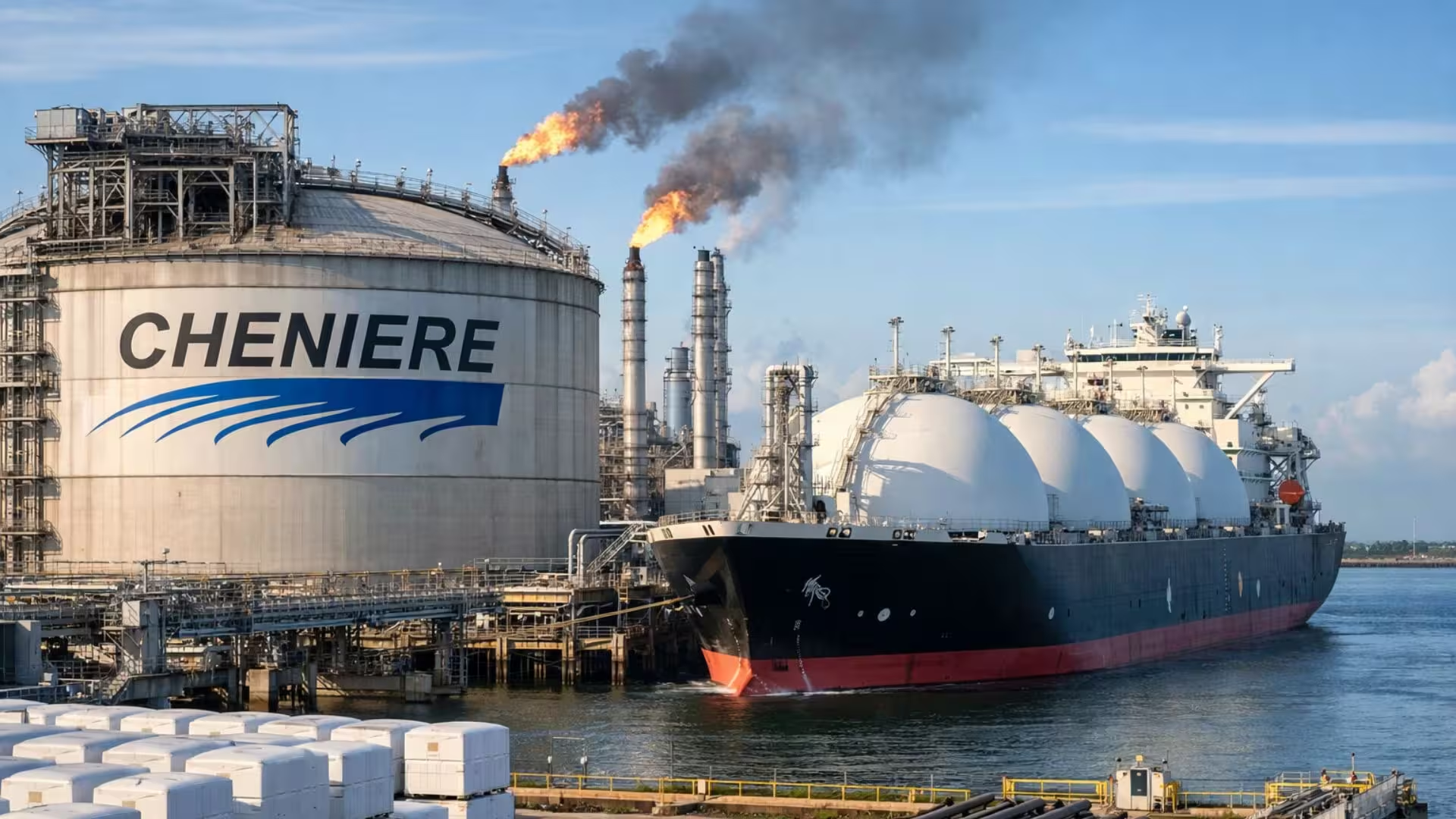
The announcement landed as a strategic provocation rather than a press release. Locking LNG supply through 2050 reframed LNG from a trade commodity into infrastructure-grade cash flow. That shift immediately elevated the decision to a board-level capital allocation debate.
Markets responded not to optimism but to duration and certainty. The 1.2 mtpa commitment signaled demand stability that most energy producers cannot credibly claim. This clarity reframed volatility as a managed variable rather than an existential risk.
What unsettled critics most was the timing. Issuing long-range certainty amid decarbonization pressure exposed how fragile short-cycle energy strategies really are. The move implicitly challenged peers relying on spot markets and short-term hedging.
The controversy sharpened with forward guidance. 2026 EBITDA of $6.75–$7.25 billion anchored valuation logic in cash predictability. Investors were forced to reassess LNG as defensive infrastructure, not cyclical speculation.
Ultimately, this introduction matters because it reframes the conversation. Long-dated contracts are no longer conservative—they are strategic leverage. That is the premise driving the entire case study.
Case Study Overview: Why Cheniere Energy’s LNG Expansion Became a Boardroom-Level Decision
This expansion began as a commercial negotiation but ended as enterprise-level strategy. A 25-year supply horizon inherently alters capital planning assumptions. Such duration demands oversight beyond operational leadership.
The counterparty, CPC Corporation, introduced sovereign-grade credibility. That credibility converted volume commitments into bankable revenue streams. The deal therefore reshaped risk modeling across the balance sheet.
The 1.2 mtpa volume was intentionally precise. It was large enough to matter but disciplined enough to preserve optionality. This balance reflected a consultancy-driven approach to scale.
Timing amplified impact. Announcing at 7:15 AM ET ensured immediate market digestion before volatility could distort interpretation. The signal was control, not reaction.
Forward guidance transformed narrative into numbers. $6.75–$7.25 billion in 2026 EBITDA became the analytical anchor for valuation models. That anchor stabilized investor expectations amid macro uncertainty.
At board level, the question shifted. This was no longer about LNG growth, but about long-term cash durability versus strategic drift. The answer justified expansion.
Case Study Context: The Strategic Logic Behind a 25-Year LNG Commitment
Multi-decade contracts matter most when cycles shorten. Energy markets are volatile precisely because planning horizons keep shrinking. Extending commitment to 2050 reverses that fragility.
Decarbonization pressure intensified the logic. Transition fuels require predictable baseload demand, not opportunistic trading. LNG filled that role with measurable economics.
Taiwan’s energy equation reinforced certainty. As an island economy with limited domestic resources, import reliability outweighs price volatility. The 1.2 mtpa volume became a security buffer.
From a consultancy lens, duration de-risks capital intensity. LNG infrastructure requires multi-billion-dollar investments with long payback cycles. Long-term offtake directly stabilizes those economics.
The contract also reframed demand risk. Instead of forecasting consumption annually, planners locked it structurally. That shift materially reduced downside scenarios.
Strategically, the commitment created symmetry. Long-life assets matched long-life revenues. This alignment is foundational to sustainable expansion.
Houston, Texas: Capital Allocation, LNG Leadership, and EBITDA Visibility
Houston is more than headquarters; it is strategic gravity. Capital markets, talent, and operational expertise converge there. That convergence supports through-2050 execution confidence.
Houston’s financial ecosystem enables disciplined reinvestment. The $6.75–$7.25 billion EBITDA outlook provides internal funding flexibility. That flexibility protects balance-sheet resilience.
Regional talent density accelerates execution. Engineering, trading, and risk management capabilities are deeply embedded. This reduces operational friction over decades.
Midstream integration further strengthens predictability. Proximity to pipelines and terminals compresses logistics risk. Cost visibility improves materially as a result.
Shareholder returns also benefit. Stable EBITDA underwrites dividends and buybacks without leverage strain. This reinforces investor trust.
Houston therefore operates as the control tower. It transforms geographic advantage into financial durability. That durability sustains the expansion thesis.
U.S. Gulf Coast LNG Corridor: Export Infrastructure Powering 1.2 mtpa Through 2050
The U.S. Gulf Coast is a scale advantage few regions can replicate. Liquefaction density reduces per-unit costs structurally. That cost compression persists across cycles.
Shipping lanes enhance reliability. Access to global routes minimizes congestion risk. This reliability underpins long-term delivery commitments.
Sustaining 1.2 mtpa improves plant utilization economics. High load factors stabilize margins over time. Underutilization risk is materially reduced.
Terminal longevity matters. Decades-long contracts justify maintenance and upgrades proactively. This extends asset life efficiently.
Consultancy analysis highlights margin defense. Scale advantages absorb commodity swings better than isolated assets. That resilience supports long-range planning.
The corridor therefore converts geography into strategy. It anchors competitiveness well beyond market cycles.
Root Causes Driving the Expansion Decision
Geopolitical shocks exposed LNG fragility. Short-term markets failed to guarantee supply security. Long-term contracts regained relevance.
Taiwan’s structural dependency intensified urgency. Limited domestic energy options elevated supply certainty over price optimization. The 1.2 mtpa figure addressed that constraint directly.
Capital intensity shaped internal decisions. LNG assets demand revenue assurance before commitment. 2026 EBITDA visibility resolved that constraint.
Volatility also influenced timing. Locking duration during uncertainty preserved optionality later. This inverted traditional risk sequencing.
Board oversight aligned incentives. Management execution matched shareholder tolerance. That alignment enabled approval.
Root causes therefore converged. Strategic necessity outweighed cyclical hesitation.
Financial Implications and Shareholder Signal
The EBITDA guidance reframed valuation. Cheniere transitioned from exporter to cash-flow infrastructure narrative. Multiples adjusted accordingly.
Long-dated revenue smoothed earnings. Volatility dampened across cycles. Forecast confidence improved.
Credit metrics strengthened. Predictable cash flows reduce refinancing risk. Cost of capital compresses.
Dividend sustainability gained credibility. Cash coverage improved structurally. Shareholder trust deepened.
Equity signaling was deliberate. Transparency reinforced governance discipline. Markets rewarded clarity.
Financially, the deal stabilized the long view. That stability is its core signal.
PESTEL Analysis: Why This LNG Deal Matters Beyond Cheniere
Politically, the LNG agreement materially strengthens energy diplomacy between the United States and Taiwan, converting commercial supply into a strategic lever. Long-term LNG flows through 2050 reduce Taiwan’s exposure to regional energy coercion while reinforcing U.S. credibility as a reliable energy partner. In effect, energy security becomes a foreign-policy asset, not just a trade outcome.
This political dimension elevates the role of Cheniere Energy from exporter to quasi-strategic infrastructure provider. Governments increasingly favor suppliers capable of guaranteeing continuity across administrations and policy cycles. As a result, LNG contracts of this duration quietly align corporate strategy with national interests.
Economically, the deal repositions LNG from a cyclical commodity into a cash-flow infrastructure business. Multi-billion-dollar EBITDA visibility stabilizes capital expenditure planning, supports domestic reinvestment, and strengthens the U.S. balance of trade through energy exports. This stability also dampens earnings volatility, which markets typically penalize in capital-intensive sectors.
The ripple effects extend beyond the company. Predictable export revenues reinforce the broader U.S. Gulf Coast industrial ecosystem, supporting employment, midstream investment, and financial services tied to energy logistics. Over time, this creates a compounding economic moat anchored in duration rather than price cycles.
Socially, the agreement intensifies the debate around LNG’s role in the energy transition. LNG is increasingly framed as a bridge fuel, balancing grid reliability against decarbonization commitments. The long-term nature of the contract forces policymakers and stakeholders to confront trade-offs openly rather than deferring them.
Public perception also evolves with duration. Long-horizon commitments heighten scrutiny around emissions, community impact, and transparency. As a result, social license to operate becomes an ongoing strategic requirement rather than a one-time approval process.
Technologically, sustaining 1.2 mtpa economics through 2050 depends on continuous efficiency gains in liquefaction, shipping, and methane management. Incremental improvements in energy intensity, boil-off reduction, and digital optimization directly protect margins over decades. Technology therefore shifts from a support function to a core value-preservation mechanism.
Innovation cadence matters because long-lived assets risk obsolescence. Operators that fail to upgrade face rising unit costs and regulatory pressure. The deal implicitly commits the exporter to ongoing technological reinvestment to remain competitive and compliant.
Environmentally, LNG occupies an uncomfortable but central position. While cleaner than coal, it still carries lifecycle emissions that face increasing regulatory and investor scrutiny. Long-term contracts amplify pressure to integrate carbon mitigation, offsets, and emerging abatement technologies.
This environmental tension reshapes capital allocation. ESG considerations increasingly influence financing terms, insurance costs, and partner selection. As a result, environmental performance becomes directly linked to cost of capital and contract longevity.
Legally, the agreement benefits from the enforceability and predictability of U.S. regulatory and contract law. Long-term LNG contracts rely on stable legal frameworks to secure financing and reduce counterparty risk. This legal certainty materially lowers risk premiums embedded in valuation models.
At the same time, legal durability must coexist with flexibility. Force majeure clauses, regulatory adaptation mechanisms, and pricing formulas are essential to manage a 25-year horizon. Strong legal architecture is therefore not static protection but structured adaptability.
Taken together, the PESTEL lens reveals scale. This LNG deal transcends corporate growth strategy and enters the realm of geopolitics, capital markets, technology evolution, and social governance. Its significance lies not just in volume or EBITDA, but in how energy, policy, and finance converge over time.
Risk Landscape and Structural Vulnerabilities
Renewable acceleration poses demand risk. Faster adoption could compress LNG relevance. Duration amplifies exposure.
Regulatory friction remains material. Permitting delays threaten Gulf Coast operations. Compliance costs may rise.
Geopolitical exposure persists. Taiwan’s strategic position introduces external risk. Currency dynamics compound complexity.
Market evolution challenges assumptions. Energy policy can shift rapidly. Long horizons magnify uncertainty.
Risk mitigation therefore cannot be static. Continuous monitoring is required. Strategy must adapt.
All Viable Strategic Solutions Evaluated
Buyer diversification reduced concentration risk. Multiple offtakers balance exposure. Flexibility improved.
Efficiency upgrades protected margins. Cost discipline preserved the EBITDA band. Operational excellence remained central.
Carbon mitigation investments addressed policy risk. Emissions strategies future-proofed assets. Social license strengthened.
Scenario modeling guided decisions. Stress testing validated resilience. Governance improved.
These solutions shared intent. Protect value across decades.
Preventive Measures for Long-Horizon LNG Commitments
Contract flexibility clauses absorbed shocks. Pricing mechanisms adapted to change. Optionality increased.
Stakeholder engagement reduced friction. Local alignment in Texas and the Gulf Coast mattered. Regulatory trust improved.
Scenario planning aligned forecasts. EBITDA models evolved with policy shifts. Strategic agility increased.
Preventive design mattered as much as expansion. Longevity demanded foresight. That foresight defined execution.
Why This Case Study Sets a New LNG Playbook
This case demonstrates how duration creates advantage. Long-term offtake, infrastructure scale, and transparent EBITDA convert uncertainty into leverage. Strategy replaced speculation.
The 2050 horizon, 1.2 mtpa scale, and $6.75–$7.25 billion EBITDA outlook reset boardroom benchmarks. LNG expansion is now judged by resilience, not growth alone. This playbook will shape energy decisions for decades.
L-Impact Solutions helps leaders turn complex uncertainty into decisive growth strategies. We blend data-driven insight, boardroom-level thinking, and execution discipline to deliver measurable outcomes—not just recommendations. If your business needs clarity, resilience, and sustainable impact, L-Impact Solutions is built to move you forward—fast.
Cheniere locked a 25-year LNG supply through 2050, openly rejecting short-cycle energy thinking and reframing LNG as infrastructure-grade cash flow.
A disciplined 1.2 mtpa commitment delivers demand certainty, stabilizes plant utilization, and de-risks capital-intensive LNG assets for decades.
Forward guidance of $6.75–$7.25B 2026 EBITDA shifts valuation from cyclical exporter to predictable cash-flow infrastructure business.
Long-dated contracts, Gulf Coast scale, and EBITDA visibility turn energy volatility into strategic advantage—setting a new LNG playbook.
Reference – https://lngir.cheniere.com/news-events/