| Key Takeaways – AI Cost Disaster: You’re Burning Cash – 5 Smarter Choices You Ignore 1. Most AI budgets are destroyed before the first model delivers value. Companies scale compute to look “AI-serious,” then wonder why cash burn outpaces results. 2. Buying more GPUs is the laziest—and most expensive—strategy. Real ROI comes from squeezing utilization, not inflating infrastructure. 3. Idle AI capacity is the quietest balance-sheet killer. What you don’t use is often costing you more than what you do. 4. Enterprises obsess over model performance and ignore cost architecture. Power efficiency, deployment timing, and workload discipline decide profitability, not benchmarks. 5. The winners aren’t spending more on AI—they’re spending smarter. Discipline, not hype, is what turns AI from a cash drain into a growth engine. |
The market loves calling legacy technology companies “ex-growth,” until AI demand brutally exposes that assumption as lazy analysis. When Dell Technologies reset expectations with a bold revenue signal, it challenged the narrative that only cloud-native players can win the AI era. This case study examines why AI server demand has rewritten Dell’s growth story in a way Wall Street could not ignore.
This was not an incremental upside disguised as optimism. The move represented a structural re-anchoring of enterprise infrastructure economics, driven by real purchase orders rather than speculative AI hype. That distinction is precisely why the market reacted decisively.
Business consultancies should treat this moment as a stress test for outdated growth frameworks. The data shows how AI infrastructure has become a core enterprise spend category, not a discretionary experiment. Dell’s trajectory forces strategists to re-evaluate how scale, timing, and execution interact in AI-led markets.
What makes this case controversial is its simplicity. Dell did not invent a new AI model or consumer platform; it sold the physical backbone enterprises cannot avoid buying. That reality reframes how durable AI revenue is likely to be.
The lesson begins here: in AI, control of infrastructure beats narrative dominance. Dell’s growth trajectory illustrates how execution compounds faster than storytelling in capital-intensive markets.
Case Study Overview: How Dell Technologies Leveraged AI Infrastructure Demand to Reset Market Expectations
The news event was deceptively straightforward but strategically explosive. Dell issued a revised fiscal outlook tied directly to AI server demand, immediately shifting institutional sentiment. This was interpreted as confirmation that enterprise AI spending had crossed from pilot phase to scaled deployment.
The material shift lay in the size and confidence of the forecast revision, not just the number itself. Markets read the signal as evidence of booked demand, not hypothetical pipeline. That clarity separated Dell from peers still speaking in probabilistic language.
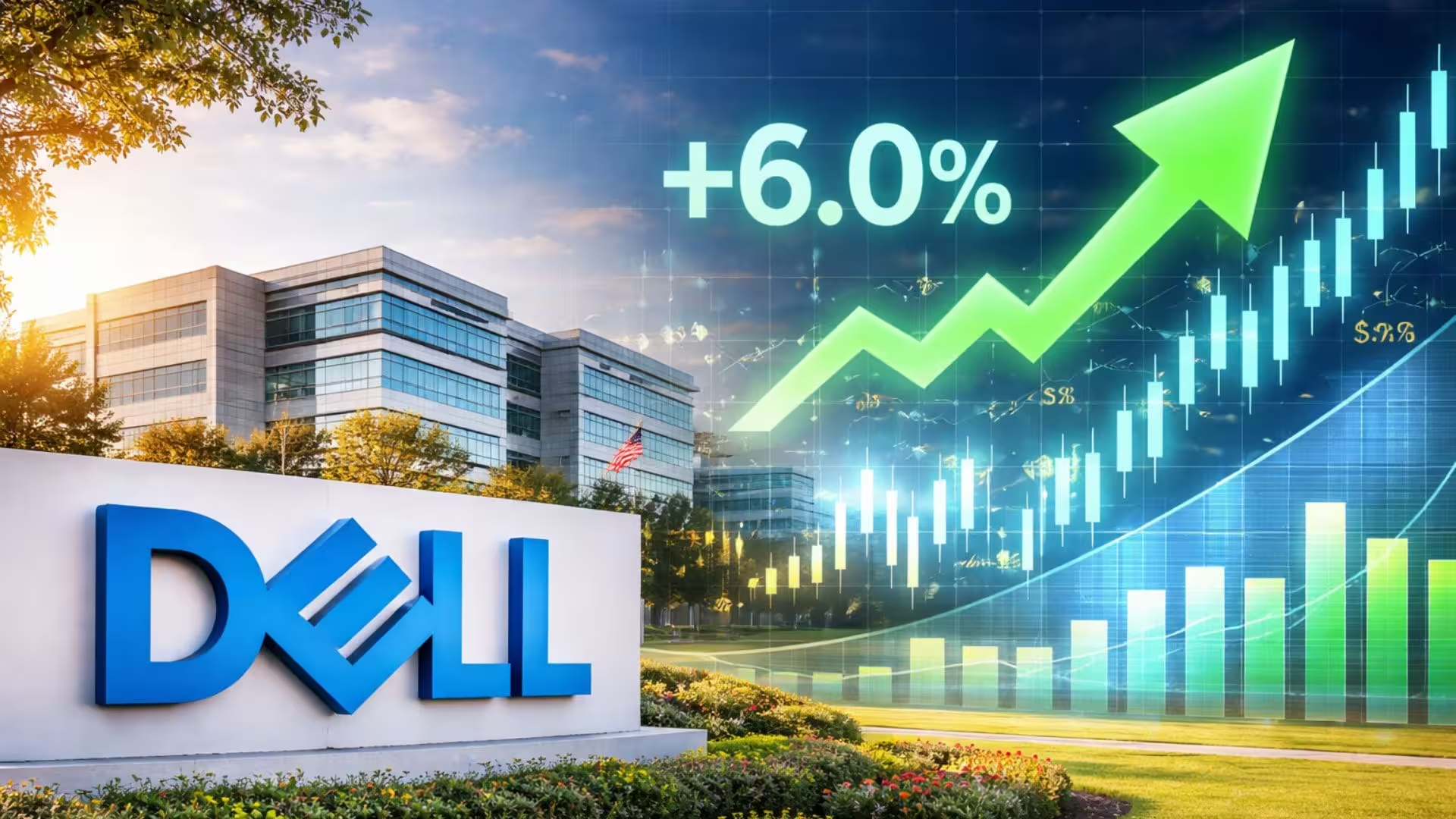
A 6% stock surge followed because investors recognized operational visibility. Equity markets reward companies that reduce uncertainty, especially in emerging technology cycles. Dell’s guidance did exactly that.
Global enterprise buyers also noticed the signal. When a top-tier infrastructure vendor commits to long-range growth, CIOs gain validation for accelerating procurement decisions. This creates a reinforcing loop between vendor confidence and buyer urgency.
This case study is positioned as a benchmark for AI-led growth execution because it demonstrates how forecasts, operations, and capital markets can align. Dell did not chase momentum; it monetized inevitability.
Case Study Context: From Legacy Hardware Cycles to AI-Centric Revenue Expansion
Dell’s historical revenue model was anchored to traditional compute refresh cycles, which limited visibility and growth velocity. AI disrupted this cadence by introducing workloads that cannot be deferred or downsized. This fundamentally altered the revenue profile of enterprise infrastructure.
The transition involved reorienting portfolios toward AI-optimized server architectures capable of handling compute-dense workloads. These systems command higher price points and longer deployment horizons. That shift materially increased revenue durability.
Strategic timing was critical. Dell upgraded its outlook as enterprise AI adoption curves steepened, not during early experimentation. This positioned the forecast as reactive to demand rather than predictive speculation.
Wall Street estimates prior to the revision underestimated the compounding effect of AI workloads on infrastructure demand. The delta mattered because it exposed analytical blind spots in legacy valuation models. Dell capitalized on that mispricing.
The result was a new growth narrative anchored in physics, not software cycles. AI workloads consume infrastructure relentlessly, and Dell aligned its business to that reality.
Market Reaction and Financial Signal Strength Behind the 6% Share Price Jump
The immediate 6% rise in Dell shares was not a momentum trade. It reflected institutional reassessment of long-term cash flow stability. Markets interpreted the forecast upgrade as evidence of locked-in demand.
Short-term hype typically fades within days. This move persisted because it was grounded in operational guidance tied to enterprise contracts. Investors could map revenue to real-world deployments.
The signal strength lay in the asymmetry of risk. Upside came from sustained AI adoption, while downside was buffered by existing enterprise relationships. That balance reduced volatility assumptions.
Capital markets also noted the alignment between sales execution and manufacturing capacity. Dell demonstrated it could deliver at scale without margin collapse. That credibility is rare in infrastructure cycles.
Ultimately, the stock reaction validated one insight: AI infrastructure rewards companies that can scale predictably. Dell proved it belongs in that category.
Regional Advantage Analysis: Texas and the Southern United States as an AI Infrastructure Powerhouse
The Southern United States has quietly become a strategic nucleus for AI infrastructure deployment. Lower energy costs and regulatory efficiency attract data center investment at scale. This creates a geographic flywheel for enterprise IT demand.
Texas sits at the center of this shift. Its technology corridor supports hyperscale data centers, logistics networks, and skilled labor pools. These factors materially lower infrastructure operating costs.
Proximity to large enterprise clients accelerates deal velocity. Physical closeness reduces deployment friction for complex AI systems. That advantage compounds as order volumes rise.
Talent availability also matters. The region supplies engineers, supply chain specialists, and operations leaders familiar with large-scale infrastructure. This reduces execution risk during rapid expansion phases.
For Dell, regional scale is not cosmetic branding. It is an operational multiplier that directly supports hyperscale and Fortune 500 demand.
Round Rock, Texas: Operational Leverage from a High-Impact Technology Hub
Dell’s headquarters in Round Rock functions as more than a symbolic base. It anchors supply chain coordination, manufacturing oversight, and enterprise sales execution. This concentration enhances speed and control.
AI server production requires tight orchestration across vendors and logistics partners. Round Rock enables real-time decision-making across complex supply chains. That capability becomes decisive when demand spikes.
Partner ecosystems in the region further compress deployment timelines. Integration partners, component suppliers, and enterprise clients operate within overlapping networks. This reduces friction at scale.
Manufacturing coordination benefits from geographic centrality. Components move efficiently across domestic routes, mitigating some global supply chain risks. This resilience supports forecast credibility.
Collectively, regional operations contribute directly to the $138B–$142B fiscal 2027 target. Operational leverage transforms ambition into deliverable revenue.
Root Causes Behind the Surge in AI Server Demand
The explosion of generative AI workloads reshaped enterprise compute requirements overnight. Models demand sustained, high-density processing that legacy servers cannot support. Replacement cycles accelerated as a result.
Healthcare, finance, and manufacturing emerged as primary demand drivers. These sectors deploy AI for mission-critical applications with zero tolerance for latency or downtime. Infrastructure quality becomes non-negotiable.
Legacy architectures revealed their limitations under AI stress. Power inefficiency, thermal constraints, and scaling bottlenecks forced enterprises to upgrade. This created a synchronized replacement wave.
Cloud-adjacent infrastructure further amplified demand. Enterprises balancing on-premise control with cloud scalability require hybrid AI systems. Dell positioned its offerings precisely for this use case.
The urgency is economic, not experimental. Enterprises cannot compete without scalable, energy-efficient AI infrastructure. That reality fuels sustained demand.
AI Cost Disaster vs Smarter AI Choices
Where enterprises burn cash — and where discipline protects ROI
Strategic Solutions Implemented by Dell to Capture AI-Led Revenue Growth
Dell executed a portfolio realignment toward high-margin AI-optimized servers. This reduced reliance on commoditized hardware segments. Margin quality improved alongside revenue scale.
Deepened relationships with hyperscalers anchored long-term demand. Multi-year contracts replaced transactional sales models. This stabilized forward revenue visibility.
Enterprise solutions were bundled with support and lifecycle services. This increased switching costs and extended customer relationships. Value capture expanded beyond initial hardware sales.
Forecast discipline played a critical role. Dell resisted overstating upside, instead anchoring guidance to booked and near-booked demand. Credibility became a strategic asset.
The result was a defensible AI infrastructure moat, built on execution rather than speculation. That distinction underpins investor confidence.
PESTEL Analysis: Why This News Matters Beyond Dell’s Balance Sheet
Politically, the U.S. prioritizes AI competitiveness and domestic industrial capacity. Dell’s expansion aligns with national technology objectives. This reduces policy risk.
Economically, the $138B–$142B revenue outlook signals sustained enterprise IT spending. It contradicts recessionary narratives in capital markets. That macro signal extends beyond Dell.
Technologically, AI infrastructure adoption has reached irreversible momentum. Innovation now depends on physical compute availability. Vendors controlling that layer gain systemic influence.
Environmental considerations also shape demand. Energy-efficient AI systems are no longer optional due to sustainability pressures. Dell’s optimized architectures address this constraint.
Legally and socially, data sovereignty and enterprise accountability favor on-premise and hybrid infrastructure. This structural shift benefits established infrastructure leaders.
Risk Factors and Structural Challenges in Sustaining AI-Driven Growth
Semiconductor supply dependencies remain a persistent risk. Pricing volatility can compress margins if not managed carefully. Scale alone does not eliminate this exposure.
Competition intensifies as rivals chase AI demand. Pricing pressure and feature parity threaten differentiation. Dell must sustain execution superiority.
Demand normalization poses another challenge. Early AI investment surges may plateau as enterprises digest deployments. Growth rates could moderate.
Operational complexity increases with scale. Managing global delivery without service degradation requires constant optimization. Failure here erodes trust quickly.
These risks are real but not disqualifying. They demand disciplined governance rather than defensive retreat.
Preventive Measures and Forward-Looking Controls for Long-Term Stability
Diversification across industries mitigates reliance on a single demand wave. Dell’s exposure spans healthcare, finance, manufacturing, and government. This balances cyclicality.
Advanced demand forecasting strengthens capacity planning. Predictive analytics reduce inventory mismatches and margin shocks. This enhances operational resilience.
Supply chain redundancy lowers geopolitical and logistics risk. Multi-sourcing strategies stabilize component availability. This supports delivery commitments.
Regulatory monitoring ensures compliance across jurisdictions. Anticipating policy shifts prevents disruption. Governance becomes a growth enabler.
Collectively, these controls protect long-term AI-driven revenue sustainability. Stability becomes a competitive advantage.
Consultancy Takeaways: What Enterprise Leaders and Investors Should Learn
Dell’s forecast revision offers a playbook for AI-era strategic foresight. Growth follows infrastructure inevitability, not application novelty. Enterprises should plan accordingly.
Regional strengths matter more than ever. Aligning geography, talent, and energy economics accelerates execution. Strategy without location awareness underperforms.
Product strategy must anticipate workload physics. AI economics reward vendors who optimize for power, scale, and reliability. This insight reshapes capital allocation.
For investors, the lesson is valuation discipline. Infrastructure-backed AI growth deserves different risk premiums than software hype cycles. Dell exemplifies this distinction.
Competitors and buyers alike should recalibrate expectations. AI infrastructure is now a multi-year commitment, not a discretionary experiment.
Conclusion: Dell’s AI Server Bet as a Defining Case Study in Modern Enterprise Growth
This case study illustrates why Dell’s trajectory is more than a short-term earnings story. It reflects structural realignment with irreversible AI demand. That distinction defines durable growth.
By anchoring guidance to real infrastructure needs, Dell positioned itself at the core of the global AI value chain. Execution, not narrative, drove credibility. Markets responded accordingly.
The $142B fiscal 2027 ceiling represents confidence grounded in operational reality. Business consultancies should treat this as a new benchmark.
AI-driven forecasts are reshaping how growth is evaluated. Infrastructure leadership now defines competitive advantage. Dell’s case makes that unmistakably clear.
L-Impact Solutions helps enterprises and investors convert AI demand signals into revenue-ready infrastructure strategy, aligning forecasts, supply chains, and go-to-market execution before competitors react. We specialize in turning AI server demand, enterprise infrastructure shifts, and market inflection points into measurable growth outcomes.
If your organization needs credible AI revenue acceleration, forecast confidence, and execution discipline, L-Impact Solutions bridges insight to impact—fast.
Most enterprises overspend on AI by scaling infrastructure before ROI is proven, turning innovation budgets into silent losses.
Idle GPUs, overprovisioned servers, and poor demand forecasting are the largest unseen drains on AI profitability.
Leaders focus on workload efficiency, energy costs, and utilization before adding new AI capacity.
AI success comes from fewer, disciplined investments that convert compute spend into predictable cash flow.
Reference – https://economictimes.indiatimes.com/news/