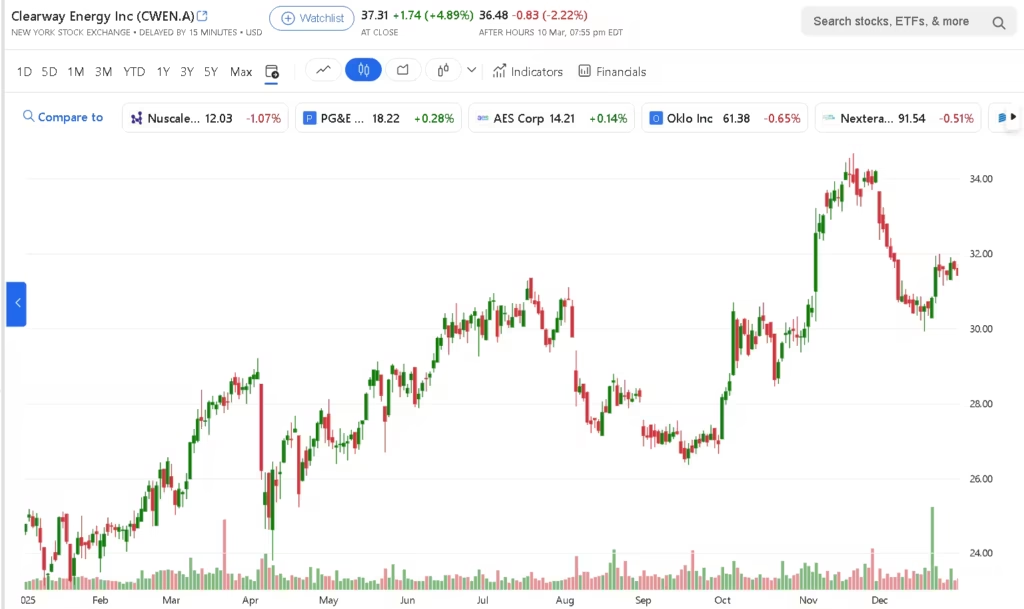
Clearway Energy (CWEN.A) has drawn rising investor attention after delivering 4.89% one-day gains, 21.61% returns over 90 days, and a 45.55% total shareholder return in the past year, with the stock trading around $37.31 per share, signaling strong momentum in the renewable energy infrastructure sector across both short-term and long-term horizons. These figures place Clearway Energy among the more stable yield-oriented energy transition plays in the U.S. public markets. The stock’s consistent upward trend reflects a growing investor appetite for clean energy cash-flow assets, dividend yield stability, and long-term infrastructure growth.
Clearway Energy operates a large portfolio of renewable and conventional energy assets exceeding 8 gigawatts of generation capacity across the United States. The company owns wind farms, solar facilities, battery storage assets, and natural gas plants, many of which operate under long-term power purchase agreements (PPAs) with utilities and corporations. These contracts create predictable revenue streams, making Clearway attractive to institutional investors seeking stable energy infrastructure investments.
The broader market context further strengthens the company’s growth narrative. The U.S. renewable energy sector surpassed 350 gigawatts of installed capacity in 2024, and projections suggest it could exceed 500 gigawatts by 2030, driven by federal incentives such as the Inflation Reduction Act (IRA). These incentives include tax credits, production incentives, and clean energy subsidies, which directly benefit companies like Clearway Energy.
Another important factor behind the share price momentum is the company’s dividend growth strategy. Clearway Energy has positioned itself as a yield-oriented renewable energy platform, targeting consistent annual dividend increases while expanding its asset base. Investors looking for income-generating energy stocks have therefore increasingly allocated capital to firms like Clearway, particularly as renewable assets offer long-term predictable returns.
Institutional ownership also plays a major role in the stock’s stability. Infrastructure funds, pension funds, and ESG-focused asset managers have significantly increased allocations to renewable infrastructure equities, especially those with stable operating portfolios. Clearway’s ability to combine energy transition exposure with predictable cash flows explains the sustained stock performance across multiple time horizons.
From a market analytics perspective, the 21.61% 90-day return suggests strong investor sentiment momentum, while the 45.55% annual shareholder return signals structural confidence in the company’s long-term energy transition strategy. In financial markets, such dual-horizon momentum often indicates both fundamental strength and institutional accumulation. This dynamic positions Clearway Energy as a notable case study in renewable infrastructure equity valuation.
| Related Analysis – NVDL’s 5.5% Growth Signals AI Chip Momentum |
Will Clearway Energy’s Stock Momentum Appeal to the U.S. Investment Audience?
Strong Relevance to the U.S. Renewable Energy Market
Clearway Energy’s stock momentum story is directly relevant to the U.S. renewable infrastructure investment landscape, making it appealing to American readers interested in energy markets and dividend-focused equities. The company’s $37.31 share price, 4.89% one-day gain, 21.61% 90-day return, and 45.55% total shareholder return over one year reflect the broader momentum building across the U.S. clean energy sector. In comparison, the S&P 500 delivered roughly 24% returns in 2023 and about 26% in 2024, while many renewable infrastructure stocks have been experiencing renewed investor interest due to long-term energy transition trends.
The U.S. renewable energy industry itself provides strong context for the appeal of such analysis. The country has already installed over 350 gigawatts of renewable power capacity, with projections suggesting the total could exceed 500–550 gigawatts by 2030 as federal incentives accelerate new projects. Policies under the Inflation Reduction Act provide more than $369 billion in clean energy incentives, encouraging investment in solar, wind, and battery storage projects across multiple states.
Clearway Energy benefits from these structural tailwinds because it owns and operates over 8 gigawatts of generation capacity, including solar farms, wind assets, battery storage facilities, and natural gas plants. Many of these projects operate under long-term power purchase agreements lasting 10–25 years, ensuring predictable revenue streams for investors. This contract-based revenue model is particularly attractive to U.S. institutional investors seeking stable cash-flow infrastructure assets.
Financial Metrics That U.S. Investors Value
U.S. investors typically evaluate energy infrastructure companies through quantitative performance metrics, and Clearway’s recent stock performance provides several compelling indicators. The company’s 45.55% annual shareholder return significantly exceeds the historical average return of the U.S. utilities sector, which typically ranges between 8% and 12% annually. Such performance signals strong investor confidence in the company’s long-term renewable infrastructure strategy.
Dividend income is another factor that attracts American investors to renewable infrastructure stocks. Clearway Energy has historically targeted annual dividend growth of around 5% to 8%, positioning itself as a yield-oriented energy platform. Dividend-focused investors often favor such companies because they combine steady income generation with long-term energy transition exposure.
The company’s financial structure also aligns with the typical infrastructure investment model used in the United States. Renewable infrastructure companies often operate with long-term project financing, predictable operating cash flows, and contracted revenue streams, which allow them to support dividend payments and gradual asset expansion. These characteristics make Clearway Energy appealing to pension funds, infrastructure funds, and ESG-focused investment portfolios.
Comparison With Other U.S. Renewable Infrastructure Leaders
To fully understand Clearway Energy’s market appeal, it is useful to compare its performance with other major players in the U.S. renewable energy sector. Companies such as NextEra Energy, Brookfield Renewable, and AES Corporation have also positioned themselves as key participants in the global energy transition. These companies collectively manage tens of gigawatts of renewable generation capacity across North America and international markets.
For example, NextEra Energy operates more than 30 gigawatts of renewable capacity, making it one of the largest renewable energy producers in the world. Brookfield Renewable manages over 25 gigawatts of renewable assets globally, while AES has expanded its renewable portfolio to approximately 14 gigawatts of renewable and energy storage capacity. Compared with these larger players, Clearway Energy operates on a smaller scale but still maintains a significant presence in the U.S. renewable infrastructure ecosystem.
This competitive landscape strengthens the credibility of Clearway’s growth story. Investors often seek companies that combine moderate scale, stable assets, and growth potential, rather than firms that are already at maximum capacity expansion levels. In this sense, Clearway Energy represents a mid-scale renewable infrastructure growth platform, which can be appealing for long-term investors.
Growing Institutional Interest in Renewable Infrastructure
Institutional capital flows further explain why stories like Clearway Energy’s stock performance attract U.S. audience interest. Global investment in renewable energy exceeded $500 billion in 2023, with North America accounting for a significant share of that capital. Infrastructure funds, pension funds, and sovereign wealth funds have increasingly allocated capital toward renewable infrastructure assets that generate stable long-term returns.
Many large institutional investors view renewable energy projects as inflation-resilient assets, since electricity contracts often include price adjustment mechanisms linked to inflation or market pricing. This characteristic becomes particularly attractive during periods of economic uncertainty. As a result, companies operating renewable assets with long-term contracts often receive strong investor demand in public equity markets.
Additionally, the corporate renewable power purchase agreement market in the United States exceeded 40 gigawatts of contracted capacity in recent years, reflecting strong demand from technology companies, manufacturers, and data center operators seeking clean energy. This expanding market creates new revenue opportunities for companies like Clearway Energy that can supply renewable electricity through long-term contracts.
Investor Takeaways for the U.S. Market
For American investors, Clearway Energy’s stock momentum represents more than just a short-term market rally. The company’s performance reflects broader structural trends shaping the U.S. energy sector, including rapid renewable deployment, strong policy incentives, and rising corporate demand for clean electricity. These trends suggest that renewable infrastructure companies will continue to play a major role in future energy markets.
However, investors must also consider potential risks associated with renewable infrastructure investments. The sector remains capital intensive, and companies must manage project financing, supply chain challenges, and regulatory changes that can impact profitability. Successful renewable infrastructure firms are those that balance growth expansion with financial discipline and operational efficiency.
Overall, Clearway Energy’s recent stock performance and underlying business model provide a case study that is highly relevant to the U.S. investment community. The combination of 45.55% annual shareholder return, long-term contracted assets, and exposure to a rapidly growing renewable energy market makes the company an attractive example of how energy transition investments can create shareholder value.
For readers in the United States seeking insight into renewable energy stocks, energy infrastructure investments, and long-term clean energy market trends, this analysis provides both context and actionable perspective.
L-Impact Solutions’ Constructive Strategic Critique
While the market celebrates Clearway Energy’s strong stock performance, share price momentum alone does not guarantee long-term strategic resilience. Renewable infrastructure companies must constantly manage capital intensity, regulatory dependence, and project financing risks. Without disciplined portfolio expansion and cost control, rapid growth can create hidden balance sheet pressures.
From a business strategy perspective, Clearway Energy must ensure that its asset acquisition strategy maintains strong return on invested capital (ROIC). Many renewable companies have historically expanded aggressively, only to face overleveraging risks and project execution delays. A sustainable growth model requires careful alignment between capital deployment, operational efficiency, and energy market pricing trends.
Another structural risk lies in policy reliance. Federal incentives like those within the Inflation Reduction Act have significantly boosted renewable investment flows, but regulatory landscapes can evolve with political cycles. Companies that depend heavily on subsidies must diversify revenue sources to maintain stability.
L-Impact Solutions emphasizes that Clearway Energy’s success should not be measured purely through share price performance. The real metric of long-term success will be portfolio efficiency, asset optimization, and disciplined capital allocation. Investors should evaluate whether the company’s expansion strategy strengthens operational cash flow rather than merely boosting capacity.
Therefore, the key strategic question is not simply “How fast can Clearway grow?” but rather “How efficiently can Clearway scale its renewable infrastructure platform?” Sustainable value creation requires a balance between growth ambition and financial discipline.
Regional Impact Across the United States
The performance of companies like Clearway Energy has broader implications across several U.S. regional energy markets. Renewable infrastructure investment is reshaping the electricity landscape in multiple regions where wind, solar, and battery storage assets are rapidly expanding. These changes influence regional grid stability, electricity prices, and energy employment patterns.
In the Texas and Southwest regions, renewable expansion has been particularly strong due to high solar irradiance and wind resources. Texas alone has installed more than 40 gigawatts of wind capacity, making it the largest renewable generation state in the country. Companies like Clearway contribute to this growth by developing and operating large renewable projects connected to regional grids.
The California energy market represents another critical region impacted by renewable infrastructure investment. California leads the nation in solar capacity deployment, and utilities increasingly rely on renewable energy producers to meet clean energy mandates targeting 100% carbon-free electricity by 2045. Clearway’s solar and storage assets play an important role in supporting these policy goals.
The Midwest region, particularly states like Iowa, Illinois, and Kansas, has become a major hub for utility-scale wind energy projects. These states benefit from strong wind resources and lower land costs, making them attractive for renewable infrastructure development. Companies operating in this region contribute to both regional economic growth and energy diversification.
In the Northeast United States, renewable expansion is tied closely to offshore wind and solar projects. States like New York and Massachusetts are pursuing aggressive clean energy targets to reduce carbon emissions. Energy infrastructure firms operating in this region help strengthen grid resilience while supporting the broader energy transition agenda.
Overall, Clearway Energy’s market performance reflects a larger transformation within U.S. regional electricity markets, where renewable infrastructure investment is reshaping energy supply dynamics.
| Related Analysis – Oil Futures Warning: Your Tech Stocks Tumble 2% |
Strategic Solutions to Address Emerging Industry Risks
Despite the promising growth trajectory, the renewable infrastructure sector faces several operational and financial challenges. Addressing these issues requires a combination of strategic innovation, disciplined capital allocation, and technology integration. Clearway Energy and similar companies must adopt forward-looking strategies to maintain sustainable growth.
One solution is expanding energy storage integration alongside renewable generation assets. Battery storage helps stabilize electricity supply by storing excess renewable power during periods of high generation and releasing it when demand increases. This approach improves grid reliability and renewable energy utilization rates.
Another important strategy involves long-term corporate power purchase agreements (CPPAs). Many large corporations are seeking renewable electricity to meet sustainability commitments, creating a growing market for private power contracts. By securing more CPPAs, energy companies can lock in stable long-term revenue streams independent of wholesale market volatility.
Operational efficiency improvements also play a key role in maintaining profitability. Advanced analytics, predictive maintenance technologies, and digital monitoring systems can reduce operational costs while increasing energy production efficiency. These technologies strengthen the financial performance of renewable assets over time.
Capital diversification represents another important solution. Renewable energy developers should access multiple financing channels, including green bonds, infrastructure funds, and institutional partnerships. Diversified financing structures reduce dependency on a single capital source and improve long-term financial stability.
Finally, companies must strengthen grid modernization partnerships with utilities and regulators. As renewable penetration increases, grid infrastructure must evolve to handle variable generation patterns. Collaborative investment in transmission upgrades and smart grid technologies will support the continued growth of renewable energy infrastructure.
Prevention Strategies for Future Market Instability
Preventing future disruptions in the renewable infrastructure sector requires proactive planning and risk management. Companies like Clearway Energy must anticipate structural challenges in energy markets rather than reacting to them after they occur. Strategic foresight becomes a critical component of sustainable growth.
The first prevention strategy involves maintaining balanced leverage ratios and conservative debt management. Renewable infrastructure projects often require substantial upfront capital, making financial discipline essential. Strong balance sheets allow companies to navigate market volatility without compromising project execution.
Another critical step is strengthening supply chain resilience. Renewable energy projects depend on components such as solar panels, wind turbines, and battery systems, many of which are sourced globally. Diversifying suppliers and building domestic manufacturing partnerships can reduce supply disruptions.
Companies should also expand investments in energy forecasting and data analytics. Advanced forecasting tools help predict electricity demand patterns, renewable generation fluctuations, and market price movements. Better forecasting enables energy companies to optimize operations and improve revenue predictability.
Policy engagement represents another important preventive strategy. Renewable infrastructure firms must maintain active dialogue with policymakers to anticipate regulatory changes that could impact energy markets. Strategic policy engagement helps companies adapt quickly to evolving energy legislation.
Finally, companies must prioritize community engagement and environmental responsibility. Renewable projects often face local opposition due to land use concerns and environmental impacts. Transparent communication and community partnerships help prevent project delays and maintain public support for clean energy development.
Conclusion: Strategic Momentum Requires Strategic Discipline
Clearway Energy’s 45.55% one-year shareholder return and strong multi-period stock momentum reflect the growing investor confidence in renewable infrastructure as a long-term asset class. However, share price performance alone does not guarantee sustainable value creation in the rapidly evolving energy sector. The real challenge lies in transforming short-term momentum into long-term operational strength and financial resilience.
L-Impact Solutions believes that renewable infrastructure companies must combine disciplined capital allocation, technological innovation, and strategic risk management to sustain their growth trajectory. Investors should focus not only on market performance but also on asset efficiency, contract stability, and operational scalability.
Organizations that balance renewable expansion with financial prudence will ultimately define the next phase of the global energy transition—and those that fail to maintain that balance may see momentum fade as quickly as it emerged.
Reference – https://uk.finance.yahoo.com/news/clearway-energy-cwen-valuation-check-001903283.html