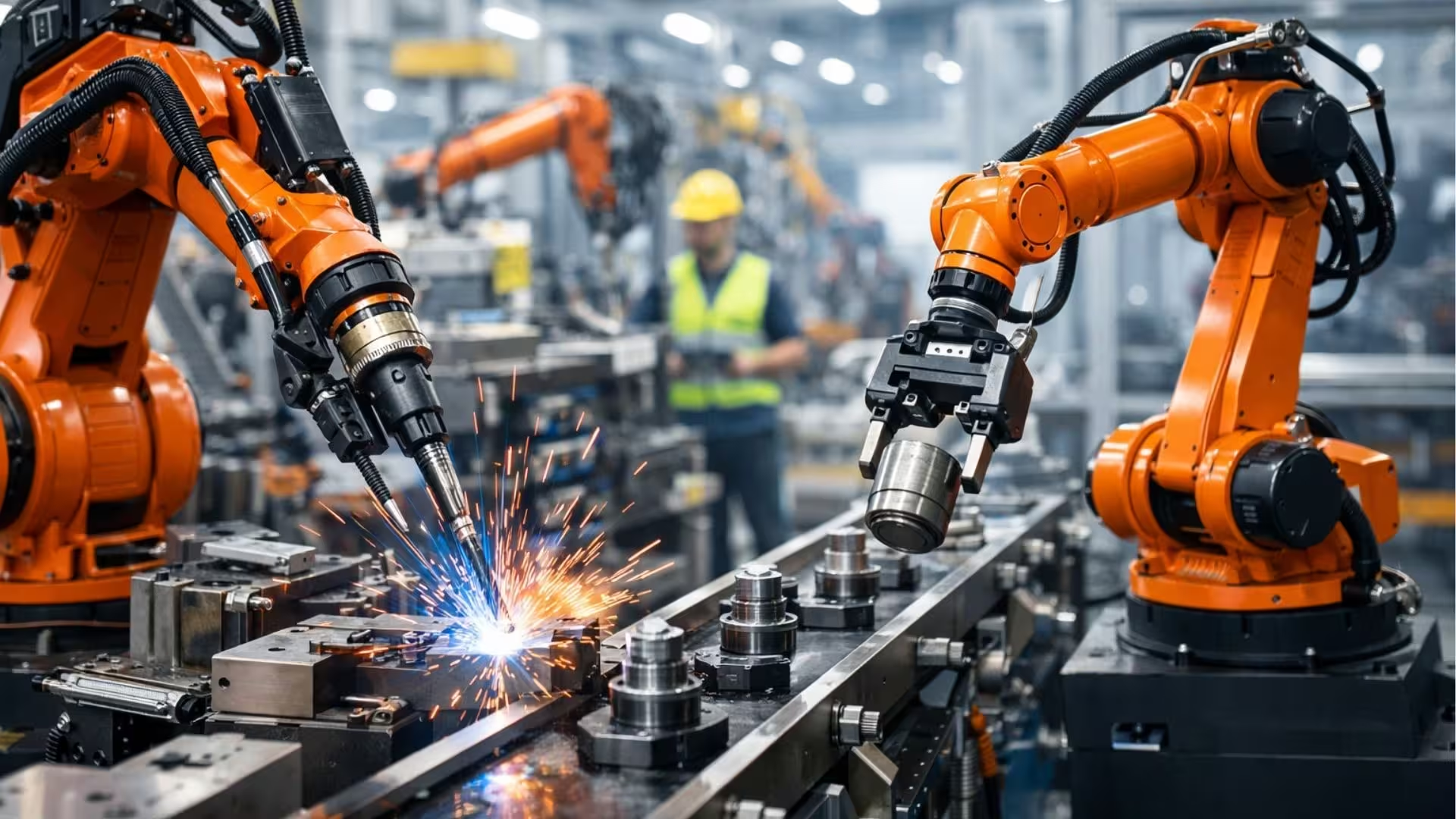
Case Study Context: Why Industrial Robots Have Become A Strategic Imperative
Industrial manufacturing is entering a structural transition where labor availability has become a binding constraint rather than a cyclical inconvenience.
Across advanced and emerging economies, manufacturers are discovering that traditional recruitment levers no longer restore capacity reliability.
Persistent vacancies, declining shop-floor participation, and rising absenteeism have transformed workforce risk into an operational constant.
Industrial robots are therefore no longer framed as efficiency enhancers but as production continuity instruments.
This case study contextualizes automation as a strategic reassurance mechanism, stabilizing output when human labor supply remains uncertain.
Insights from leadership at RobCo reinforce this shift in mindset across industrial sectors.
Rather than displacing labor, robots are increasingly deployed to backfill structural gaps that hiring pipelines cannot close.
Manufacturers now treat automation decisions as risk management choices, not discretionary technology upgrades.
This reframing elevates robotics from engineering departments into board-level capital allocation discussions.
Operational predictability has emerged as the dominant investment criterion.
Production volatility is now more damaging than marginal efficiency losses.
Industrial robots directly address this volatility by reducing dependency on scarce skills.
The strategic imperative is therefore rooted in resilience, not cost arbitrage.
This reality applies most acutely to SMEs and mid-cap manufacturers.
These firms lack labor elasticity and pricing power.
Robotics becomes their only scalable buffer against workforce erosion.
Automation thus operates as an insurance layer across industrial value chains.
This case study analyzes that insurance logic systematically.
It positions robotics as structural infrastructure for modern manufacturing.
L-Impact Solutions bridges this strategic translation by converting labor-risk signals into automation roadmaps aligned with capital discipline and workforce sustainability.
Case Study Snapshot: Labor Shortage Magnitude And Automation Urgency
Manufacturing vacancy rates exceeding 7–10% now represent a persistent baseline, not an anomaly.
In parallel, 25–30% of skilled industrial workers are approaching retirement age, accelerating experience loss.
Vocational pipelines are shrinking rather than replenishing talent pools.
Workforce participation declines have compounded post-pandemic.
Manufacturers face simultaneous attrition and under-enrollment pressures.
This creates a widening labor supply deficit.
Automation urgency emerges directly from this arithmetic imbalance.
Industrial robot deployments are growing 10–15% annually in core manufacturing hubs.
This growth rate exceeds overall industrial output expansion.
The divergence signals substitution pressure driven by necessity.
Robotics adoption correlates strongly with regions experiencing acute labor stress.
Capital investment follows workforce scarcity patterns.
Manufacturers are no longer waiting for labor markets to normalize.
They are designing around permanent constraints.
Automation timelines have compressed from five-year plans to immediate execution cycles.
Delayed deployment now carries opportunity costs.
Idle capacity translates into lost market share.
Robotics reduces exposure to unpredictable hiring outcomes.
It stabilizes planning assumptions.
The snapshot confirms automation as a defensive strategy.
Executive Signal From Industry Leadership: Robots As Reassurance, Not Replacement
Industry leadership increasingly frames robots as operational stabilizers rather than labor substitutes.
The reassurance narrative reflects risk mitigation priorities.
Robots reduce dependency on fragile staffing levels.
They mitigate absenteeism volatility.
They sustain throughput during labor shocks.
This framing is especially relevant for SMEs.
Smaller firms lack redundancy buffers.
Missed shifts directly impair delivery commitments.
Robots provide consistency under constrained conditions.
This consistency reassures customers and investors.
Production reliability becomes a competitive differentiator.
The CEO perspective emphasizes continuity over displacement.
Robotics fills roles that remain unfilled.
Human workers are redeployed toward supervision and quality tasks.
This improves job sustainability.
It also reduces burnout risks.
Robots absorb repetitive, high-fatigue operations.
The executive signal reshapes internal narratives.
Automation resistance decreases when reassurance dominates discourse.
Strategic alignment accelerates deployment acceptance.
Root Causes Analysis: Why Labor Shortages Have Become Structural, Not Cyclical
Demographic aging represents the most immovable constraint.
Industrial workforces are aging faster than replacements enter.
Vocational enrollment has declined 20–40% in multiple economies.
Younger cohorts prefer service and digital sectors.
Manufacturing perception challenges persist.
Digitalization has shifted skill requirements.
Legacy skills mismatch modern production needs.
Reskilling systems lag technology evolution.
Post-pandemic realignment altered workforce expectations.
Flexibility preferences conflict with rigid shift structures.
Immigration tightening has reduced supplemental labor inflows.
Cross-border labor mobility has become politically constrained.
These factors reinforce one another structurally.
Temporary wage increases fail to resolve gaps.
Recruitment cycles lengthen without improving outcomes.
Manufacturers experience chronic understaffing.
This chronicity defines structural shortage conditions.
Cyclical recovery assumptions no longer apply.
Automation emerges as the only scalable response.
The root causes validate long-term robotics integration.
Economic Pressure Points: Rising Wage Inflation And Productivity Risk
Labor scarcity has driven wage inflation running 1.5–2× headline inflation.
Manufacturing margins face sustained compression.
Wage increases do not guarantee retention.
Productivity gains lag compensation growth.
Unit labor costs escalate unpredictably.
Pricing power remains limited in competitive markets.
Margin volatility undermines investment confidence.
Robots convert variable labor costs into fixed capital assets.
This stabilizes cost structures.
Output predictability improves EBITDA visibility.
Automation smooths multi-year planning assumptions.
Productivity improvements compound over time.
Human error rates decline in automated workflows.
Rework costs decrease.
Scrap rates improve.
Quality consistency strengthens customer trust.
Economic pressure thus favors capital substitution.
Robotics insulates margins from labor inflation.
This insulation underpins long-term competitiveness.
Economic logic reinforces strategic adoption.
Industrial Robots As A Strategic Operating Model Shift
Modern robotics enables continuous production models.
24/7 operations become feasible without workforce scaling.
Dependency on scarce skilled operators declines.
Collaborative robots integrate alongside human workers.
Cobots reduce safety barriers.
They enable flexible cell configurations.
Throughput consistency improves 15–30% in automated lines.
Cycle times stabilize.
Bottlenecks become predictable.
Operational variability declines sharply.
Maintenance scheduling becomes proactive.
Data-driven optimization accelerates.
Robotics embeds resilience into workflows.
Human labor focuses on exception handling.
Skill leverage improves.
Operating models shift from labor-centric to system-centric.
This shift enhances scalability.
Capacity expansion decouples from hiring success.
Strategic optionality increases.
Operating resilience becomes the primary outcome.
Capital Allocation Case Study: ROI Economics Of Industrial Robotics
Robot payback periods average 18–36 months.
This compares favorably with recurring labor costs.
Total cost of ownership remains transparent.
Maintenance costs are predictable.
Downtime risk declines with redundancy design.
Capital expenditure replaces volatile operating expenses.
Productivity gains accumulate annually.
Labor scarcity accelerates ROI realization.
Deferred automation increases opportunity costs.
Financing options lower upfront barriers.
SMEs gain access through leasing models.
Depreciation aligns with tax optimization strategies.
Robotics investments hedge wage inflation.
They also hedge hiring uncertainty.
Return profiles improve under scarcity conditions.
Capital discipline strengthens decision confidence.
Robotics becomes financially defensive.
Investment risk declines relative to labor exposure.
ROI economics support accelerated deployment.
Capital markets increasingly reward automation strategies.
Political And Policy Dimensions: Automation Amid Workforce And Employment Debates
Automation remains politically sensitive.
Job displacement narratives persist.
However, empirical data contradicts mass replacement fears.
Robots primarily fill unoccupied roles.
They offset demographic decline effects.
Governments increasingly recognize this nuance.
Industrial competitiveness concerns dominate policy debates.
Domestic manufacturing resilience gains priority.
Automation supports reshoring initiatives.
Labor shortages constrain industrial policy ambitions.
Robotics aligns with national productivity goals.
Policy incentives are gradually emerging.
Training subsidies accompany automation grants.
SME adoption receives targeted support.
Political framing is slowly shifting.
Automation is repositioned as workforce support.
Employment quality improves through skill upgrading.
Policy coherence remains uneven across regions.
Balanced narratives remain essential.
Robotics policy integration is still evolving.
Macroeconomic Importance: Robots As Pillars Of Industrial Competitiveness
Manufacturing output stability underpins economic resilience.
Labor participation below 60–65% threatens industrial capacity.
Robots compensate for participation deficits.
Export competitiveness depends on delivery reliability.
Automation stabilizes export commitments.
Deindustrialization risks increase without intervention.
Robotics slows industrial erosion.
Supply chain resilience strengthens.
Domestic value creation remains viable.
Macroeconomic volatility declines with stable production.
Industrial robots become systemic assets.
They support GDP stability indirectly.
Productivity gains offset demographic drag.
Capital deepening replaces labor depletion.
Robotics adoption correlates with industrial retention.
Regions lagging automation face output decline.
Macroeconomic divergence may widen.
Robotics policy alignment becomes critical.
Competitiveness increasingly depends on automation density.
Robots emerge as macro stabilizers.
Technology Evolution: Why The New Generation Of Robots Changes The Equation
AI-enabled robotics improves adaptability.
Vision systems enhance task flexibility.
Low-code programming reduces deployment friction.
SMEs can now adopt efficiently.
Integration timelines shorten significantly.
Customization costs decline.
Robots handle variable batch sizes.
Changeovers accelerate.
Data analytics enhances continuous improvement.
Cyber-physical integration matures.
Interoperability improves across systems.
Human-machine interfaces become intuitive.
Training requirements decrease.
Adoption barriers fall rapidly.
This democratizes automation access.
Market penetration expands beyond large enterprises.
Technology evolution reduces strategic risk.
Flexibility improves return profiles.
Robotics scalability increases.
The equation fundamentally shifts in favor of adoption.
Future Demand Outlook: Industrial Robots In A Shrinking Workforce Era
Industrial robot installations are projected to grow 2–3× faster than manufacturing output.
Labor shortages remain unresolved structurally.
Reshoring intensifies capacity pressures.
Operational risk management gains prominence.
Robotics demand aligns with these trends.
Investment cycles extend beyond economic fluctuations.
Automation becomes baseline infrastructure.
Capacity planning embeds robotics assumptions.
Demand diversifies across sectors.
SMEs drive incremental volume growth.
Supply ecosystems expand accordingly.
Software-led differentiation increases.
Services revenue scales.
Robotics becomes recurring strategic spend.
Workforce shrinkage reinforces demand.
Human-robot collaboration normalizes.
Adoption curves steepen.
Market resilience strengthens.
Demand outlook remains robust.
Robotics becomes indispensable.
Emerging Risks And Future Issues In Automation-Led Strategies
Over-automation without upskilling creates friction.
Workforce disengagement risks increase.
Cybersecurity exposure rises in connected factories.
Data integrity becomes critical.
Capital misallocation remains possible.
Poor process selection undermines ROI.
Regulatory backlash may emerge.
Social narratives can shift rapidly.
Change management failures disrupt operations.
Skill gaps persist if ignored.
Vendor lock-in risks grow.
Technology obsolescence accelerates.
Integration complexity can be underestimated.
Governance frameworks must evolve.
Risk oversight becomes essential.
Balanced deployment strategies are required.
Automation is not risk-free.
Strategic discipline mitigates downside exposure.
Holistic planning reduces failure probability.
Risk awareness enhances resilience.
Preventive Strategies: Balancing Robotics Adoption With Workforce Resilience
Hybrid human-robot models optimize outcomes.
Reskilling programs sustain workforce relevance.
Phased deployment reduces disruption.
SME incentives accelerate equitable adoption.
Policy alignment supports transition stability.
Workforce communication builds trust.
Training investments improve acceptance.
Automation complements human judgment.
Job redesign enhances engagement.
Data governance strengthens security.
Cyber resilience frameworks become mandatory.
Capital pacing aligns with capability maturity.
Operational pilots validate assumptions.
Feedback loops improve execution.
Social impact considerations reduce backlash.
Preventive strategies preserve legitimacy.
Resilience depends on balance.
Technology and labor must co-evolve.
Strategic foresight prevents missteps.
Sustainable automation emerges from integration.
Strategic Recommendations For Business Leaders And Policymakers
Prioritize automation where labor scarcity is structural.
Align robotics investment with risk exposure.
Integrate workforce planning into automation roadmaps.
Avoid siloed technology decisions.
Embed change management early.
Leverage data for continuous optimization.
Support SMEs with targeted incentives.
Standardize reskilling frameworks.
Monitor social and political signals.
Maintain transparent narratives.
Balance speed with inclusivity.
Adopt modular automation architectures.
Strengthen cybersecurity governance.
Evaluate ROI dynamically.
Plan for long-term labor contraction.
Treat robotics as infrastructure.
Align policy with demographic realities.
Encourage public-private collaboration.
Reward productivity-enhancing investment.
Strategic coherence maximizes impact.
Long-Term Outlook: Industrial Robots As Structural Insurance Against Labor Volatility
Industrial robots now function as structural insurance against labor volatility.
They protect production capacity amid demographic decline.
They stabilize cost structures under wage inflation.
They reinforce competitiveness in constrained markets.
Robotics is no longer discretionary.
It is foundational to industrial survival.
Future-ready systems embed automation deeply.
Labor volatility becomes manageable.
Productivity erosion is countered.
Resilience replaces fragility.
Strategic reassurance defines investment logic.
Manufacturers that delay risk obsolescence.
Automation maturity differentiates winners.
Economic resilience increasingly depends on robotics.
Long-term outlook favors integrated adoption.
Human and machine collaboration defines sustainability.
Strategic foresight remains essential.
Execution discipline determines outcomes.
L-Impact Solutions provides structured, relevant, and forward-looking guidance to help organizations navigate these automation-led transitions and solve complex labor resilience challenges with strategic clarity.