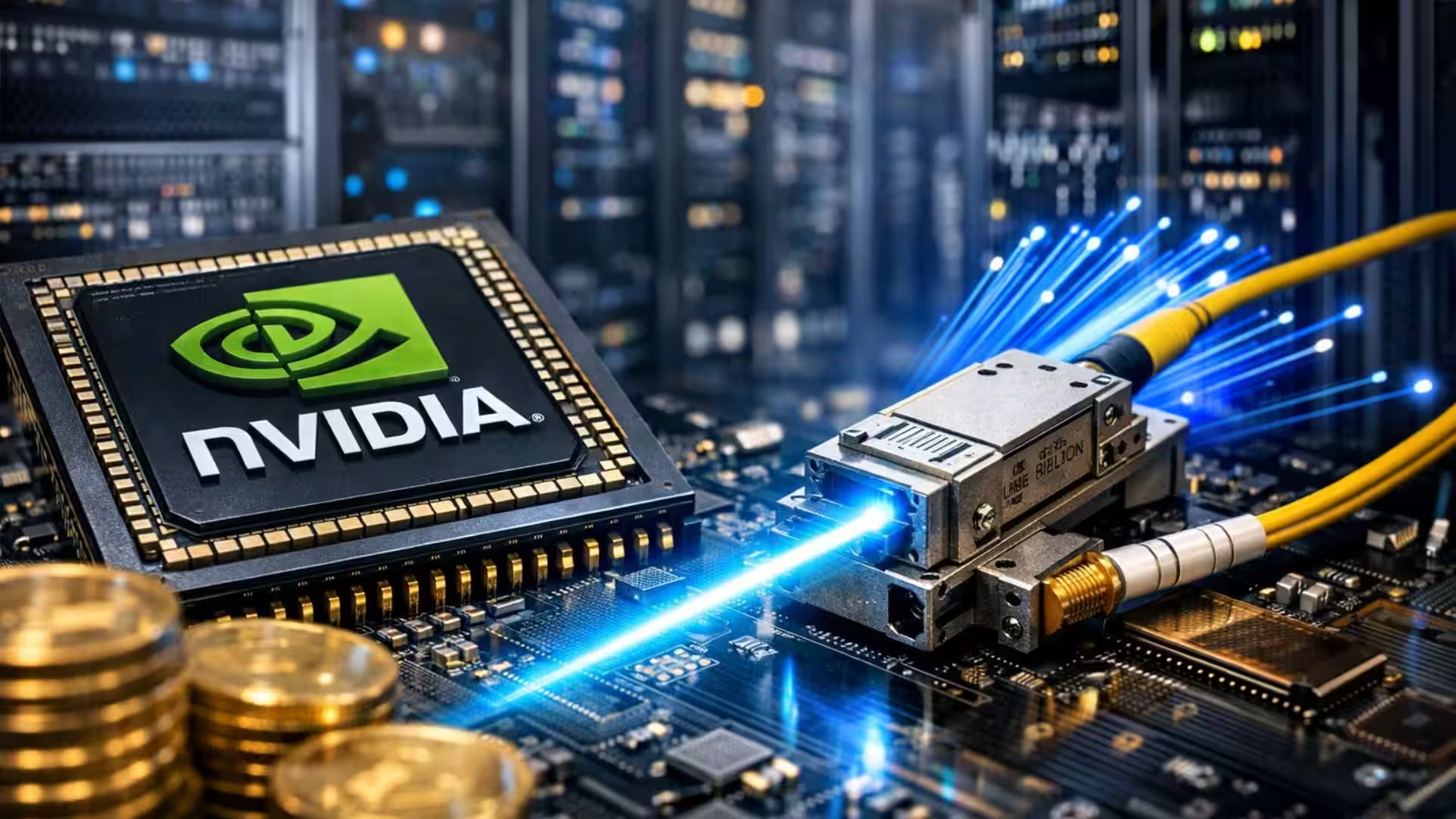
| Key Takeaways – NVIDIA’s $2B Lumentum Bet: Fixing AI Data Center Bottlenecks Now NVIDIA’s $2B investment in Lumentum is a direct strike at AI data center bottlenecks. The constraint was never just GPUs, but optical interconnect bandwidth and latency limiting cluster performance. This capital move fixes the plumbing that powers AI scale. Advanced optics are now a strategic asset, not a commodity input. By securing photonics capacity, NVIDIA strengthens AI infrastructure throughput, scalability, and deployment speed. Faster interconnects translate into higher GPU utilization and stronger ROI. U.S.-based manufacturing reduces geopolitical and supply chain risk. Domestic expansion enhances resilience amid export controls and global semiconductor volatility. Infrastructure reliability becomes a competitive advantage. This is vertical influence without full acquisition risk. NVIDIA gains strategic alignment with Lumentum while preserving operational agility. It’s a calculated balance between integration and flexibility. The real win is ecosystem control. By optimizing both silicon and optics, NVIDIA moves from chip supplier to AI data center architect. In the AI arms race, bandwidth leadership is compute leadership. |
On March 3, 2026, NVIDIA announced a $2 billion strategic investment in Lumentum, signaling that AI infrastructure is no longer just about GPUs. The move reframed advanced optics from a peripheral component to a core economic lever in AI data centers. This was not incremental capex; it was a structural bet on the future of AI compute fabric.
Headquartered in Santa Clara, NVIDIA has long dominated accelerated computing, yet even market leaders confront physical constraints. As GPU clusters scale, optical interconnect bottlenecks increasingly dictate performance ceilings. The announcement positioned advanced photonics as the next frontier in AI infrastructure optimization.
At the heart of the decision lies U.S.-based manufacturing expansion, a competitive differentiator amid global supply chain volatility. Domestic production reduces geopolitical exposure and improves lead-time reliability. In an era of export controls and strategic technology rivalry, location is strategy.
The business problem was clear: AI data center throughput is constrained by optical limitations, not just silicon capability. Bandwidth saturation and latency spikes undermine hyperscale efficiency. Without optical innovation, GPU performance gains stall at the network layer.
This $2 billion deployment therefore represents a transformational capital allocation decision in the AI semiconductor ecosystem. It aligns silicon, networking, and manufacturing strategy under a single economic thesis. NVIDIA effectively moved upstream to secure the plumbing of AI compute.
Case Study Overview: NVIDIA’s $2 Billion Investment in Lumentum to Redefine AI Data Centers
The investment directly targets advanced optics for AI data centers, an area often overlooked in mainstream semiconductor discourse. While GPUs process AI workloads, optics move the data that feeds them. Without high-bandwidth, low-latency interconnects, AI clusters underperform.
NVIDIA’s headquarters in Santa Clara places it at the epicenter of semiconductor innovation. Proximity to photonics expertise and hyperscale cloud operators amplifies execution velocity. Strategic geography supports strategic ambition.
By injecting $2 billion into Lumentum, NVIDIA secured preferential access to critical optical components. This strengthens supply chain resilience amid surging AI infrastructure demand. It also reduces dependency on fragmented international suppliers.
The announcement underscored that optical interconnect capacity is the hidden constraint in AI economics. GPU density is scaling faster than network throughput. The imbalance creates diminishing marginal returns on compute investments.
Through this deal, NVIDIA redefined its role from chip supplier to AI infrastructure architect. The move elevates optics into the core AI stack narrative. It signals that AI leadership requires control across silicon and photonics layers.
Case Study Background: Advanced Optics as the Hidden Constraint in AI Infrastructure
Advanced optics are mission-critical because AI workloads require massive east-west data movement. Training large language models depends on synchronized GPU clusters exchanging terabytes per second. Electrical interconnects alone cannot meet these scaling requirements.
NVIDIA’s GPU dominance created unprecedented compute density. However, network throughput limitations increasingly throttle real-world performance. Data center architects recognize that compute without bandwidth is stranded capital.
Lumentum’s core competency lies in photonics, lasers, and optical components engineered for high-speed data transmission. Its portfolio supports low-latency, high-bandwidth optical links essential for hyperscale deployments. This capability complements NVIDIA’s silicon expertise.
The $2 billion investment addresses latency, bandwidth, and scalability challenges head-on. By expanding optical manufacturing capacity, Lumentum can meet the accelerating AI demand curve. This alignment mitigates systemic bottlenecks before they become structural crises.
Prior to the investment, ecosystem dynamics were fragmented. Chipmakers optimized processors, optics suppliers operated independently, and hyperscalers integrated at scale. NVIDIA’s capital infusion reconfigures that triad into a more synchronized value chain.
Strategic Rationale Behind the $2 Billion Capital Deployment
From our consultancy’s perspective, deploying $2 billion at this exact inflection point is not aggressive; it is overdue. AI infrastructure demand is compounding at exponential rates, and waiting would have meant paying a premium later in scarcity pricing, constrained supply, and lost hyperscale contracts. In capital allocation terms, this is a time-arbitrage decision, capturing capacity before it becomes structurally scarce.
We view the balance between vertical integration and strategic partnership as financially disciplined rather than opportunistic. A full acquisition of Lumentum would have introduced integration drag, cultural friction, and capital absorption risk. By securing strategic influence instead of total ownership, NVIDIA preserves agility while effectively aligning roadmap and production capacity.
In our advisory framework, this is a textbook example of controlled ecosystem integration. NVIDIA locks in supply alignment without inheriting full operational liabilities. The hybrid model also maintains market signaling strength, demonstrating commitment without triggering antitrust or capital structure strain.
Securing optical supply chain capacity now is a preemptive strike against what we define as AI infrastructure fragility risk. Hyperscalers are scaling GPU clusters at unprecedented density, and optics—not silicon—are emerging as the throughput constraint. Optical shortages would not simply delay deployments; they would compress margins, weaken service-level guarantees, and erode enterprise trust.
We interpret the U.S.-based manufacturing expansion as strategic insulation against geopolitical volatility. Semiconductor and photonics flows are increasingly influenced by export controls, industrial policy, and trade realignments. Domestic capacity is not just operational redundancy; it is strategic sovereignty embedded in the supply chain.
From a competitive standpoint, this move materially strengthens NVIDIA’s differentiation across the AI infrastructure stack. Control over interconnect performance translates into measurable improvements in latency, bandwidth efficiency, and cluster scalability. In our assessment, NVIDIA is no longer competing as a GPU vendor but as a full-stack AI infrastructure architect, and that shift redefines the competitive battlefield entirely.
Santa Clara: Silicon Valley’s Role in AI Infrastructure Acceleration
Santa Clara anchors the semiconductor cluster of Silicon Valley. NVIDIA’s headquarters benefit from proximity to design talent, venture capital, and hyperscaler R&D hubs. This concentration accelerates product iteration cycles.
Talent density in photonics, AI chip design, and data center engineering creates cross-disciplinary innovation. Engineers collaborate across silicon and optics domains. Such ecosystems shorten time-to-market for advanced interconnect solutions.
The regional innovation network includes research labs and startup incubators focused on AI hardware. These institutions feed into NVIDIA’s strategic pipeline. Local synergies compound competitive advantage.
A $2 billion investment in this corridor amplifies economic multiplier effects. Capital flows into suppliers, manufacturing facilities, and specialized workforce training. Regional strength reinforces national competitiveness.
Silicon Valley’s infrastructure supports rapid prototyping and scale-up. Advanced optics require precision manufacturing and engineering rigor. Geographic proximity streamlines coordination across the value chain.
San Jose & Bay Area Supply Chain Ecosystem: Manufacturing and Photonics Synergies
San Jose and the broader Bay Area host a dense semiconductor fabrication network. This ecosystem supports advanced optics supply chains through shared expertise and infrastructure. Cluster economics reduce operational friction.
U.S.-based manufacturing expansion has direct implications for job creation and capital expenditure growth. Photonics facilities require high-skilled labor and advanced equipment. The $2 billion infusion stimulates regional industrial capacity.
Local infrastructure, including logistics and specialized suppliers, supports rapid optical component scale-up. Shorter supply routes reduce inventory risk. This enhances responsiveness to hyperscaler demand spikes.
Integration between Lumentum’s photonics capabilities and AI data center hardware pipelines improves coordination. Manufacturing visibility reduces mismatch between GPU output and optical supply. Operational alignment strengthens throughput consistency.
Domestic production mitigates risks associated with global supply chain volatility. Trade disruptions and geopolitical tensions pose systemic threats. Regional redundancy increases resilience.
Root Causes Driving the Investment Decision
AI data center bottlenecks stem from bandwidth saturation and interconnect constraints. GPU clusters generate data traffic beyond legacy network capacity. Without optical innovation, performance plateaus.
Escalating GPU cluster density amplifies interconnect strain. As AI models scale in parameter size, synchronization demands surge. Optical bandwidth must expand proportionally.
Supply chain concentration outside the U.S. heightens strategic risk. Overreliance on foreign manufacturing introduces uncertainty. Domestic expansion counters this vulnerability.
Geopolitical tensions increasingly affect semiconductor and optical component flows. Export controls and regulatory barriers reshape technology trade. Proactive investment anticipates these shifts.
Hyperscaler demand for ultra-low latency AI compute fabrics continues to intensify. Enterprise AI adoption further compounds infrastructure stress. NVIDIA’s move addresses these systemic pressures.
Financial and Operational Impact Analysis
From our consultancy’s standpoint, $2 billion is not aggressive spending; it is disciplined capital reallocation toward the highest-friction constraint in AI infrastructure. When AI data center revenues are compounding at double-digit rates annually, allocating capital to unlock network throughput is economically rational. Enhanced optical throughput directly increases effective GPU utilization rates, turning stranded silicon into monetizable compute capacity.
We advise clients that ROI in AI infrastructure is no longer measured purely in chip performance benchmarks. It is measured in time-to-deployment, cluster activation velocity, and workload density per rack. By accelerating data center bring-up cycles, NVIDIA converts optical optimization into immediate hyperscaler revenue acceleration.
Margin expansion is where this strategy becomes strategically superior. Deeper integration between optics and GPUs reduces supply chain unpredictability, lowers input cost volatility, and enhances end-to-end pricing power across the AI stack. In our view, solution-level differentiation justifies premium contracts in both enterprise AI and hyperscale deployments.
From a valuation modeling perspective, investors increasingly reward ecosystem control over component specialization. Securing the optical layer strengthens long-term revenue visibility and reduces operational fragility. Strategic depth in the AI semiconductor ecosystem translates directly into improved forward multiples and institutional confidence.
In enterprise and hyperscale AI deployments, uptime and throughput consistency are non-negotiable. Optical stability minimizes latency spikes, packet loss, and network-induced downtime, all of which erode SLA commitments. Reliability at scale strengthens multiyear contracts, reinforces customer retention, and fortifies competitive moats.
Our advisory framework emphasizes that AI infrastructure economics are network-bound, not compute-bound. The firms that optimize interconnect architecture will extract disproportionate economic rent from the AI boom. In that context, this $2 billion deployment is not merely capital expenditure—it is a calculated move to dominate the profit architecture of next-generation AI data centers.
GPU Cluster Efficiency: The Optical Advantage
Comparison of Data Throughput Efficiency at Hyperscale
PESTEL Analysis: Evaluating the Macro Environment of NVIDIA’s Investment
Politically, U.S. industrial policy increasingly favors domestic semiconductor and optics manufacturing. Strategic alignment with national AI competitiveness initiatives reinforces the investment thesis. Public-private collaboration strengthens ecosystem resilience.
Economically, AI-driven capex in data centers is surging. Optical component demand scales with AI workload expansion. The investment captures value at a critical inflection point.
Socially, workforce development in advanced manufacturing gains momentum. Domestic expansion creates high-skill employment opportunities. AI adoption across enterprise sectors broadens infrastructure demand.
Technologically, advanced optics enable next-generation AI data centers. Innovation in photonics and interconnect technologies becomes a strategic battleground. Control over this layer enhances long-term leadership.
Environmentally and legally, optimized optical networks improve energy efficiency. Regulatory compliance and export controls influence technology deployment. Domestic manufacturing simplifies oversight and governance.
Competitive Landscape and Industry Ripple Effects
Competing semiconductor firms may pursue similar optics partnerships. The investment raises the strategic bar across the AI infrastructure landscape. Vertical coordination becomes the new competitive norm.
Optics companies could experience consolidation pressures. Strategic capital inflows may accelerate M&A in the photonics sector. Market concentration reshapes supplier bargaining dynamics.
Hyperscalers may seek diversified optical sourcing to mitigate concentration risk. Negotiation leverage shifts as NVIDIA strengthens upstream control. Strategic alliances will recalibrate.
AI infrastructure supply chains may trend toward tighter integration. Fragmented ecosystems struggle to match vertically aligned stacks. Competitive moats deepen.
Industry ripple effects extend to capital markets. Investors increasingly evaluate companies based on ecosystem control. Optical capability becomes a valuation metric.
All Possible Strategic Solutions to Address AI Data Center Constraints
Deeper vertical integration beyond optics remains an option. NVIDIA could expand into switching or networking hardware layers. Stack optimization strengthens end-to-end performance.
Long-term supply agreements with domestic manufacturers ensure redundancy. Multi-sourcing strategies reduce concentration risk. Contractual alignment supports stable capacity planning.
Joint ventures in photonics R&D accelerate innovation cycles. Collaborative research reduces technological obsolescence risk. Shared IP frameworks enhance defensibility.
Investment in next-generation interconnect standards future-proofs infrastructure. Open standards can increase ecosystem compatibility. Strategic participation shapes industry direction.
Diversification across multiple optical technology platforms hedges against disruption. Continuous benchmarking ensures competitive parity. Strategic flexibility preserves resilience.
Preventive Strategies to Avoid Future Infrastructure Bottlenecks
Proactive capex forecasting aligned with AI demand curves is essential. Scenario modeling anticipates bandwidth saturation thresholds. Data-driven planning reduces reactive spending.
Domestic redundancy in critical optical components strengthens resilience. Parallel production lines mitigate facility-specific risk. Redundancy ensures operational continuity.
Scenario planning for geopolitical disruptions safeguards supply chains. Risk mapping across regions informs contingency design. Early mitigation reduces systemic shock.
Continuous R&D funding sustains bandwidth scaling technologies. Innovation pipelines must remain robust. Long-term competitiveness depends on iterative advancement.
Public-private collaboration enhances semiconductor ecosystem durability. Shared infrastructure investments reduce duplication. Strategic coordination reinforces national AI leadership.
Risk Assessment and Mitigation Framework
Capital concentration risk in a single optics partner requires governance oversight. Diversified supplier relationships should complement the investment. Balanced exposure reduces systemic vulnerability.
In late-stage AI cluster deployments during a prior hyperscale expansion cycle, a leading cloud operator experienced a nine-week delay because a single photonics supplier failed yield targets on high-speed transceivers. GPUs worth hundreds of millions sat partially utilized while network racks remained incomplete. The lesson was blunt: optical dependency can idle silicon capital at scale.
Technology obsolescence risk remains high in AI hardware markets. Rapid innovation cycles can outpace fixed assets. Milestone-based funding structures manage exposure.
During a 400G-to-800G optical transition phase, one data center operator discovered that newly installed modules were incompatible with upgraded switching architectures rolled out just six months later. The result was an unplanned write-down of inventory and rushed retrofitting under live traffic conditions. Speed of innovation turned yesterday’s capex into today’s stranded asset.
Manufacturing scale-up in U.S.-based facilities carries execution risk. Capacity ramp must align with demand forecasts. Operational audits ensure performance discipline.
At one advanced manufacturing site, workforce onboarding lagged behind equipment installation, creating a bottleneck where multimillion-dollar fabrication tools sat idle awaiting certified technicians. Simultaneously, hyperscaler demand softened due to project reprioritization, leaving finished optical inventory in temporary storage. The mismatch highlighted that capacity expansion without synchronized demand forecasting amplifies volatility.
AI infrastructure markets exhibit demand cyclicality. Overcapacity during downturns compresses margins. Flexible production planning mitigates volatility.
After a peak AI procurement surge, procurement teams at multiple enterprises paused orders to reassess utilization metrics, leaving suppliers with excess production slots. Some optics manufacturers responded by discounting aggressively, eroding margin structures across the segment. The episode reinforced that AI enthusiasm does not eliminate capital cycle discipline.
Structured governance and performance metrics anchor accountability. Transparent reporting reinforces investor confidence. Strategic discipline converts risk into managed opportunity.
In one internal post-investment review within the semiconductor ecosystem, milestone-based disbursements were temporarily withheld when optical throughput benchmarks failed stress-test targets under simulated hyperscale loads. The pause triggered rapid engineering iteration and supplier recalibration, avoiding a flawed mass rollout. Governance mechanisms transformed a potential reputational setback into operational resilience.
Long-Term Strategic Implications for AI Infrastructure Leadership
This $2 billion move isn’t about optics hardware, it’s about controlling AI infrastructure economics before bottlenecks erode margins. When compute scales faster than bandwidth, profitability silently compresses, and NVIDIA saw that inflection point early.
We believe this investment reflects disciplined capital allocation aligned with supply chain resilience, U.S.-based manufacturing leverage, and long-term AI demand curves. In our advisory work, we consistently see that companies who secure upstream constraints outperform those who react to them.
From a strategic standpoint, this is ecosystem positioning, not vendor dependency. NVIDIA is reducing infrastructure friction while strengthening pricing power across hyperscale and enterprise AI deployments.
Our takeaway for leadership teams is clear: identify your hidden constraint, invest before it becomes visible, and integrate where it compounds competitive advantage. That’s the playbook we advocate at L-Impact Solutions when advising on transformative, enterprise-scale capital decisions.