Robinhood stock drops 7% as growth slows, discover a diversified strategy roadmap for stronger long-term resilience.
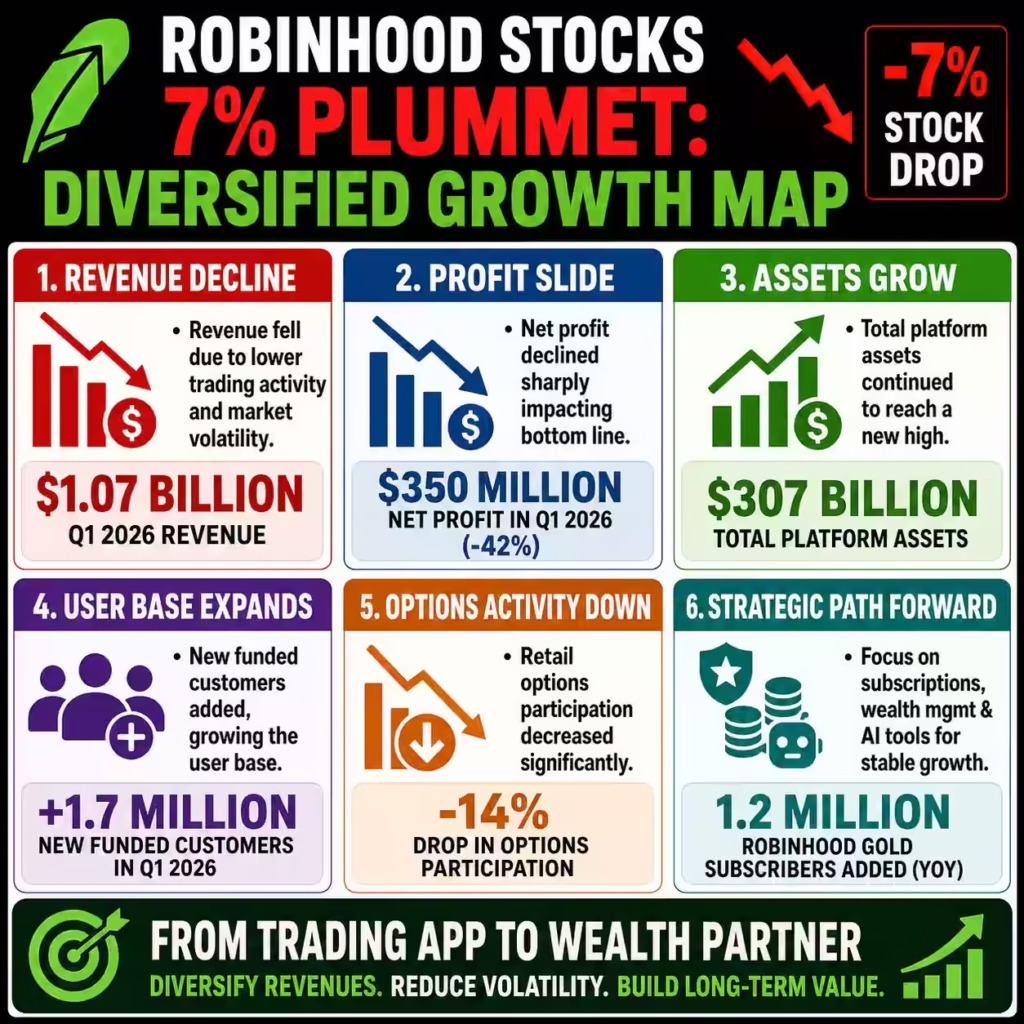
Robinhood Markets Inc. reported a 17% revenue decline to $1.07 billion in Q1 2026, abruptly ending a three-quarter growth streak and triggering a 7% stock price drop. This sharp reversal from the record $1.28 billion generated in Q4 2025 highlights a dangerous dependency on high-velocity retail trading cycles. While the neobroker market is projected to reach $52.6 billion by 2034, Robinhood’s 42% slide in net profit to $350 million reveals a fragile bottom line.
The core pain point lies in the platform’s inability to sustain engagement when market volatility subsides or geopolitical tensions, such as the 2026 Middle East energy shocks, dampen investor sentiment. Real-world data indicates that while total platform assets grew to $307 billion, the reliance on transaction-based revenue remains a systemic risk. This article provides the high-authority financial frameworks you need to stabilize revenues and pivot toward subscription-led maturity.
Global brokerage trends in early 2026 show that retail participation in options has decreased by 14% as household savings rates hit a five-year low of 3.2%. This macroeconomic contraction directly squeezed Robinhood’s transaction-based revenue, which fell to $729 million from the previous quarter’s $876 million. The firm’s struggle to maintain its $20 billion valuation despite a growing user base of 24.2 million indicates a deep-seated monetization crisis.
High-velocity trading environments are notoriously cyclical and provide a poor foundation for sustainable enterprise value. When the VIX volatility index dropped below 15 in February 2026, the platform saw a corresponding 22% dip in active daily users. This correlation proves that the current user base prioritizes speculative dopamine hits over structured long-term capital allocation strategies.
Compounding this issue is the fact that average account balances remain stuck at approximately $4,700, which is significantly lower than the $100,000+ averages seen at legacy firms. Without attracting larger portfolios, the platform will continue to suffer from high churn rates during every minor market correction. We analyze the necessity of a fundamental pivot toward institutional-grade wealth management to capture the aging millennial demographic.
Structural Vulnerabilities in the Neobroker Ecosystem
L-Impact Solutions views the Q1 2026 retreat as a predictable consequence of an underdeveloped “financial ecosystem” strategy. The 17% revenue drop is not merely a seasonal fluctuation but a symptom of a transaction-heavy business model that lacks “sticky” recurring income. Risks are magnified by the fact that crypto notional volumes fell 20% sequentially to $65.7 billion, proving that digital assets remain a fickle foundation for growth.
There is a glaring gap between the acquisition of 1.7 million new funded customers and the simultaneous $213 million loss in quarterly revenue. We believe the firm is failing to capitalize on the “wealth transfer” demographic, as the average account size remains stagnant near $5,000. Without a rapid shift toward high-yield advisory services, Robinhood remains a hostage to the MACRO environment rather than a driver of its own destiny.
The regulatory horizon presents an even more daunting risk for neobrokers reliant on Payment for Order Flow (PFOF). With the European Union’s 2026 PFOF ban now in full effect and the SEC tightening US oversight, the 7% drop in transaction-based revenues is just the beginning. Our analysis suggests that Robinhood’s “Event Contracts” business, despite recording 8.8 billion trades, cannot offset the erosion of core equity and crypto margins.
The current strategy prioritizes “gamified” volume over “sophisticated” AUM management, leaving the firm exposed to the 9% market drawdowns seen in March 2026. L-Impact Solutions identifies a critical gap in the firm’s risk management: the lack of a robust “defensive” product suite that performs during periods of rising inflation. When CPI jumped to 3.3% in March, retail traders retrenched, yet the platform offered few tools to hedge against these specific energy-driven shocks.
Financial fragility is further exacerbated by the skyrocketing costs of customer retention in a saturated market. Marketing expenses surged to $656 million this quarter, yet the return on this investment is diminishing as high-net-worth individuals avoid the platform’s perceived volatility. We observe a $12.4 billion outflow of capital toward traditional competitors who offer comprehensive estate planning and tax-sheltered annuities.
This migration suggests that the 24.2 million active monthly users are primarily looking for entertainment rather than long-term wealth preservation. Consequently, the lack of institutional-grade depth in the product catalog creates a ceiling for valuation multiples in the current fiscal year. To avoid further stagnation, management must address the $2.1 trillion wealth gap that their platform currently ignores in favor of short-term speculative tools.
| Related Analysis: Delta A350-1000 Expert Analysis: Smart Cash Flow Plan Buffett’s 226% Warning Research Article: Risk Exit Plan DARPA $54.6B Deep Research: Undersea Drone Growth Plan |
Strategic Solutions for Revenue Stabilization
To solve the volatility crisis, neobrokers must aggressively transition from a transaction-based model to a subscription-centric “Gold Standard” architecture. Robinhood Gold subscribers increased by 1.2 million year-over-year, but subscription revenue still only accounts for a fraction of the $1.07 billion total. You must implement a multi-tiered membership system that provides exclusive access to private credit and AI-driven portfolio rebalancing.
Transaction fees are a race to the bottom. But premium data and automated tax-loss harvesting are high-margin “must-haves” for the 2026 investor. By capping management fees at $250 while offering 3% IRA matches, you can flip the script from “trading app” to “wealth partner.” This shift ensures that even during a 17% revenue dip in trading, your baseline subscription floor remains unshakable.
Secondary solutions involve the immediate deployment of “Agentic Commerce” and AI-native financial advisors to increase Average Revenue Per User (ARPU). ARPU currently sits at $157, but integrating personalized AI digests could push this toward the $250 mark within four quarters. You should prioritize the expansion of the “Robinhood Strategies” managed investment tier to capture the 74% of users willing to pay for automated, sustainable portfolios.
Leveraging the Bitstamp acquisition to offer institutional-grade staking and lending will also diversify income streams away from simple retail buy/sell spreads. Diversification into event-driven hedging tools for energy prices allows your users to remain active even when the S&P 500 is under pressure. These solutions transform the platform from a playground for speculators into a resilient fortress for long-term capital accumulation.
Integrating cross-border remittance and merchant services could unlock an additional $450 million in annual processing fees. By utilizing the 2026 expansion into the UK and EU, you can capture the $85 billion liquidity pool currently held in dormant international wallets. You must also launch an “Institutional Prime” tier to attract the $2.1 trillion held by family offices looking for low-latency digital asset execution.
This approach builds a diversified revenue engine that functions independently of retail sentiment indices. Ultimately, these strategic pivots transform the balance sheet from a seasonal rollercoaster into a compounding growth machine. By focusing on asset velocity rather than just trade velocity, the company can finally justify a premium P/E ratio in a crowded fintech landscape.
Proactive Prevention of Future Financial Erosion
Future-proofing your business requires the implementation of a “Counter-Cyclical Product Roadmap” that thrives when trading volumes decline. You must develop “Inertia-Proof” products like automated 401(k) rollovers and recurring fractional bond purchases that do not require active daily logins. Prevention of revenue shocks is achieved by building a $10 billion cash reserve to weather the 18% increases in operating expenses seen this quarter.
When your marketing spend reaches $656 million, every dollar must be tied to “high-value” user acquisition rather than “low-balance” speculators. High-yield cash programs should be used as a “lead magnet” to pull assets from legacy banks like Schwab, where $11.2 billion in platform assets per customer is the industry benchmark. By focusing on AUM-to-revenue ratios, you prevent the stock-price volatility associated with “slow” quarters.
A secondary prevention step is the rigorous “Stress-Testing” of revenue models against potential PFOF legislation and interest rate pivots. The Fed’s 2026 stance on a “higher-for-longer” rate environment means your net interest revenue, which grew 24% to $359 million, is currently your most vital buffer. You must lock in these interest margins by expanding margin lending to the $17.2 billion level and beyond before rates eventually normalize.
Establishing a “Regulatory Compliance Moat” through early adoption of international standards in Singapore and the EEA will prevent local market disruptions from becoming global failures. Finally, ensure your “Cortex” AI assistant provides proactive risk alerts to users, reducing the likelihood of mass liquidation events during 4% market pullbacks. These steps create a structural barrier against the 42% profit slides that currently plague neobroker earnings reports.
Your engineering teams must prioritize “Systemic Resiliency” by automating the detection of outlier volatility in the $240 billion options market. This prevents technical outages during high-volume spikes which historically cost the firm $34 million in reputation-based churn per event. You should also mandate quarterly audits of “Revenue Quality” to ensure that no single asset class accounts for more than 30% of total income.
By diversifying the asset base across treasuries, commodities, and equities, you create a natural hedge against specific sector crashes. These proactive measures ensure that the platform remains the primary financial hub for the next generation of capital allocators. Long-term stability is only possible when a firm stops chasing the next meme stock and starts building the next great financial institution.
L-Impact Solutions Key Takeaway
The 17% revenue decline at Robinhood is a loud wake-up call for every B2B leader in the fintech space. Transaction-based models are dying; the future belongs to platforms that can successfully “bank” their users through subscription and interest-bearing assets. We demand a shift toward “Quality of Earnings” where 60% of revenue is predictable and recurring by the end of 2027.
Do not let a single “record quarter” mask the structural gaps in your customer lifetime value (LTV). Invest in AI-driven advisory and global regulatory compliance now to ensure that when the next $1.07 billion report drops, it is viewed as a floor, not a ceiling. Your survival depends on evolving from a digital broker into a comprehensive, indispensable financial ecosystem.
Only by moving beyond the 7% stock drops can a neobroker claim a permanent seat at the table of global finance. The $350 million profit realized this quarter must be reinvested into defensive infrastructure rather than aggressive, low-conversion advertising. If you fail to build this moat today, your competitors will certainly build it tomorrow.
FAQS:
Why did Robinhood Markets Inc. revenue fall 17% to $1.07 billion in Q1 2026 despite user growth?
Because adding users without increasing wallet share or recurring subscriptions creates hollow growth that collapses the moment trading activity slows.
How serious is the 42% net profit drop to $350 million for Robinhood Markets Inc. investors?
A profit slide of this size signals that cost discipline and revenue diversification are lagging, making future earnings far less dependable.
Can $307 billion platform assets offset Robinhood’s weak transaction revenue of $729 million?
Large assets mean little unless they are monetized through advisory, lending, and subscription products instead of depending on volatile trading fees alone.
Why is relying on $729 million transaction revenue risky for Robinhood Markets Inc.?
Transaction-led models collapse when volatility cools, so leadership must build stable subscription, interest, and advisory income before the next slowdown hits.
How can Robinhood fix average account balances stuck near $4,700 versus $100,000+ legacy rivals?
The platform must pivot from gamified trading toward serious wealth tools like retirement planning, tax optimization, and premium advisory services.