Table of Contents
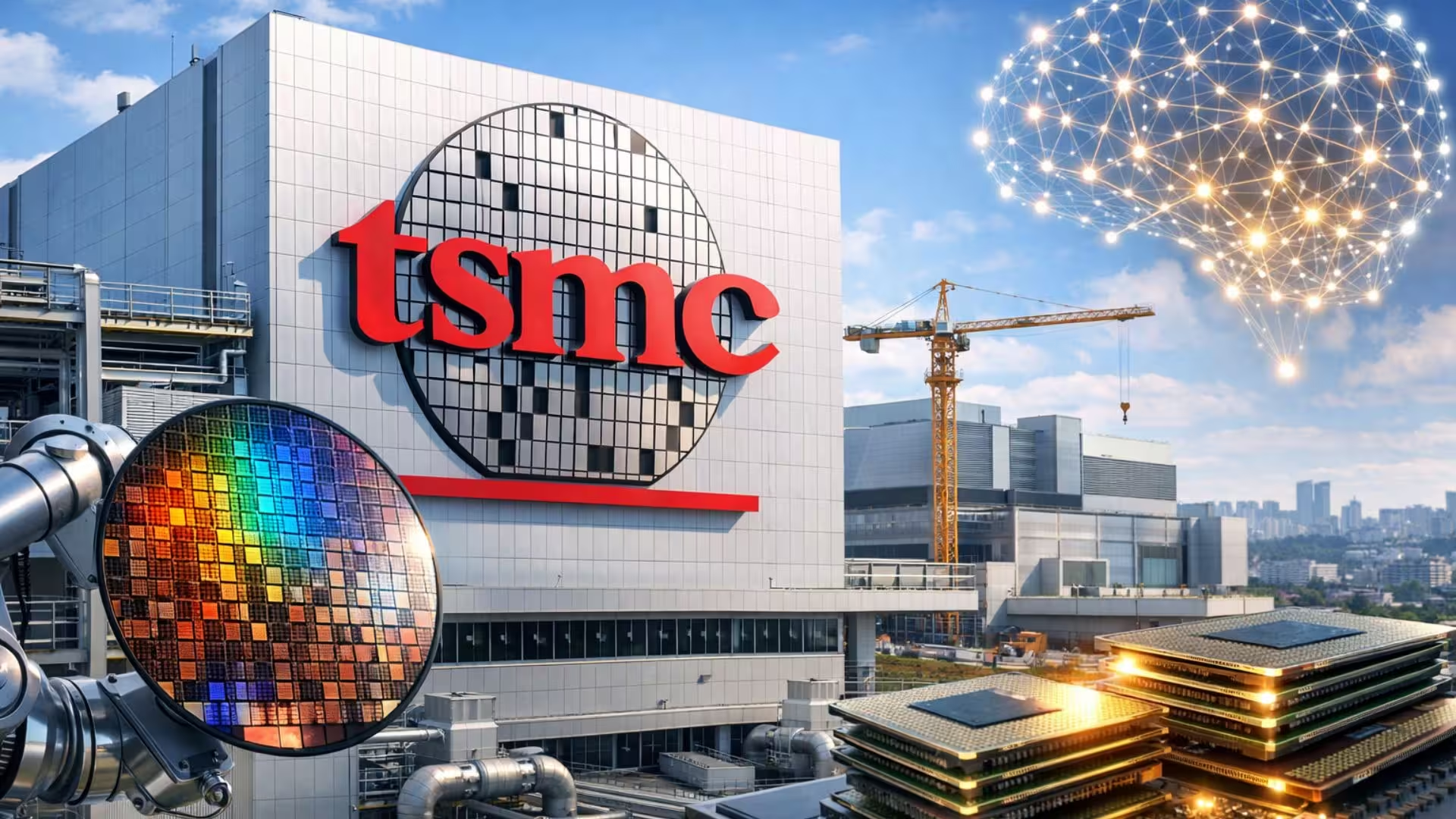
TSMC $56 billion AI semiconductor capex is no longer a routine investment headline; it is a structural signal redefining global semiconductor strategy, AI infrastructure economics, and long-cycle capital planning.
The announcement that TSMC plans up to $56 billion in 2026 capital expenditure, representing a 37% year-on-year capex surge, arrives at a moment when AI semiconductor demand, hyperscaler infrastructure build-outs, and sovereign compute ambitions are colliding with macro uncertainty.
For CEOs, procurement leaders, investors, and policymakers, this case study demonstrates how AI-driven semiconductor demand overrides cyclical volatility, reframes risk tolerance, and elevates advanced-node capacity as a strategic asset rather than a cost center.
Case Study Context: Why TSMC’s 37% Capex Jump Matters to Global Strategy
The TSMC $56 billion AI semiconductor capex decision matters because it converts AI demand visibility into irreversible capital commitment, signaling that management views the current AI cycle as structural rather than speculative.
This 37% YoY capex expansion is not reactive spending but a deliberate long-horizon infrastructure bet, indicating that AI compute demand, advanced semiconductor manufacturing, and data-center silicon will remain capacity-constrained well beyond short-term market corrections.
For global decision-makers, this case study clarifies that semiconductor capital expenditure strategy is now inseparable from AI strategy, industrial policy, and national competitiveness.
At this inflection point, L-Impact Solutions operates at the intersection of AI infrastructure strategy, semiconductor risk assessment, and capital planning advisory, helping enterprises and governments interpret what large-scale capex signals mean for procurement, pricing power, and long-term exposure.
Case Study Snapshot: Key Data Points Driving This $56 Billion Decision
The numerical backbone of this AI semiconductor case study is stark and intentional.
$56 billion in planned 2026 capex, +37% year-on-year growth, and execution during a period of macro uncertainty collectively indicate exceptional management conviction.
This scale of semiconductor capital expenditure directly aligns with hyperscaler AI infrastructure expansion, advanced-node capacity demand, and long-duration customer commitments tied to AI accelerators and HPC workloads.
Rather than waiting for demand certainty, the strategy implies that capacity itself becomes the bottleneck, making early investment a competitive moat in the AI semiconductor ecosystem.
The data signals that AI chip demand elasticity remains low, while pricing leverage and utilization rates justify aggressive upfront spending.
Strategic Rationale: Why AI Demand Overrides Short-Term Market Volatility
The strategic logic behind TSMC’s AI capex surge rests on the transformation of demand curves driven by AI accelerators, HPC workloads, and data-center silicon intensity.
Unlike consumer cycles, AI compute demand compounds, as model scaling, inference deployment, and enterprise AI adoption reinforce one another.
Management is effectively communicating that volatility is statistical noise, while AI semiconductor demand represents a multi-year infrastructure build-out comparable to historical electricity or telecom expansions.
This reframing justifies front-loaded capex, because delayed investment risks irreversible market share loss in advanced nodes and packaging capabilities.
The strategy assumes that AI workloads will absorb capacity faster than pessimistic forecasts suggest.
Root Causes: Structural Forces Behind the “Insatiable” AI Chip Demand
The term “insatiable AI demand” reflects structural, not cyclical, forces.
AI models are scaling in parameter count, training frequency, and inference density, each of which directly increases semiconductor consumption per workload.
At the same time, energy-efficient advanced nodes are becoming mandatory, forcing customers toward leading-edge foundries with the highest yield learning curves.
Sovereign compute initiatives further amplify demand, as governments prioritize domestic AI capacity, secure supply chains, and strategic autonomy.
These forces converge to make massive upfront semiconductor capex unavoidable, not optional.
Supply-Side Implications: Capacity Expansion, Nodes, and Technology Bets
A $56 billion semiconductor capex envelope reshapes supply dynamics across leading-edge nodes, advanced packaging, and ecosystem tooling.
Capital allocation increasingly favors sub-5nm processes, chiplet integration, and high-bandwidth memory adjacency, reinforcing technological barriers to entry.
However, execution risk rises with scale, as yield ramp timelines, equipment availability, and customer alignment must synchronize precisely.
The bet assumes that customer roadmaps remain locked into advanced nodes, validating long depreciation cycles.
Failure to execute flawlessly would magnify downside, making operational discipline as critical as capital availability.
Global Hardware Procurement Impact: How Buyers Must Rethink Strategy
For OEMs, hyperscalers, and governments, TSMC’s AI capex surge forces a rethink of hardware procurement strategy.
Capacity constraints imply longer lead times, prepayment requirements, and strategic partnerships replacing spot-market sourcing.
Buyers must treat semiconductor access as a strategic negotiation, not a transactional purchase.
This environment rewards early commitments, co-investment models, and demand signaling, while penalizing reactive procurement behavior.
In effect, procurement becomes a board-level function, directly tied to AI competitiveness.
Economic Significance: Capex Cycles, Pricing Power, and Industry Margins
From a macro perspective, a 37% YoY semiconductor capex increase reinforces capex-led economic growth across equipment suppliers and regional ecosystems.
High utilization expectations preserve pricing power, even as depreciation expenses rise.
Margins remain resilient because AI demand absorbs capacity faster than historical cycles, compressing oversupply risk.
Spillover benefits extend to tooling vendors, materials suppliers, and skilled labor markets, creating multiplier effects.
This dynamic positions AI semiconductor manufacturing as a macroeconomic stabilizer, not a volatility amplifier.
Political and Geopolitical Importance: Semiconductors as Strategic Assets
The $56 billion AI semiconductor investment carries profound geopolitical implications.
Semiconductors now function as strategic infrastructure, shaping industrial policy, export controls, and alliance dynamics.
Governments interpret such capex as a signal of long-term technological alignment, influencing subsidies, localization incentives, and regulatory posture.
The concentration of advanced-node capacity heightens national security considerations, making supply resilience a political priority.
This case study underscores why AI chips are treated as strategic assets rather than commercial goods.
Risk Landscape: Execution, Overcapacity, and Demand Elasticity
Despite optimism, risk remains embedded in scale.
Execution missteps, geopolitical shocks, or delayed AI monetization could expose temporary overcapacity.
Demand elasticity, while currently low, could normalize if AI efficiency gains reduce silicon intensity per workload.
Capex overruns or equipment bottlenecks would strain returns.
The strategy therefore balances high-confidence demand with disciplined risk governance, not blind expansion.
Solution Pathways: How Stakeholders Can Mitigate Downside Risks
Risk mitigation requires phased capacity ramps, diversified customer contracts, and co-investment frameworks that align incentives.
Procurement hedging, long-term offtake agreements, and policy coordination reduce exposure to demand timing mismatches.
Transparency between foundries, customers, and governments stabilizes planning horizons.
These measures convert AI semiconductor capex risk into shared ecosystem resilience, preserving returns even under stress scenarios.
Future Forecast: 2026–2030 Semiconductor Demand Scenarios
Looking ahead, three scenarios dominate AI semiconductor demand forecasting.
The base case assumes sustained AI infrastructure expansion, absorbing capacity steadily through 2030.
The bull case accelerates adoption via autonomous systems, enterprise AI, and sovereign compute, tightening supply further.
The stress case moderates growth but still maintains utilization due to long deployment cycles.
Across scenarios, the $56 billion capex remains defensible, reinforcing long-cycle confidence.
Future Issues on the Horizon: Energy, Talent, and Supply Constraints
Aggressive semiconductor expansion intensifies energy consumption, talent scarcity, and equipment bottlenecks.
Power availability becomes a gating factor, especially for advanced fabs.
Skilled labor shortages raise operational risk.
Sustainability pressures increase scrutiny on carbon intensity and water usage.
These constraints require integrated planning beyond pure capital expenditure.
Prevention Strategies: Avoiding Boom–Bust Cycles in AI Silicon
Avoiding historical boom–bust cycles demands structural safeguards.
Long-term contracts, modular fab designs, and real-time demand signaling smooth utilization.
Policy frameworks that discourage speculative overbuilding while supporting strategic capacity are essential.
The goal is controlled expansion aligned with AI adoption curves, not reactive scaling.
Future Demand Hotspots: Where AI Compute Growth Will Concentrate
Future AI compute demand will concentrate in hyperscale data centers, edge AI deployments, and sovereign infrastructure.
Each segment reinforces the need for advanced nodes, energy efficiency, and packaging innovation.
These hotspots justify continued high semiconductor capex beyond 2026, anchoring long-term strategy.
Executive Takeaway: What This Case Study Signals for Decision-Makers
This TSMC $56 billion AI semiconductor capex case study reframes AI as a decade-long infrastructure cycle, not a transient technology trend.
For executives, it signals that procurement, capital planning, and policy alignment must converge around AI silicon access.
The investment validates advanced semiconductor manufacturing as a strategic choke point shaping competitive advantage.
L-Impact Solutions provides strategic guidance, risk frameworks, and decision intelligence to help organizations navigate AI-driven semiconductor volatility, procurement exposure, and long-cycle capital strategy, ensuring stakeholders remain resilient and competitive in an AI-dominated global economy.