Table of Contents
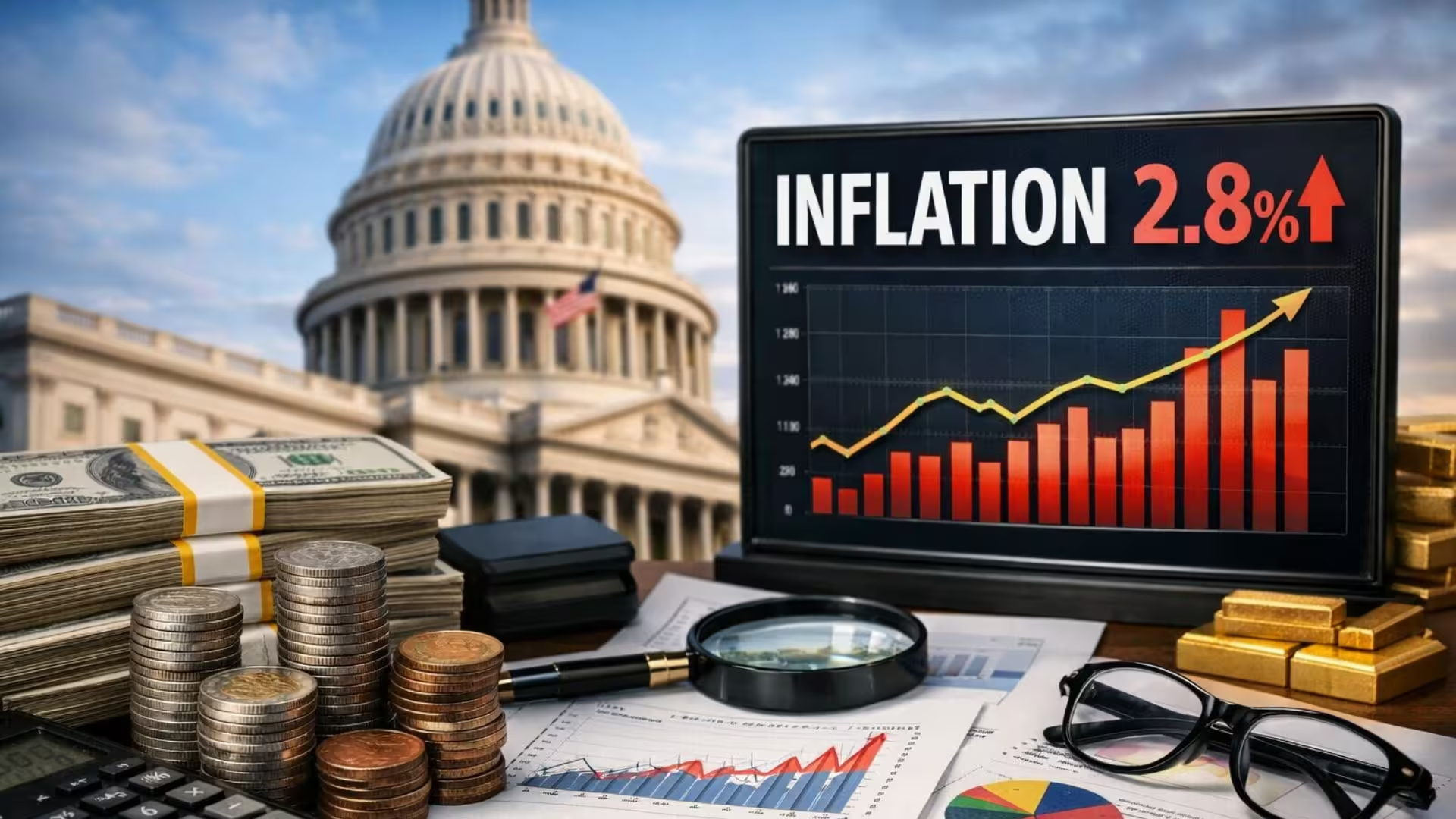
US inflation stickiness defines the strategic reality confronting American executives, policymakers, and capital allocators as the economy navigates a prolonged deviation from price stability, with the latest 2.8% core PCE reading signaling that inflationary pressures have shifted from cyclical noise into a structurally embedded challenge that demands executive-level interpretation rather than short-term macro optimism.
Case Study Context: Why Core PCE Inflation at 2.8% Matters Now in US Inflation Stickiness
The 2.8% core PCE inflation reading is strategically material because it remains meaningfully above the Federal Reserve’s 2% target, signaling that inflation normalization has stalled rather than completed.
This persistence confirms that US inflation stickiness is no longer driven by post-pandemic goods distortions but by deeper service-sector cost structures.
Goods prices continue to cool due to global supply normalization, inventory rationalization, and subdued consumer discretionary demand.
In contrast, service inflation remains structurally elevated because labor intensity, wage rigidity, and housing-related costs do not adjust downward easily.
For executives, this divergence matters because pricing power now varies sharply by sector rather than moving in tandem across the economy.
Capital markets interpret this stickiness as a signal that monetary easing will be delayed, raising long-term discount rates.
Corporate planning assumptions built on rapid inflation convergence are therefore misaligned with current macro signals.
From a governance perspective, boards must recalibrate risk frameworks to account for persistent cost inflation rather than transitory shocks.
Policy credibility is also at stake, as repeated inflation overshoots risk anchoring expectations above target.
This environment elevates strategic intelligence as a core executive competency rather than a peripheral function.
Decision-makers must understand that inflation persistence reshapes competitive dynamics, cost structures, and investment sequencing.
This case study sets the foundation for analyzing inflation as a structural constraint on growth rather than a temporary macro variable.
At this strategic inflection point, L-Impact Solutions bridges macroeconomic intelligence with executive decision frameworks, enabling leadership teams to interpret inflation signals with clarity, contextual relevance, and actionable foresight rather than reactive commentary.
Case Study Snapshot: Key Inflation Data Shaping the US Economy
The headline data point anchoring this case study is the 2.8% core PCE inflation reading, which strips out volatile food and energy components.
This metric is critical because it is the preferred inflation gauge of the Federal Reserve and directly informs policy decisions.
Goods inflation has moved into outright disinflation due to excess capacity, technological efficiency, and global trade normalization.
Durable goods prices, in particular, reflect declining input costs and competitive pricing pressures.
However, service-sector inflation continues to rise due to wage pass-through effects.
Housing rents remain elevated because supply expansion has lagged demographic demand.
Healthcare and hospitality costs reflect labor shortages that resist rapid normalization.
The combined effect is an inflation profile that appears benign on the surface but is structurally imbalanced beneath the aggregate figure.
This imbalance confirms that inflation persistence is asymmetric rather than broad-based.
Market participants increasingly interpret this data as confirmation of inflation stickiness rather than cyclical fluctuation.
Corporate CFOs must therefore reassess cost forecasts embedded in long-term budgets.
Investors are repricing duration risk accordingly.
This snapshot reinforces why the 2.8% reading carries outsized strategic significance despite appearing modest numerically.
Macroeconomic Diagnosis: Root Causes Behind Persistent 2.8% Inflation
Persistent inflation at 2.8% reflects structural supply-demand mismatches rather than overheating consumption.
US labor markets remain historically tight, particularly in service-oriented roles.
Wage growth in healthcare, logistics, education, and hospitality continues to outpace productivity gains.
These wage increases feed directly into service pricing.
Housing inflation persists due to chronic undersupply and zoning constraints.
Multifamily construction has not kept pace with household formation.
Meanwhile, goods supply chains have largely normalized, removing their inflationary contribution.
This divergence creates a macro environment where disinflation stalls despite slower growth.
Importantly, service inflation exhibits downward rigidity because wages rarely decline in nominal terms.
This rigidity anchors inflation above target even when demand moderates.
The result is US inflation stickiness driven by labor intensity and housing constraints.
Policy tools are less effective against these drivers compared to demand-driven inflation.
Executives must recognize that these root causes imply persistence rather than rapid reversal.
Sectoral Breakdown: Goods Cooling vs. Services and Housing Overheating in US Inflation Stickiness
Goods-producing sectors benefit from automation, global competition, and supply elasticity.
Price competition in electronics, apparel, and consumer durables continues to intensify.
These forces exert downward pressure on goods inflation.
Services, by contrast, are constrained by human capital availability.
Healthcare costs rise due to staffing shortages and regulatory complexity.
Hospitality pricing reflects wage competition and seasonal demand volatility.
Housing rents remain elevated due to structural supply shortages.
Mortgage rate volatility further distorts rental demand.
This sectoral asymmetry explains why aggregate inflation masks underlying pressures.
Executives operating in service-heavy sectors face disproportionate margin compression risks.
Goods-based firms experience relative pricing relief.
This divergence reinforces the narrative of inflation stickiness rooted in services rather than goods.
Strategic resource allocation must account for these sector-specific inflation dynamics.
Monetary Policy Implications: The Federal Reserve’s Dilemma at 2.8%
A 2.8% core PCE reading places policymakers in a strategic bind.
Cutting rates prematurely risks reigniting inflation expectations.
Maintaining restrictive policy prolongs financial tightness.
This trade-off delays monetary easing.
Capital costs remain elevated as a result.
Credit availability tightens for leveraged firms.
Equity valuations face higher discount rates.
Corporate refinancing becomes more expensive.
The gap between 2.8% and the 2% target constrains policy flexibility.
Markets increasingly price a “higher-for-longer” rate environment.
Executives must adapt capital structures accordingly.
Inflation stickiness thus translates directly into strategic financing risk.
Political and Economic Significance: Inflation Stickiness as a Policy Risk
Inflation persistence carries political consequences.
Cost-of-living pressures erode household confidence.
Housing affordability remains a voter-sensitive issue.
Wage growth narratives clash with purchasing power realities.
Fiscal policymakers face pressure to intervene.
However, expansionary fiscal measures risk fueling inflation further.
This tension complicates macro coordination.
Economic credibility depends on inflation containment.
Persistent inflation challenges policy messaging.
Executives must anticipate regulatory and fiscal responses.
Inflation stickiness therefore becomes a governance risk.
Strategic planning must incorporate political economy considerations.
Strategic Business Impact: What 2.8% Core PCE Means for Corporations
Persistent inflation reshapes corporate strategy.
Pricing power becomes uneven across sectors.
Margins compress where cost pass-through is limited.
Labor-intensive firms face rising operating leverage risk.
Long-term contracts become mispriced.
Capital allocation decisions must account for sustained cost pressure.
Supply chain diversification gains renewed relevance.
Automation investment becomes strategically defensive.
Inflation stickiness alters competitive positioning.
Strategic agility becomes a differentiator.
Executives must reassess assumptions embedded in growth forecasts.
This environment rewards data-driven leadership.
Solution Landscape: Policy, Corporate, and Market-Driven Adjustments
Addressing inflation persistence requires multifaceted solutions.
Productivity-enhancing investments reduce labor cost pressure.
Service automation offsets wage inflation.
Housing supply expansion alleviates rent inflation.
Zoning reform accelerates construction.
Monetary restraint anchors expectations.
Corporate efficiency initiatives regain prominence.
Dynamic pricing strategies improve margin resilience.
Talent optimization reduces structural cost growth.
Each lever targets a root cause of inflation stickiness.
Solutions must be coordinated rather than isolated.
Strategic coherence is essential.
Risk Mitigation Pathways: Preventing Inflation Re-Acceleration
Preventive strategies focus on expectation management.
Wage growth must align with productivity.
Rental market transparency reduces pricing distortions.
Supply-side capacity investment stabilizes costs.
Scenario planning prepares firms for volatility.
Financial hedging mitigates rate risk.
Cost discipline remains critical.
Governance oversight strengthens resilience.
Inflation stickiness requires proactive risk management.
Reactive approaches prove insufficient.
Strategic foresight becomes indispensable.
Forward-Looking Forecast: Inflation Trajectory Beyond 2.8%
Inflation convergence will be gradual.
Labor normalization takes time.
Housing supply responds slowly.
Services inflation decelerates incrementally.
A return to 2% is not guaranteed.
Structural forces may anchor inflation near 2.5–3.0%.
Policy credibility remains pivotal.
Corporate adaptation influences outcomes.
Executives must plan for persistence.
Optimism must be tempered by realism.
Strategic patience is required.
Emerging Challenges: Structural Inflation in a Services-Driven Economy
Demographic aging tightens labor supply.
Immigration constraints amplify shortages.
Service demand grows structurally.
Housing undersupply persists.
Technological substitution faces limits.
Regulatory complexity adds friction.
These factors entrench inflation risk.
Goods disinflation cannot offset services pressure indefinitely.
Structural inflation becomes the baseline.
Strategic recalibration is unavoidable.
Leadership must evolve accordingly.
Future Demand Outlook: Capital, Labor, and Housing Under Sticky Inflation
Capital demand shifts toward productivity.
Labor demand prioritizes skills over scale.
Housing investment becomes strategic infrastructure.
Institutional investors recalibrate risk premiums.
Long-term planning horizons shorten.
Flexibility becomes valuable.
Cost certainty diminishes.
Inflation stickiness reshapes demand allocation.
Strategic optionality gains value.
Enterprises must adapt structurally.
Macro literacy becomes a leadership asset.
US Inflation Stickiness Through a Domestic Power Lens: Labor, Housing, Policy, and Market Frictions
US inflation stickiness at 2.8% is reinforced by deeply domestic structural forces that are visible across labor markets, housing supply, fiscal mechanics, regulatory environments, consumption behavior, and technological deployment, making this inflation episode fundamentally homegrown rather than imported.
The US labor market remains historically tight, with the prime-age (25–54) employment-to-population ratio near multi-decade highs, indicating that available slack for wage moderation is extremely limited.
Average hourly earnings in service-heavy sectors such as healthcare, leisure, and professional services continue growing between 4% and 5% year-over-year, well above the pace compatible with a 2% inflation regime.
Job openings consistently exceed unemployed workers, reinforcing wage-setting power at the employee level rather than employer level, which directly feeds service inflation.
Housing remains the most persistent domestic inflation amplifier, with national rent inflation still running above pre-pandemic averages despite higher mortgage rates, due to an estimated multi-million-unit housing supply deficit accumulated over the last decade.
Single-family housing starts remain constrained by zoning restrictions, labor shortages in construction, and elevated financing costs, delaying supply-side relief.
Fiscal dynamics further entrench inflation stickiness, as federal interest expense has surged, injecting income into the economy even under restrictive monetary conditions.
State- and local-level spending on infrastructure, education, and healthcare continues to circulate demand into labor-intensive sectors that are least responsive to rate hikes.
Regulatory frameworks in healthcare, insurance, and housing limit rapid cost compression, creating downward price rigidity that keeps inflation elevated even as growth cools.
Consumer behavior reinforces persistence, as US households maintain strong nominal spending supported by wage growth and accumulated wealth, particularly among higher-income cohorts.
Credit card balances and revolving credit usage indicate stress at the lower-income end, yet aggregate consumption remains resilient enough to sustain service pricing.
Technological adoption, while accelerating productivity in goods and logistics, lags materially in face-to-face service sectors, limiting disinflation potential where inflation is currently concentrated.
Energy price volatility, though excluded from core PCE, indirectly influences transportation, insurance, and municipal costs at the local level.
Insurance premiums across auto, health, and property lines have risen sharply, reflecting domestic risk pricing rather than global supply shocks.
State-level labor regulations, minimum wage laws, and worker protection mandates further elevate baseline service costs.
Demographic trends, including retirements among skilled workers and slower labor force re-entry, structurally constrain labor availability.
Immigration normalization, while improving, has not yet fully offset workforce attrition in caregiving, construction, and hospitality.
Financial conditions remain restrictive, yet nominal GDP growth continues to exceed inflation, signaling that domestic demand is cooling slowly rather than contracting.
Small and mid-sized enterprises report sustained input cost pressure, especially in payroll, insurance, and rent, limiting their ability to reduce prices.
Large enterprises with scale efficiencies absorb costs better, reinforcing pricing bifurcation across firm sizes, which sustains aggregate inflation averages.
Municipal fees, utilities, and local taxes have risen to fund higher operating costs, embedding inflation into everyday services.
Healthcare utilization continues to rise due to aging demographics, reinforcing demand-driven service inflation independent of cyclical forces.
Education costs, childcare expenses, and eldercare services show persistent annual price increases, directly linked to labor intensity.
All these domestic signals explain why US inflation stickiness remains anchored near 2.8%, despite aggressive monetary tightening by the Federal Reserve.
For executives, this local data confirms that inflation persistence is not a temporary policy lag but a structural equilibrium shaped by US-specific labor, housing, fiscal, and regulatory realities.
Executive Takeaway: Strategic Lessons from the 2.8% Inflation Case Study
This case study demonstrates that US inflation stickiness at 2.8% reflects a structural, not cyclical, challenge.
Service-sector rigidity, labor constraints, and housing undersupply anchor inflation above target.
Policy normalization will be slow and uneven.
Corporate strategies must evolve accordingly.
Assumptions of rapid reversion to 2% are strategically hazardous.
Executives must integrate inflation persistence into governance, finance, and operations.
Strategic intelligence replaces macro optimism.
Long-term resilience outweighs short-term growth acceleration.
Decision-makers who adapt early gain competitive advantage.
In navigating this prolonged above-target inflation environment, L-Impact Solution will provide related and relevant guidance to help organizations interpret risks, recalibrate strategy, and implement resilient solutions aligned with evolving macroeconomic realities.