Explore DARPA’s $54.6B undersea drone plan, growth outlook, key risks, and strategic opportunities.
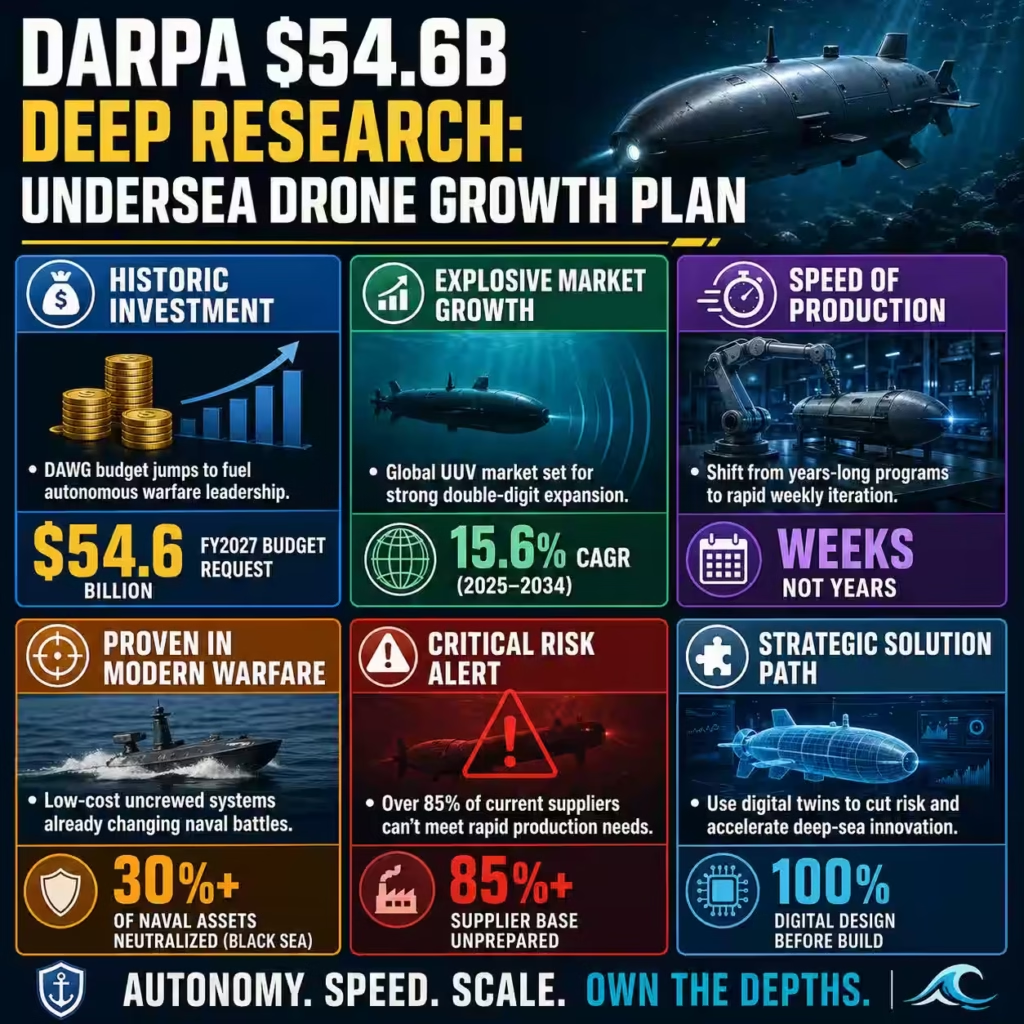
The Defense Advanced Research Projects Agency (DARPA) recently initiated a radical solicitation for the “Deep Thoughts” program to develop autonomous underwater drones using readily available commercial parts. This initiative signals a pivot toward an AI-first warfighting model supported by a staggering $54.6$ billion budget request for the Defense Autonomous Warfare Group (DAWG) in the 2027 fiscal cycle, representing a 24,166 percent increase from the group’s initial $225$ million allocation. The strategic pain point addressed is the traditional decade-long development cycle for undersea platforms which fails to keep pace with the breakneck speed of modern attrition-based warfare.
By demanding autonomous undersea vehicles (AUVs) that can be designed, produced, and iterated upon in weeks rather than years, DARPA aims to replicate the “drone dominance” seen in the 2024-2025 aerial theaters. Global military unmanned underwater vehicle (UUV) market valuations are consequently projected to surge from $5.8$ billion in 2025 to over $13.4$ billion by 2034, registering a compound annual growth rate of 15.6 percent. This shift transforms the deep ocean into a contested digital battleground where rapid scalability and the “Replicator” logic of mass production become the primary currency of maritime power.
High-authority analysis suggests that this transition marks the end of bespoke naval engineering and the dawn of software-defined maritime dominance. The solicitation specifically targets the “full-ocean depth” capability, meaning these low-cost units must survive pressures exceeding 15,000 pounds per square inch while remaining economically disposable. We are witnessing a fundamental restructuring of the Department of War’s investment portfolio, moving away from a few multi-billion dollar submarines toward hundreds of thousands of autonomous agents.
Current real-world data from the Black Sea theater confirms that low-cost uncrewed systems have already successfully neutralized over 30 percent of traditional naval surface assets in restricted waters. This fiscal realignment is not merely a budgetary shift but a recognition that the speed of iteration is now more lethal than the thickness of armor. The “Deep Thoughts” program represents the apex of this evolution, forcing a merger between silicon-valley agility and deep-sea military requirements.
Strategic Critique: Navigating the Technical and Fiscal Gaps
L-Impact Solutions views the “Deep Thoughts” solicitation as a high-risk, high-reward gambit that exposes significant structural gaps in current naval industrial base logic. The demand for “months or even weeks” in production timelines ignores the physical reality of pressure-vessel manufacturing and specialized deep-sea sensor calibration. While the U.S. Marine Corps has successfully leveraged 3D-printing for the HANX aerial drone, subsea environments impose hydrostatic pressures that common additive manufacturing materials cannot yet withstand at scale.
There is a glaring risk that relying on “readily available parts” will introduce sub-standard components into critical deep-sea mission sets, leading to high failure rates in hostile zones. Furthermore, the $54.6$ billion investment focuses heavily on hardware procurement while directing less than two percent toward doctrine and organizational integration. Without a corresponding shift in command structures, these autonomous swarms risk becoming expensive technological novelties rather than decisive strategic assets.
The transition from custom-built $10$ million Large Displacement UUVs (LDUUVs) to low-cost modular units requires a complete overhaul of the defense acquisition mindset which remains anchored in slow-moving legacy contracts. Current data indicates that over 85 percent of the current U.S. naval supplier base is unequipped to meet the rapid, iterative manufacturing cycles demanded by this new program. There is a critical gap between the Pentagon’s “Drone Dominance” vision and the reality of a supply chain that still relies on specialized components with 18-month lead times.
We also identify a major risk in the “Deep Thoughts” requirement for launch flexibility from submarines, ships, and planes. Integrating these diverse launch triggers requires a universal digital handshake that does not currently exist across the multi-branch military architecture. The fiscal concentration on procurement rather than “edge-intelligence” training means that the human element of the loop is being dangerously sidelined.
This critique emphasizes that spending billions on hardware without solving the fundamental physics of deep-sea connectivity is a recipe for operational paralysis. The industry must acknowledge that a “move fast and break things” approach has life-or-death consequences in the deep ocean. Failure to address these logistical and structural gaps will cause a fragmented autonomous fleet that cannot communicate or survive the harsh reality of the abyss.
| Related Analysis: TSLA $25B Capex Alert: Strengthen Cash Control Plan Intel 20% Surge: Does it Hide $2.5B Foundry Loss? Delta A350-1000 Expert Analysis: Smart Cash Flow Plan |
Strategic Solutions: Bridging the Undersea Autonomy Divide
The first solution involves the rapid adoption of a “multi-level secure digital engineering ecosystem” to facilitate collaborative, real-time prototyping between defense startups and established primes. This ecosystem must utilize AI-driven generative design to optimize pressure hulls for specific depths using non-traditional, COTS-compatible materials like advanced carbon-fiber composites. By leveraging digital twins during the design phase, manufacturers can simulate deep-sea performance before a single physical component is ever manufactured.
Second, manufacturers must pivot toward modular open systems architecture (MOSA) to ensure that subsea drones can be “hot-swapped” with new sensors as technology evolves. This prevents the “obsolescence trap” where a vehicle’s hardware outlasts its intelligence capabilities during a conflict. Current projections show that vehicles utilizing MOSA reduce lifetime maintenance costs by 40 percent while increasing mission readiness by 25 percent.
Third, private sector consultants recommend establishing “undersea micro-factories” located near naval deployment hubs to enable the 3D-printing of replacement parts and hull components in-house. This localized production model mirrors the success of the HANX program and reduces the logistical strain of transporting delicate AUVs across global theaters. These micro-factories should utilize automated quality control systems to ensure that 3D-printed parts meet the rigorous standards required for 6,000-meter depths.
Finally, integrating low-earth orbit (LEO) satellite constellations is essential for providing the wide-area communication links needed for swarm coordination. These satellite links can be paired with acoustic-to-optical gateways that allow AUVs to transmit data to the surface without exposing their location. Such a solution addresses the bandwidth bottleneck that currently limits UUV operations to low-data-rate acoustic pings.
Implementing these four strategic pillars will transform the AUV from a singular, precious platform into a scalable, disposable, and lethal network of sensors. By prioritizing software-led agility, the B2B sector can meet DARPA’s aggressive timelines while maintaining mission efficacy. This comprehensive approach ensures that the “Deep Thoughts” initiative delivers on its promise of rapid, iterative undersea warfare capability.
Proactive Prevention: Mitigating Future Subsea Operational Failures
To prevent future supply chain collapses, defense agencies must aggressively diversify the sourcing of critical materials like high-purity graphite and lithium-ion cells away from single-region dependencies. Recent data shows that China processes over 80 percent of battery-grade materials and 95 percent of spherical graphite, representing a fatal choke point for any mass-scale AUV production effort. Developing domestic processing facilities and prioritizing “lithium iron phosphate” (LFP) chemistries can mitigate these risks while lowering costs by $47$ per kilowatt-hour.
Prevention also requires the implementation of “Digital Twins” for every undersea unit to monitor structural integrity and predict mechanical failures before they occur in the deep ocean. This proactive maintenance schedule reduces the risk of losing high-value payloads due to simple seal failures or battery thermal runaways. Analytical models suggest that predictive maintenance can extend the operational life of small AUV fleets by 35 percent through optimized deployment cycles.
Additionally, the industry must develop robust “Counter-AUV” (C-AUV) protocols to protect friendly swarms from electronic jamming and acoustic spoofing. As the CobraJet C-UAS system has shown in the aerial domain, the cost of defense must be lower than the cost of the attack to ensure long-term fiscal sustainability. Proactive cyber-defense must include “zero-trust” architectures at the hardware level to prevent adversaries from hijacking autonomous fleets through digital backdoors.
We recommend that all COTS components undergo rigorous automated firmware auditing to identify vulnerabilities before they are integrated into the “Deep Thoughts” ecosystem. Future issues can also be prevented by mandating “at-sea” testing phases every four weeks to ensure that rapid iterations do not introduce systemic software bugs. This continuous testing loop creates a feedback mechanism that catches failures in months rather than at the end of a multi-year program.
Finally, establishing a “sovereign autonomy stack” ensures that the AI models governing these drones are not reliant on vulnerable cloud infrastructures. This defensive layering prevents the “Deep Thoughts” project from becoming a liability in a contested electromagnetic spectrum. By hardening the entire lifecycle, from material sourcing to edge-inference, we can ensure the long-term viability of autonomous subsea swarms.
L-Impact Solutions’ Key Takeaway
The era of the “Precious Platform” is over; the future belongs to the “Intelligent Swarm” that can be produced at the speed of software updates. Success in the subsea domain now depends on a company’s ability to master the intersection of rapid manufacturing and autonomous AI integration. We believe that the $54.6$ billion budget infusion represents the single largest opportunity for defense contractors since the Cold War, provided they can pivot to modularity.
To survive this transition, firms must abandon legacy 20-year development cycles in favor of the “weeks or months” timeline demanded by DARPA. Focus on the supply chain, secure your digital engineering pipelines, and prioritize COTS-based scalability over bespoke engineering. The deep ocean is no longer a hiding spot—it is a high-speed data environment where the fastest to iterate will dominate the depths.
Market players who fail to adapt to this “Software-First” procurement model will find themselves obsolete by the 2030 fiscal cycle. Your value proposition must move from selling a single hull to providing a scalable, networked capability. The mission is clear: innovate at the speed of threat or face irrelevance in the new autonomous maritime order.
FAQs:
How can DARPA’s $54.6 billion Deep Thoughts budget avoid becoming another slow defense spending cycle?
Without acquisition reform and rapid field testing, even $54.6 billion risks funding bureaucracy instead of battlefield-ready autonomous underwater capability.
Why is the projected $13.4 billion UUV market by 2034 still facing major operational pain points?
Market growth means little if suppliers cannot solve reliability, connectivity, and deep-sea survivability at scalable cost.
Can a 24,166% budget increase realistically fix decade-long submarine development delays?
Money alone cannot compress timelines unless legacy contracts are replaced with agile procurement and modular manufacturing systems.
Why are 18-month component lead times a serious threat to rapid AUV production goals?
Any warfighting model built on speed collapses when critical parts still move at peacetime industrial pace.
How should defense firms respond when 85% of naval suppliers are unequipped for iterative manufacturing?
Prime contractors must rapidly build startup partnerships, digital engineering networks, and micro-factory models or lose relevance fast.