Qantas Airways raised its second-half fiscal 2026 fuel cost outlook from A$2.2 billion to A$3.1 billion–A$3.3 billion after jet fuel prices doubled due to the Middle East war, causing oil markets to surge. This move, which also paused its share buyback, highlights severe margin pressure across the airline sector, where fuel is 25-30% of total costs.
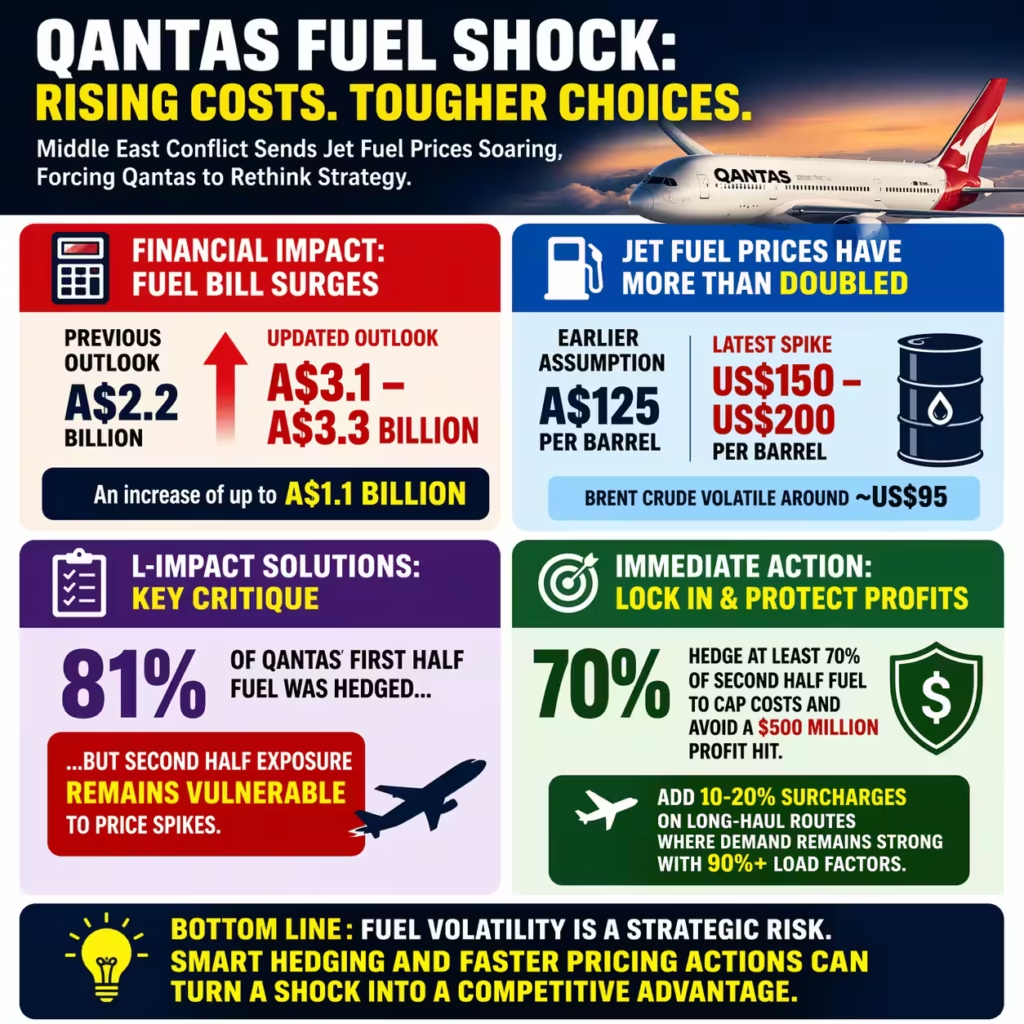
Global jet fuel prices have surged over 100% in the last month, nearing $150-$200 per barrel, while Brent crude has fluctuated around $95 amid volatility from ceasefires and Strait of Hormuz disruptions. The analysis that follows explores mitigation strategies like hedging and efficiency upgrades.
The escalation began with the Iran conflict in late February 2026 closing key shipping routes and stranding millions of barrels daily. Qantas now faces a potential 500 million dollar profit shock if the situation drags on according to recent market analysis. Industry wide the disruption could add 25 billion dollars in unbudgeted expenses for U.S. and global carriers this year alone.
Qantas reported strong first half fiscal 2026 results with underlying profit before tax at $1.456 billion and revenue at $12.9 billion. Yet the updated second half fuel bill reflects consumption of roughly 16.2 million barrels at current spot prices far above earlier assumptions of A125 per barrel. This reversal comes despite fleet modernization delivering 3.9% ASK growth and load factors holding above 90% on key European routes.
Analysts note Qantas shares extended losses following the announcement as investors priced in delayed capital returns. The airline had announced an on market buyback of up to A150 million in February alongside a 20% dividend hike to $300 million. Now both face uncertainty amid the fuel spike.
High authority analysis shows this case mirrors broader sector vulnerability exposed by the largest oil supply disruption in history. IATA data confirms jet fuel cracks widened dramatically with premiums up 132% year over year. Carriers without sufficient hedges or efficiency buffers see margins compress rapidly even as demand remains robust from post pandemic travel.
L-Impact Solutions Critique of Qantas Fuel Strategy
At L-Impact Solutions we view Qantas decision to pause its share buyback as a symptom of deeper strategic gaps that leave the airline exposed to repeated geopolitical shocks. The pain point is clear with jet fuel costs doubling in weeks and eroding the 1.456 billion dollar first half profit momentum achieved through capacity growth and fleet upgrades. This risks not only 500 million dollars in earnings pressure but also shareholder confidence after February commitments to return up to 450 million dollars in distributions.
Risks compound quickly in a low margin industry where fuel volatility can wipe out quarterly gains overnight. Qantas hedging covered 81% of first half needs but evidently fell short for second half exposure leaving it vulnerable to spot market spikes above 200 dollars per barrel. The critique highlights over reliance on traditional crude benchmarks without enough layered protection against refined product disruptions from Hormuz chokepoints.
Gaps appear in proactive scenario planning for Middle East tensions that have now driven Brent crude swings of 10 to 13% in single sessions. While Qantas excels in domestic market share and loyalty growth its international long haul routes consume disproportionate fuel without corresponding cost pass through speed. This creates a competitive disadvantage against carriers that raise fares immediately or cut unprofitable capacity.
Further the pause signals conservative capital allocation that may delay fleet renewal benefits from A321XLR and A350 deliveries already underway. Industry peers face similar 20% airfare hikes yet Qantas international load factors exceed 90% suggesting room exists for faster pricing adjustments. At L-Impact Solutions we see this as a missed opportunity to protect margins before they erode further into fiscal 2027.
Critically the strategy lacks visible diversification into sustainable aviation fuel or supplier partnerships that could insulate against future 100% price surges. With global airline profits projected at 41 billion dollars for 2026 under stable conditions the current shock threatens to reverse record load factors and ancillary revenue gains. Qantas strong balance sheet with net debt at 5.6 billion dollars offers buffer yet repeated pauses undermine the disciplined returns framework investors expect.
| Related Analysis: 0.5% USA Q4 2025 GDP Slump: Build Resilient Growth Strategy COHR 8.4% SiC Surge Targets AI Power Cost Crisis Capital One’s $5.15B Brex Deal: AI Platform Growth Playbook |
Qantas Fuel Volatility Solutions: Immediate Actions
Qantas and other major carriers are advised to immediately secure dynamic fuel hedging contracts, covering a minimum of 70% of second-half exposure. This measure is crucial for capping costs near the current $150 per barrel level and preventing further adverse profit impacts, potentially exceeding $500 million. The deployment of options and collars can offer protection against price spikes above $200 per barrel while retaining the potential to benefit if prices moderate toward $95 due to temporary ceasefires. This financial instrument will provide immediate margin stability without imposing rigid pricing across the entire fleet.
It is recommended to expedite fare adjustments and ancillary revenue initiatives, particularly on long-haul routes where fuel consumption is highest. Given the sustained high demand, with load factors surpassing 90% on European services, targeted surcharges of 10% to 20%, mirroring successful peer implementations, can be introduced. Simultaneously, efforts should focus on enhancing premium cabin yields and bundling services to mitigate the A$3.1 billion to A$3.3 billion fuel expenditure without compromising passenger volume.
Optimization of the network capacity is necessary through a review of underperforming routes and the reallocation of aircraft toward high-yield corridors. Following the example of some U.S. major airlines, the reduction of marginal flights over the next two quarters will conserve fuel for profitable sectors, while the introduction of A321XLR aircraft is expected to improve efficiency by 20% per seat. This operational realignment can transform the current challenge into a catalyst for a more streamlined deployment strategy.
Exploring short-term supplier partnerships for jet fuel from non-Middle Eastern sources, such as U.S. Gulf Coast refineries, is advisable to diminish vulnerability to disruptions in the Strait of Hormuz. Negotiating fixed-price contracts for 10% to 15% of the total volume will establish a physical hedge layer to complement the financial tools. Furthermore, piloting sustainable aviation fuel blends on select flights will allow the carrier to capture green premiums and government credits, thereby lowering net operating costs.
Transparent communication with investors regarding these strategic actions is imperative to restore confidence following the pause in the share buyback program. Highlighting the robust A$1.8 billion operating cash flow and A$12.6 billion liquidity positions the airline as proactive rather than reactive. These immediate steps are designed to preserve shareholder value while creating time for the implementation of longer-term prevention measures.
Qantas Future Fuel Risk Prevention: Proactive Measures
Future volatility is mitigated through the establishment of a multi-year fuel resilience plan, which incorporates a 30% Sustainable Aviation Fuel (SAF) adoption target aligned with fleet modernization initiatives. Strategic investment in domestic SAF production partnerships secures supply at anticipated premium levels and qualifies for carbon credits, thereby reducing the net annual fuel expenditure, currently at A$5.11 billion, over the long term. This strategic pivot provides a safeguard against the refined product volatility that resulted in a doubling of prices in March 2026.
Quarterly geopolitical scenario planning should be conducted with external experts to model potential oil price fluctuations between $80 and $130, and to predefine triggers for capacity, fares, and hedging strategies. Crude sourcing is diversified across multiple regions to mitigate single points of failure, such as the Strait of Hormuz, which previously jeopardized 20% of global supply. The team establishes financial resilience by aiming for net debt at the lower bound of the $5.6 billion to $7.0 billion range, even amidst periods of strategic growth.
Fuel efficiency metrics are integrated into all major capital expenditure decisions, spanning from aircraft procurement to route network optimization. While current A350 and A321 programs already yield efficiency gains, the organization is expediting retrofit programs on older aircraft to achieve an additional 5 to 10% reduction in fuel consumption. Furthermore, electric or hybrid ground support operations are being explored at key hubs to minimize non-flight fuel usage.
Supplier contracts are being fortified with comprehensive escalation clauses and joint venture agreements that facilitate shared risk during periods of disruption. A dedicated Fuel Risk Committee, which reports directly to the Board of Directors, is maintained to ensure rigorous accountability. These proactive measures transition volatility from an existential threat to a managed variable, safeguarding the organization’s 3.9% margin targets through 2027 and beyond.
Technology is being leveraged to enable real-time fuel monitoring and deploy predictive analytics capabilities that provide early identification of price anomalies. Procurement teams receive specialized training in advanced derivatives and physical commodity trading to ensure hedging strategies remain anticipatory of market movements. This preemptive approach preserves the strong performance demonstrated in the first half of fiscal year 2026 and positions Qantas as an industry vanguard in cost resilience.
L-Impact Solutions Key Takeaways on Qantas Challenges
At L-Impact Solutions we believe Qantas must treat this A3.3 billion fuel surge and buyback pause as a defining moment that demands total transformation of its energy strategy or risk permanent erosion of the margin gains built over recent years. The Middle East war has exposed how quickly doubled jet fuel prices can wipe out 500 million dollars in projected profit and delay shareholder returns yet the airline’s robust cash flow and fleet investments give it every tool needed to emerge stronger. We urge immediate aggressive hedging combined with accelerated efficiency and SAF adoption to transform vulnerability into competitive advantage.
You cannot afford to repeat reactive pauses when volatility becomes the new normal in global oil markets. Our analysis shows carriers that act decisively on hedging and pricing preserve investor trust while others lag. Qantas proven demand resilience across domestic and international routes provides the perfect foundation for these changes.
In our view proactive prevention through diversified supply scenario planning and board level oversight will secure sustainable returns well beyond fiscal 2026. The industry faces 25 billion dollars in extra costs this year alone but leaders who embed resilience now will capture market share as weaker players falter. L-Impact Solutions stands ready to partner with Qantas on tailored implementations that deliver measurable margin protection and long term value creation.
Reference – Qantas lifts fuel cost forecast as Middle East war jolts oil markets