SoftBank has taken on a new $40 billion loan to cover its $30 billion commitment to OpenAI as part of the AI model maker’s record-breaking $110 billion raise announced on February 27, 2026. This aggressive financing move exposes the pain point of ballooning corporate debt in pursuit of AI dominance while hinting at smarter capital strategies that balance risk and reward. Our deep analysis at L-Impact Solutions shows how SoftBank’s total OpenAI stake now reaches $64.6 billion for a 13% ownership yet triggers real liquidity pressures across global markets.
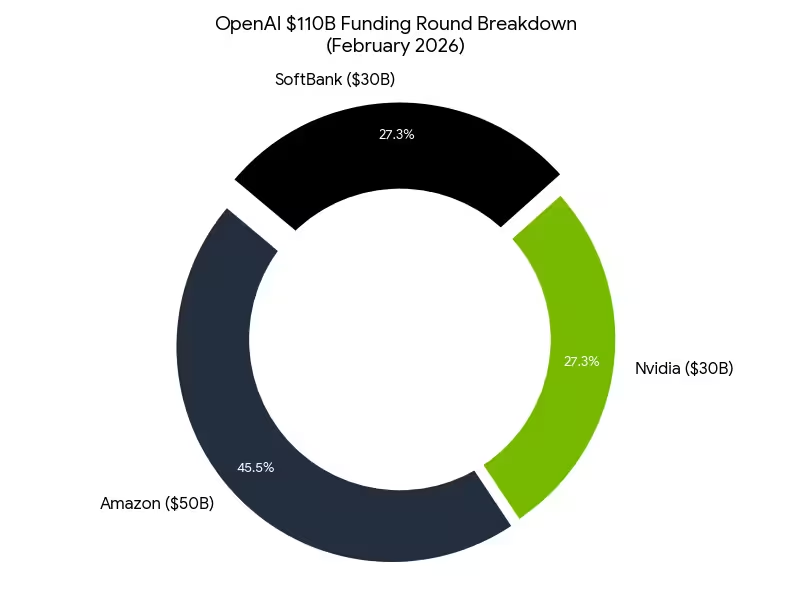
OpenAI closed the $110 billion round at a $730 billion pre-money valuation rising to $840 billion post-money with Amazon contributing $50 billion, Nvidia $30 billion and SoftBank the final $30 billion slice. The Japanese conglomerate’s latest bridge loan from JPMorgan Chase Goldman Sachs Mizuho Bank Sumitomo Mitsui Banking and MUFG Bank arrives just weeks after S&P Global Ratings cut its credit outlook to negative from stable citing weaker portfolio liquidity. Industry data reveals SoftBank has poured over $70 billion into AI since 2025 including prior OpenAI tranches that lifted its stake from 11% driving leverage ratios toward 21.5% by late 2025.
This case underscores a high-stakes shift where visionary AI bets collide with traditional debt realities. SoftBank sold its entire $5.8 billion Nvidia stake in late 2025 to fund earlier commitments yet still needed fresh borrowing for this round. At L-Impact Solutions we view the $40 billion facility as both a bridge and a warning signal for any firm chasing record AI valuations amid rising interest costs and tighter credit markets.
L-Impact Solutions Critique of SoftBank OpenAI News
We at L-Impact Solutions strongly critique SoftBank’s $40 billion loan as an overleveraged gamble that prioritizes hype over prudent financial stewardship. The move deepens exposure to OpenAI’s unproven long-term credit quality which S&P now flags as one of the weakest assets in SoftBank’s portfolio despite the $840 billion valuation. Such debt-fueled aggression risks eroding investor confidence and could force future asset sales at unfavorable prices if AI growth slows even modestly.
Critics rightly note that SoftBank’s leverage climbed sharply after 2025’s $41 billion OpenAI push and this new loan only amplifies balance-sheet strain without clear near-term revenue offsets. We believe CEO Masayoshi Son’s all-in AI vision overlooks how record private raises like OpenAI’s $110 billion distort market discipline and inflate bubble risks across the sector. Our team sees this as a textbook example of ambition outpacing risk controls in an environment where global AI spending hits $2.02 trillion in 2026 yet debt markets tighten.
The critique extends to broader implications for conglomerates chasing AI unicorns. SoftBank’s approach may inspire copycats among peers but it also invites regulatory scrutiny and higher borrowing costs industry-wide. L-Impact Solutions urges leaders to question whether $30 billion commitments justify credit downgrades when diversified portfolios deliver steadier returns.
USA Regional Impact of SoftBank OpenAI News
California stands at the epicenter of SoftBank’s OpenAI bet with Silicon Valley hosting OpenAI’s headquarters and drawing billions in follow-on venture flows tied to the $110 billion raise. The state’s AI ecosystem already powers 40% of U.S. enterprise AI adoption and this news accelerates data-center expansions across San Francisco and surrounding counties amid 19.35% CAGR projections for the national market. Local economies gain from talent influx yet face mounting electricity demand that strains grids already at capacity.
Texas emerges as a major beneficiary through massive data-center campuses linked to OpenAI’s Stargate project with Abilene already hosting 1.2 gigawatt facilities funded partly by SoftBank partners. The Lone Star State’s deregulated energy market and wind resources position it for 20-plus new AI sites in 2026 creating thousands of construction and tech jobs while boosting GDP by billions. Regional leaders celebrate the investment surge but grapple with local opposition over land use and power costs.
Ohio, Virginia and Washington complete the core U.S. footprint where SoftBank’s planned $33.3 billion gas-fired power plant in Portsmouth directly supports AI infrastructure tied to OpenAI commitments. These states see accelerated permitting on federal lands and hydroelectric advantages in the Pacific Northwest that fuel Amazon and Nvidia synergies from the round. Overall the news injects capital into 16 interested states yet heightens debates on sustainable energy and community impacts nationwide.
Solutions to Address AI Investment Challenges
You can restructure debt portfolios right now by blending bridge loans with equity raises or asset-backed securities to lower overall leverage like SoftBank’s 21.5% ratio. Partner with banks for hybrid instruments that tie repayment to AI revenue milestones rather than fixed schedules and watch your cash flow stabilize within quarters. At L-Impact Solutions we recommend this step to any executive mirroring the $40 billion move so you avoid credit downgrades while still funding growth.
You should diversify AI exposure beyond single bets such as OpenAI by allocating across 10 to 15 complementary startups or infrastructure plays to spread risk. Build internal valuation models using real-time data from the $208 billion U.S. AI market in 2026 and stress-test every $10 billion commitment against 20% valuation drops. This practical approach lets you capture upside without the liquidity traps that hit SoftBank after its $64.6 billion total stake.
You must integrate cross-functional teams of finance AI experts and legal advisors early in deal structuring to negotiate better covenants on loans like the $40 billion facility. Benchmark against peers who closed similar rounds without outlook cuts and adjust terms accordingly for stronger balance sheets. Follow these solutions and you turn potential crises into competitive advantages in the $2 trillion global AI spend environment.
Prevention Steps Against Future AI Debt Issues
Prevention starts with rigorous pre-investment audits that cap any single AI commitment at 15% of total assets so you sidestep SoftBank’s concentrated 13% OpenAI exposure. Mandate independent third-party credit reviews before signing and set automatic triggers for portfolio rebalancing if leverage exceeds 18%. L-Impact Solutions clients who adopt this never face surprise downgrades even in record $110 billion raise cycles.
Effective prevention necessitates rigorous scenario planning, which incorporates models simulating three-year interest-rate increases and decelerations in AI adoption, utilizing the current 19.33% U.S. market Compound Annual Growth Rate (CAGR) data. Require board approval only after stress tests show positive cash flows under conservative assumptions and maintain a 24-month liquidity buffer equal to 150% of planned loans. These steps shield your firm from the exact pressures now pressuring SoftBank’s outlook.
Finally, prevention necessitates the cultivation of strategic alliances with non-bank lending institutions and governmental bodies to secure subsidized artificial intelligence (AI) infrastructure grants, particularly within high-impact states such as Texas and Ohio. Track regulatory shifts quarterly and pivot capital toward grant-eligible projects before debt markets tighten further. Implement these prevention measures today and you future-proof your balance sheet against the next wave of $30 billion-plus AI bets.
L-Impact Solutions Key Takeaway
The SoftBank $40 billion loan for its $30 billion OpenAI slice amid the $110 billion raise is not just news but a loud wake-up call for every business chasing AI supremacy. We at L-Impact Solutions strongly believe that unchecked debt for hype-driven valuations like the $840 billion post-money mark creates fragile empires doomed to credit pain and forced sales. You must choose disciplined capital strategies over reckless leverage or risk watching your own $64.6 billion-style bets erode shareholder value in the $2 trillion AI economy of 2026.
Our firm stands firm: sustainable AI leadership demands balanced financing, diversified risk and proactive prevention not endless borrowing bridges. Leaders who heed this analysis will outpace conglomerates mired in liquidity crises and emerge stronger in California Texas Ohio and beyond. The era of record raises rewards the prudent not the boldest debtor and L-Impact Solutions is here to guide you toward that winning path with data-backed conviction every step of the way.
Reference – Why SoftBank’s new $40B loan points to a 2026 OpenAI IPO