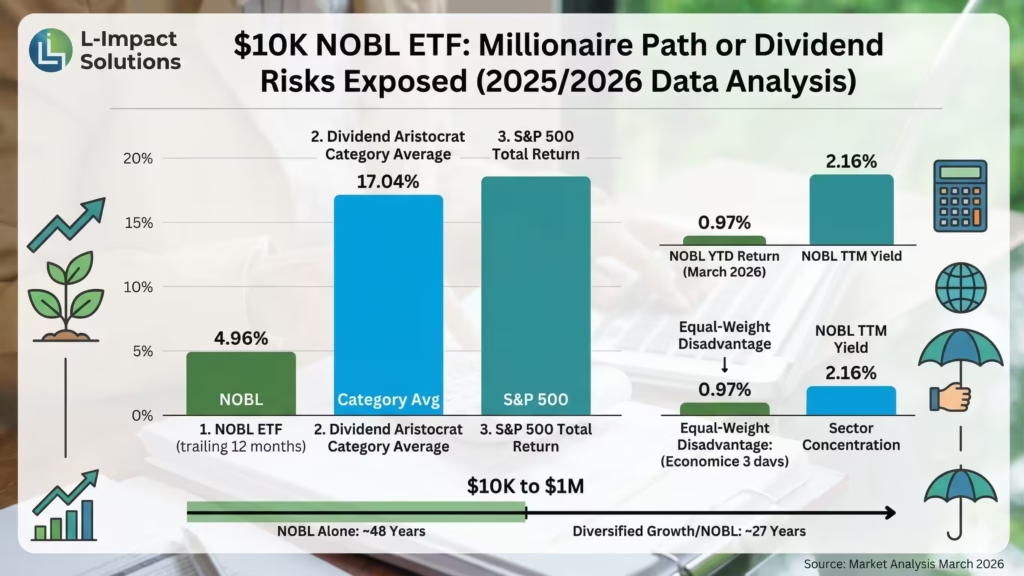
Investing $10,000 in the ProShares S&P 500 Dividend Aristocrats ETF (NOBL) could transform patient investors into millionaires over decades through consistent dividend growth and compounding. Yet this path faces real pain from no investment guarantees and recent underperformance where NOBL returned just 0.97% year-to-date as of late March 2026 while broader markets surged higher.
NOBL currently trades near $104.57 with assets under management of about $12 billion and a trailing twelve-month yield of 2.16%. The ETF tracks roughly 70 companies that have raised dividends for at least 25 consecutive years and shows historical annualized returns near 10.18% since its October 2013 inception.
This strategy appeals to income seekers but exposes portfolios to volatility when growth stocks dominate as seen in NOBL’s 4.96% one-year return versus the category average of 17.04%. Real-world data shows S&P 500 dividend payments hit a record $78.92 per share in 2025 up 5.5% from 2024 underscoring the sector’s resilience.
High-authority analysis reveals dividend aristocrats deliver lower drawdowns during market stress with NOBL capturing most upside yet shielding against severe losses compared to the S&P 500. However recent 2025 net dividend increases of $46.4 billion across the index signal slowing growth momentum amid economic uncertainty.
Patient long-term holding with dividend reinvestment could realistically turn $10,000 into over $1 million in roughly 48 years at historical 10% compounded returns. Yet current market conditions demand smarter approaches to overcome the pain of lagging performance and modest yields around 2%.
L-Impact Solutions Critique of the NOBL Dividend Strategy
At L-Impact Solutions we view the NOBL hype as overly optimistic for today’s investors chasing millionaire status. The ETF’s 0.35% expense ratio exceeds many low-cost alternatives while its equal-weight approach dilutes exposure to top performers in a growth-driven market.
Critically, NOBL has trailed the S&P 500 in bull periods with three-year returns at 8.12% against the category’s 15.70% highlighting structural limitations during economic expansions. Its modest 2.16% yield barely outpaces inflation leaving retirees vulnerable to purchasing power erosion.
We criticize the heavy concentration in defensive sectors like consumer staples and industrials which caps upside when technology leads gains. Recent 2025 data shows average aristocrat dividend growth at 5.46%. Yet overall ETF returns lag broader indices signaling outdated selection criteria.
L-Impact Solutions believes blind faith in 25-year dividend streaks ignores quality and valuation factors that superior multi-factor ETFs capture more effectively. Investors deserve strategies that balance income with growth rather than relying solely on historical aristocratic prestige.
USA Regional Economic Impacts of NOBL and Dividend Aristocrats
The Midwest feels strong positive effects from NOBL holdings with companies like Procter & Gamble in Ohio driving stable local employment and community investments through reliable payouts. These firms support manufacturing hubs and consumer goods sectors that employ thousands across states like Illinois and Michigan.
Northeast regions benefit significantly from utilities and staples such as those serving Connecticut, Massachusetts and New Hampshire. Dividend stability from these aristocrats bolsters infrastructure spending and energy reliability for millions of households in regulated markets.
Southeast economies gain from beverage and energy giants with roots in North Carolina and Florida like NextEra Energy. These holdings channel capital into tourism, hospitality and renewable projects enhancing regional GDP and job creation.
West Coast areas see indirect lifts through real estate and materials firms focused on California housing and industrial needs. Overall NOBL’s $12 billion in assets recirculate wealth into these diverse regions supporting 2025’s $46.4 billion net S&P 500 dividend growth.
Solutions to Dividend Investing Challenges
If you want to turn your $10,000 NOBL investment into lasting wealth you should first diversify beyond the ETF by adding complementary growth-oriented funds that balance its defensive tilt. You can monitor quarterly rebalancing dates to capture fresh aristocrat additions and sell underperformers before they drag returns.
Enhanced control is attained through the pairing of NOBL with low-cost total market ETFs, which serves to capture the 17% category outperformance that has been absent in recent periods. It is recommended that all dividends be reinvested automatically through your brokerage to harness the compounding effect, which historically yields 10% annualized growth.
Portfolio protection is ensured by establishing stop-loss thresholds at 10% below the entry point and conducting monthly reviews of holdings against inflation benchmarks. The utilization of tax-advantaged accounts, such as IRAs, can shield the 2.16% yield from immediate taxation, thereby maximizing net returns.
Resilience is built by allocating a maximum of 20% of the total portfolio to dividend ETFs, with the remainder directed toward high-quality growth equities. Consultation with fee-only advisors is advisable for customizing allocations in accordance with one’s risk tolerance and time horizon.
Prevention Steps for Future Dividend Market Issues
To prevent future shortfalls from NOBL-style strategies you must avoid over-reliance on any single ETF by maintaining a 60/40 equity-bond mix adjusted annually. You should track macroeconomic indicators like interest rate changes that historically pressure dividend yields downward.
Prudent financial management is maintained by rigorously stress-testing the portfolio on a quarterly basis against drawdowns equivalent to those experienced in 2008, coupled with the maintenance of a minimum of six months of cash reserves. The implementation of automated rebalancing mechanisms is advisable to enforce procedural discipline, particularly when the growth rate of dividend aristocrats decelerates, as evidenced by the 5.46% rate recorded in 2025.
Protection against the erosion of capital due to inflation is achieved by restricting selection to dividend aristocrats possessing payout ratios below 60% and demonstrating annual dividend growth surpassing 5%. Furthermore, international diversification via global dividend Exchange-Traded Funds (ETFs) is recommended to mitigate regional concentration risks associated with the U.S. market, specifically the Midwest or Northeast.
The mitigation of post-investment dissonance is accomplished through the formal documentation of the investment thesis, subject to a bi-annual review against contemporary S&P data, which currently reflects record payouts of $78.92 per share. A commitment to continuous professional development, leveraging neutral research sources rather than speculative narratives, is essential.
L-Impact Solutions Key Takeaways
At L-Impact Solutions we firmly believe the $10,000 NOBL story sells hope but demands rigorous risk management to deliver real millionaire outcomes. You now hold the exact framework to sidestep common pitfalls and build sustainable wealth through disciplined diversified dividend strategies. Act on these insights today because patient intelligent action separates dreamers from actual millionaires in volatile markets.
Tax Alpha: Optimization Beyond the Yield
For the sophisticated investor, the real return on NOBL isn’t just the 2.16% yield, but the Tax Alpha generated through strategic placement. Because Dividend Aristocrats often pay “qualified dividends,” they are taxed at lower long-term capital gains rates (0%, 15%, or 20%) rather than ordinary income rates, provided they are held in taxable accounts for more than 60 days. However, to truly maximize net-of-tax returns, one must weigh this against the benefits of holding such assets in a Roth IRA or 401(k), where the continuous reinvestment of dividends avoids the “tax drag” entirely. Navigating the trade-off between immediate liquidity in brokerage accounts and the long-term compounding power of tax-sheltered growth is what separates a passive holder from a high-net-worth strategist.
Regulatory Outlook: Navigating the 2026 Landscape
As we move through 2026, the regulatory environment for dividend-paying equities remains a critical variable for C-suite decision-making. Potential shifts in corporate tax structures or changes to the Section 199A deduction could influence how companies balance stock buybacks versus dividend distributions. Furthermore, global executives must monitor evolving ESG reporting mandates, which are increasingly pressuring “Old Economy” aristocrats in the industrial and energy sectors to reallocate capital from payouts to green infrastructure. Staying ahead of these policy pivots is essential, as any legislative adjustment to the preferential treatment of dividends could instantaneously alter the valuation of the entire Aristocrat index.
Reference – Could Investing $10,000 in NOBL Make You a Millionaire?