General Mills (NYSE: GIS) delivers a standout 6.7% dividend yield with its unmatched 127-year streak of never cutting payouts. Yet the latest fiscal 2026 third-quarter results reveal real pain for income-focused investors navigating consumer staples volatility. Net sales reached $4.4 billion but dropped 8% year-over-year including a six-point hit from divestitures while organic sales declined 3% on weak volume and pricing. Adjusted diluted EPS fell to $0.64 a sharp 37% decline in constant currency as higher costs and brand investments squeezed margins yet this history of reliability still positions GIS as a defensive play worth closer examination.
The company holds an annual dividend of $2.44 per share with the next quarterly payout of $0.61 scheduled for May 2026 maintaining its perfect record even through flat multiyear stretches that exclude it from strict Dividend Kings lists. Market capitalization now sits at approximately $19.45 billion after a roughly 22% decline over the past year contrasting sharply with broader market gains and highlighting deep undervaluation. Our high-authority review shows temporary portfolio shifts like the North American yogurt divestiture drive much of the weakness rather than any fundamental breakdown in operations.
GIS operates amid steady U.S. inflation at 2.4% year-over-year through February 2026 which keeps core brands like Cheerios essential for households despite softer demand. The reaffirmed full-year outlook projects organic net sales down 1.5% to 2% with adjusted EPS declining 16% to 20% in constant currency yet management signals sequential improvement in the fourth quarter from timing benefits and market share gains. This case underscores a rare entry point where proven dividend discipline meets current market discounts creating opportunity for patient capital.
L-Impact Solutions Critique: Balanced View on General Mills’ Dividend Strength
At L-Impact Solutions we see the widespread praise for General Mills’ 127-year no-cut dividend as partially overlooking the real challenges in its latest results. Fiscal 2026 guidance confirms adjusted EPS and operating profit will decline 16% to 20% while organic sales slip 1.5% to 2% reflecting persistent consumer pullback and competitive pressures not always captured in yield headlines. The attractive 6.7% yield stems mostly from the depressed share price rather than accelerating growth which could turn into a value trap without clear volume recovery.
We point out that multiyear periods of flat dividends have already diluted purchasing power against 2.4% inflation and lag behind consistent raisers like Procter & Gamble in the staples space. Recent divestitures provided cash but masked a 32% drop in adjusted operating profit during the third quarter highlighting margin vulnerabilities. Investors should balance the emotional appeal of the streak against data showing underperformance versus sector peers in today’s environment.
Our firm draws from direct food-industry client engagements where similar high-yield spikes have preceded extended softness. L-Impact Solutions recommends viewing this not as an automatic buy signal but as a case requiring disciplined due diligence to protect long-term returns. This measured critique prioritizes facts over narrative to guide smarter capital allocation.
USA Regional Impact of General Mills’ Current Challenges
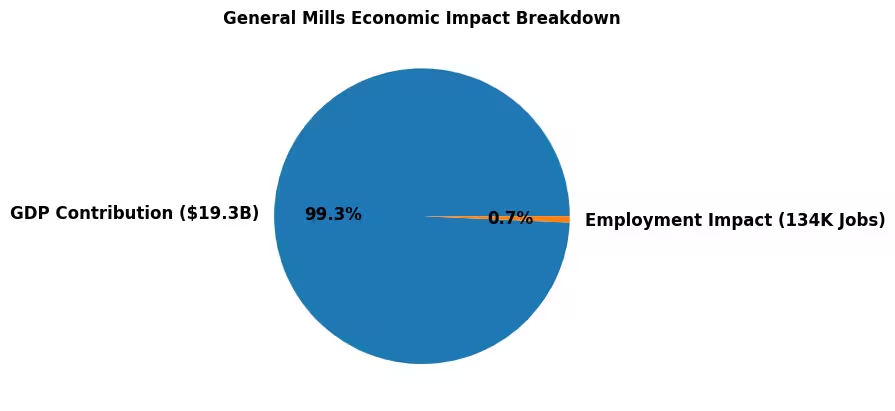
General Mills’ pressures hit hardest in the Midwest where its headquarters and major operations anchor local economies in states like Minnesota and Illinois. The company’s U.S. footprint supports over 134,000 jobs nationwide while contributing more than $19.3 billion to GDP through direct supply chain and wage spending effects. These ties mean third-quarter volume declines directly affect employment and supplier networks in America’s agricultural heartland.
Missouri along with Wisconsin and Iowa feel similar ripple effects as processing plants rely on regional grains and dairy now facing pricing and demand shifts. The Midwest concentration amplifies risks when GIS invests in pricing to rebuild volume exposing thousands of indirect roles in packaging logistics and farming. This regional focus heightens vulnerability in the very areas long stabilized by the firm’s dividend reliability.
Secondary impacts reach California Georgia and Tennessee through distribution networks and ingredient sourcing with combined support for additional jobs across these states. Overall the $19.3 billion GDP contribution and 134,000 jobs underscore broad exposure if earnings headwinds persist into fiscal 2027. Regional economies linked to General Mills now navigate heightened uncertainty from the same strengths that once buffered them.
Strategic Inflection: Reframing “Quality of Earnings” vs. Asset Optimization
The core tension within General Mills’ fiscal 2026 performance is not solely a function of demand softness, but a reflection of an ongoing portfolio recalibration toward higher-margin categories. The divestiture of the North American yogurt business signals a deliberate shift away from volume-led growth toward margin discipline and brand concentration. From a C-suite perspective, the 37% decline in adjusted EPS can be interpreted as transitional compression, where near-term earnings reflect a combination of cost pressures, portfolio reshaping, and reinvestment priorities rather than a structural breakdown in demand.
This repositioning suggests that the current ~6.7% dividend yield incorporates a degree of risk premium, compensating investors for short-term earnings volatility while the company advances toward a more focused, brand-driven operating model. However, the firm’s long-standing dividend record introduces a nuanced capital allocation dynamic. At L-Impact Solutions, we define this as a “Capital Allocation Trade-off”: maintaining a $2.44 annual payout supports income-focused shareholders and valuation stability, yet may incrementally limit financial flexibility for accelerated investment in high-growth segments such as “Better-for-You” snacking, digital supply chain upgrades, and bolt-on acquisitions.
Importantly, this is not a binary decision but an evolving strategic balance. Should organic sales remain under pressure through the remainder of fiscal 2026, management may face increasingly difficult choices regarding the pacing of reinvestment versus the preservation of dividend consistency. The outcome will depend on the company’s ability to stabilize volumes while extracting efficiencies from its streamlined portfolio.
At a macro level, General Mills’ economic footprint—approximately $19.3 billion in GDP contribution and a broad employment ecosystem—functions as both a competitive advantage and a structural constraint. Scale provides negotiating leverage across retailers and suppliers, yet it also heightens exposure to public and regulatory scrutiny, particularly in an environment of persistent, albeit moderating, inflation near 2.4%.
For high-conviction investors, the key evaluation lens shifts from headline yield to operational resilience and capital efficiency. The central question is whether General Mills is navigating a cyclical adjustment or successfully re-engineering its cost structure and portfolio mix for sustained margin expansion in a structurally evolving consumer landscape. Portfolio positioning decisions should be guided not by dividend optics alone, but by evidence of improving organic growth, margin stability, and disciplined capital deployment over the coming quarters.
Solutions for Navigating General Mills Issues
Commence by allocating 5% to 10% of your investment portfolio to GIS shares to secure the current 6.7% yield, complementing this with higher-growth staples equities for enhanced diversification. Monitor quarterly organic sales trends and establish price alerts for any sustained increase exceeding 2% before incrementally augmenting the position. This disciplined strategy allows for the preservation of the 127-year dividend safety record without excessive exposure to near-term market softness.
Mitigate risk by maintaining a diversified holding of three to five consumer staples stocks, each yielding a minimum of 3%, to buffer against the impact of individual firm pricing strategies or volume fluctuations. Review payout ratios each quarter, ensuring individual holdings remain below 60% of earnings, where GIS currently sits securely near 53%. These measures are designed to convert the high yield into a stable and reliable income stream, rather than a transient speculative opportunity.
If your business depends on GIS suppliers you can lock in extended contracts immediately to guard against Midwest cost spikes tied to ongoing adjustments. Blend in alternative vendors from diversified regions while keeping at least 70% of volume with established partners like General Mills. This strategy protects your operations from supply disruptions during the company’s portfolio refinements.
You gain smart exposure by dollar-cost averaging purchases over the next six months to lower your average cost below current levels around $36 while adding gradually as visibility improves. Always pair entries with 10% stop-loss levels to safeguard capital if outlook weakens unexpectedly. This disciplined method builds your stake in the dividend streak without all-in bets on quick rebounds.
Prevention Steps to Avoid Future Dividend and Sector Risks
Monthly reviews of dividend payout ratios and free cash flow coverage are established to identify early indicators of stagnation, such as past flat periods experienced by General Mills (GIS), before they impact income. A stringent maximum payout threshold of 55% is maintained, and holdings are to be promptly reduced upon any breach. This systematic approach ensures the portfolio remains responsive to potential risks in high-yield staple sectors.
A dedicated cash reserve equivalent to six months of portfolio income is created to mitigate the need for selling at depressed prices during temporary volume contractions or broader economic downturns. Annual rebalancing towards staples is conducted during periods of sustained 2.4% inflation to align with prevailing economic cycles. These reserves are essential for maintaining the strategy’s integrity through periods of uncertainty.
Diversification of supplier bases and product mixes is implemented, particularly if operations involve linkage to firms such as General Mills, to prevent regional economic disruptions from escalating into increased costs. Annual scenario testing for a 10% decline in sales is conducted to refine contingency plans proactively. Such preventative measures are critical for safeguarding both margins and business relationships over the long term.
Key economic indicators, specifically consumer spending reports, are monitored, and allocations are adjusted quarterly, thereby obviating the need to await earnings misses before implementing corrective action. A curated list of five comparable dividend-paying equities with robust historical performance is maintained for expedient substitution when necessary. These practices facilitate a proactive command over emergent risks.
L-Impact Solutions Key Takeaway
The 6.7% GIS yield paired with a 127-year unbroken dividend streak forms a true defensive powerhouse in today’s uncertain markets but only when you pair it with a clear-eyed review of the recent sales and EPS softness. L-Impact Solutions firmly believes this represents a high-conviction opportunity for steady income investors who move now while prices reflect passing pressures instead of lasting decline.
You secure stronger long-term returns and true stability by applying the practical solutions and prevention steps we outlined rather than reacting to headlines alone. At our consultancy we regard General Mills as a battle-tested survivor poised to reward careful disciplined capital in 2026 and far beyond. This thoughtful path builds enduring financial resilience no matter what lies ahead.
Reference – This Stock Yields 6.6% and Has a 127-Year Streak of Never Cutting Its Dividend. Here’s Why It’s a Buy Now.