UiPath is down 87% from its all-time highs near $85 and shows little sign of improvement, with the stock dropping more than 35% in 2026 alone as of April. This decline has resulted in the erasure of over $50 billion in market value since 2021, culminating in the current share price of $11.24 and a market capitalization of approximately $6 billion. At L-Impact Solutions, we see this as a classic case of market disconnect where solid fundamentals clash with investor fear over AI disruption.
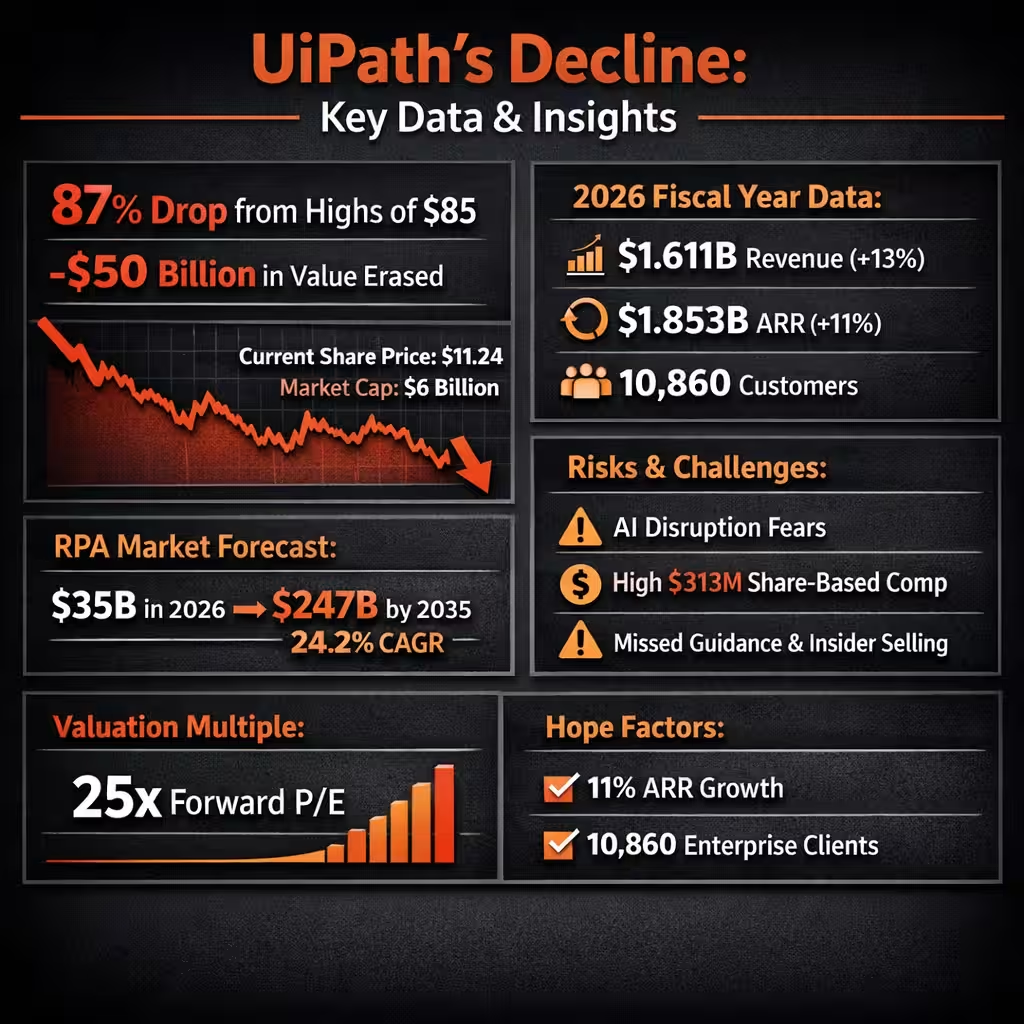
The company delivered full-year fiscal 2026 revenue of $1.611 billion, up 13% year-over-year, while Q4 revenue hit $481 million with 14% growth. Despite achieving strong financial and customer growth, with annualized recurring revenue (ARR) climbing 11% to $1.853 billion and the customer base expanding to over 10,860, the company’s stock was penalized by Wall Street. This was driven by the company’s guidance, which projected slower future expansion. The market reaction reflects current macroeconomic uncertainty and a noticeable shift in enterprise spending priorities towards solutions focused purely on generative AI. The company maintained a solid dollar-based net retention rate of 107%.
RPA market size stands at approximately $35 billion in 2026 and is forecasted to reach $247 billion by 2035 at a 24.2% CAGR, driven by AI-powered automation in finance, healthcare, and manufacturing. Despite UiPath’s Gartner Magic Quadrant leadership, its valuation of just 25x forward non-GAAP earnings is significantly lower than software peers. This gap highlights how perception of competitive threats has overshadowed UiPath’s agentic AI progress with its Maestro platform and recent WorkFusion acquisition.
Pain hits hardest for long-term holders who bought at IPO levels, watching enterprise automation demand surge while shares languish. North America still commands 39% of the global RPA market, but Asia-Pacific grows fastest at 34.5% CAGR as SMEs adopt cloud-native bots. The existence of sticky demand for UiPath is evidenced by its 2,506 large accounts, each generating over $100,000 in Annual Recurring Revenue (ARR). However, the dramatic 87% drawdown in the stock price suggests a significant failure in the broader investment narrative.
Our high-authority analysis shows the drop stems less from execution failure and more from sector rotation. Hyperscalers like Microsoft and Amazon redirect budgets to AI agents that promise end-to-end autonomy without traditional RPA scripting. UiPath’s high share-based compensation of over $300 million annually further pressures margins during this transition. Still, the company’s clean balance sheet and 11% ARR growth position it for rebound if it accelerates agentic AI storytelling.
This case study reveals a textbook opportunity in distressed tech leaders. While 2026 YTD performance sits at negative 31%, UiPath’s remaining performance obligation of $1.475 billion signals backlog strength. The pain point is clear: temporary valuation compression amid AI hype cycles. In the sections ahead, we outline exact solutions you can apply today to protect or grow your position in RPA leaders like UiPath.
L-Impact Solutions’ Critique: Pain Points, Risks, and Gaps Exposed
UiPath’s 87% plunge exposes critical vulnerabilities that investors and RPA adopters can no longer ignore. Revenue growth slowed to 13% in fiscal 2026 despite a booming $35 billion RPA market, revealing execution gaps in communicating AI upside. At L-Impact Solutions, we interpret this situation as a self-imposed narrative vulnerability where robust metrics, such as the $1.853 billion Annual Recurring Revenue (ARR), are overshadowed by wider concerns regarding the reallocation of AI budgets.
High share-based compensation exceeding $313 million in trailing periods inflates costs and dilutes shareholders without delivering proportional growth acceleration. Competition from Automation Anywhere, Microsoft Power Automate, and emerging AI-first agents threatens UiPath’s deterministic RPA core. Current enterprise spending is increasingly being directed towards hyperscaler platforms, which makes UiPath’s 11% Annual Recurring Revenue (ARR) growth appear modest when compared to the sector’s projected Compound Annual Growth Rate (CAGR) exceeding 24%.
Macro risks are exacerbating the situation, with guidance citing uncertainty in the U.S. public sector, and spending cuts related to DOGE significantly affecting a critical business vertical. The repeated failure to meet guidance and substantial insider selling have severely damaged trust, contributing to the 2026 stock decline exceeding 31%. The gap lies in slow monetization of agentic AI features despite Maestro launches and healthcare-specific bots announced in February 2026.
Valuation compression to 16 times 2026 earnings ignores UiPath’s 10,860 customers and 333 million-dollar ARR accounts, yet highlights real risks of displacement by generative AI tools. North America’s 39.6% RPA dominance offers stability, but Asia-Pacific’s faster 34.5% growth exposes UiPath’s slower international scaling. Without bolder cost discipline and partnership moves, the stock risks further stagnation below $12.
Our critique is direct: UiPath excels in RPA leadership per Gartner yet fails to counter AI disruption perception effectively. This creates portfolio risk for any business reliant on automation vendors. Legacy bots pose a pain point, going beyond shares to operational exposure, as they are vulnerable to cheaper AI alternatives. Gaps in transparency around AI revenue contribution widen the credibility deficit.
L-Impact Solutions warns that ignoring these risks invites prolonged underperformance. The 87% drawdown from highs proves markets reward clear AI transition roadmaps over historical RPA strength. Addressing these head-on is non-negotiable for survival in the $247 billion RPA endgame by 2035.
Solutions: Practical Steps You Can Take Now
In response to the significant 87% decline in UiPath’s stock value, we advise a strategy focused on converting inherent risk into potential reward. L-Impact Solutions recommends the accelerated integration of proprietary agentic AI technologies alongside a selective increase in exposure to UiPath, utilizing a dollar-cost averaging approach at the present valuation of $11.24 per share. This tactical investment should be complemented by broader portfolio diversification across pure-play AI companies to effectively hedge against sector rotation risks.
Review your RPA contracts immediately and negotiate volume discounts or multi-year commitments tied to UiPath’s Maestro upgrades. To increase dollar-based net retention beyond 107%, prioritize and demand proof-of-concept pilots for agentic AI bots specifically designed to handle unstructured data. This move directly counters the growth slowdown seen in UiPath’s 13% revenue rise.
Restructure internal automation teams to blend UiPath bots with hyperscaler AI agents, reducing dependency on any single vendor. Target 20-30% cost savings in finance and HR processes where RPA already delivers ROI. Track key metrics like process completion rates weekly to quantify gains against the broader 24.2% RPA CAGR.
If you hold UiPath shares, engage actively via investor calls pushing for clearer AI revenue disclosure and lower SBC targets below $300 million annually. Consider covered call strategies on your position to generate income while waiting for the anticipated rebound to analyst targets of $14.27. This tactical layer protects against further 2026 volatility.
For enterprise buyers, pilot UiPath’s healthcare and clinician-focused agentic solutions launched in early 2026 to capture compliance-driven demand in regulated sectors. Cloud-native deployment cuts implementation time by 40% compared to legacy on-premise systems. Benchmark success against your ARR growth, aiming to mirror UiPath’s 11% rate.
Build supplier redundancy by qualifying two additional RPA providers while maintaining 70% spend with UiPath for continuity. Use this leverage to extract favorable pricing amid its valuation discount. Monitor quarterly ARR releases closely, as beats above $1.85 billion could catalyze 20%-plus stock moves.
You can also explore UiPath partnerships for co-developed industry templates, turning vendor challenges into customized automation advantages. Allocate 5-10% of your tech budget to agentic AI training for staff, ensuring internal teams maximize the $1.611 billion revenue ecosystem UiPath supports. These steps collectively stabilize your exposure while positioning you for the $247 billion RPA market expansion.
Prevention: Safeguarding Against Future RPA and Automation Risks
You must embed prevention habits now to avoid repeating UiPath’s 87%-style drawdowns in your automation investments. At L-Impact Solutions, we advise quarterly vendor health audits that score revenue growth, ARR trends, and AI pipeline visibility against the 24% industry CAGR. Flag any slowdown below 12% as an early exit signal.
It is recommended to diversify the Robotic Process Automation (RPA) portfolio across a minimum of three platforms from the outset, limiting expenditure with any single vendor to a maximum of 50%. This strategy mitigates the risk of competitive displacement by hyperscale providers and ensures operational resilience, even in the event of performance issues, such as guidance misses, from a major player like UiPath. Annual review of vendor contracts is essential to secure AI upgrade clauses that guarantee future-proof pricing.
Build internal governance committees to track macroeconomic signals such as public sector budget cuts or AI spending shifts that hit UiPath in 2026. Automated alerts should be established for quarterly share price declines surpassing 20%. Such a drop will necessitate an immediate rebalancing of the portfolio. Maintain a 15% cash buffer in tech budgets for opportunistic buys during sector corrections.
Train cross-functional teams on agentic AI fundamentals so your organization stays ahead of deterministic RPA obsolescence. Mandate annual ROI audits on every bot deployment, targeting minimum 25% efficiency gains aligned with global market forecasts to $247 billion by 2035. This discipline prevents over-reliance on any lagging vendor.
Establish supplier scorecards that penalize high SBC or opaque AI monetization, using UiPath’s $313 million example as benchmark. Formal quarterly briefings from vendors are necessary, focusing on competitive positioning and pipeline conversion rates. These metrics are crucial for identifying narrative discrepancies before they result in significant valuation declines, often exceeding 30% within a year.
You should also simulate crisis scenarios annually, modeling 35% stock drops and testing contingency automation switches. Partner with consultancies like L-Impact Solutions for independent audits that benchmark your RPA maturity against Gartner leaders. This proactive layer turns potential pain into sustained competitive advantage across the evolving $35 billion RPA landscape.
Key Takeaways from L-Impact Solutions
UiPath’s 87% plunge and 35% 2026 drop represent a rare reset in a $35 billion-and-growing RPA sector where fundamentals remain intact. L-Impact Solutions views the current stock compression as creating asymmetric upside, particularly for proactive leaders who immediately adopt agentic AI. Despite the significant pain and clear risks, the outlined solutions offer a path to measurable recovery.
You now hold a complete playbook: audit vendors relentlessly, diversify intelligently, and accelerate your own AI integration to outpace market volatility. Prevention habits built today will shield portfolios and operations from future 30%-plus corrections. Disregard for this current juncture carries the risk of forfeiting the anticipated rebound toward analyst projections exceeding $14, concurrent with the substantial expansion of the overall automation market to $247 billion.
Our opinion is unequivocal: UiPath and the RPA category are undervalued relative to their 11-14% growth delivery amid explosive sector tailwinds. Execute the strategies above with discipline and you transform this crisis into your strongest 2026 advantage. L-Impact Solutions stands ready to help you implement them—because in enterprise automation, hesitation costs more than any single stock drop.
Reference – Got $1,000? This Agentic AI Growth Stock Is Down 87% From Its Highs