In 2020 Hamza Lemssouguer turned down an offer to manage several billion dollars for Ken Griffin at Citadel, yet today his Arini Capital manages $20 billion after launching with just $1.3 billion in 2022. This explosive growth hits the pain point of talent drain at mega-funds where Citadel itself sits around $65 billion in assets while the global hedge fund industry swelled to a record $5.15 trillion by the end of 2025. Our deep analysis at L-Impact Solutions shows this case reveals how bold independent bets in credit markets can outpace traditional giants amid 562 new fund launches last year alone.
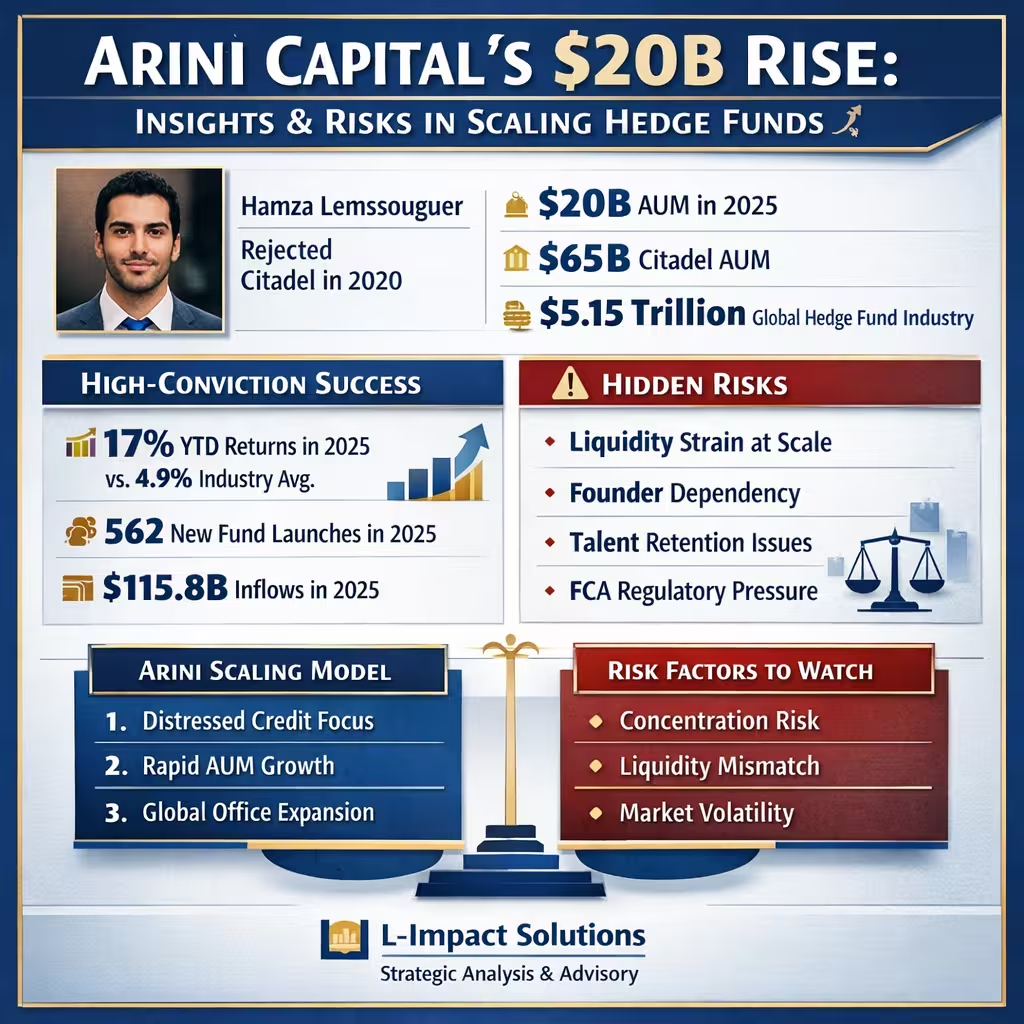
Lemssouguer focused on distressed debt and high-conviction credit plays that delivered standout results including 17% year-to-date returns through August 2025 versus the HFR industry average of just 4.9% at that point. Arini expanded across London New York and Abu Dhabi offices while the UK hedge fund market reached $531 billion in 2025 with London holding a 37% share. This trajectory positions Arini as the fastest-growing new manager per Hedge Fund Research data and signals a shift toward nimble specialists in a $5 trillion-plus industry hungry for alpha.
The firm’s credit expertise allowed it to seize opportunities in European junk debt and direct lending where it closed a $2.3 billion fund in late 2025. Meanwhile Citadel returned roughly 10% in its flagship in 2025 but faced pressure to return $5 billion to investors trimming its AUM. Such comparisons highlight how rejecting a safe corporate path unlocked unmatched scaling speed for Lemssouguer at age 35.
London’s finance scene benefits directly as Arini contributes to the city’s 5.12% projected CAGR through 2031 in a post-Brexit resilient environment. Global inflows reached $115.8 billion industry-wide in 2025 the strongest since 2007. This case study proves entrepreneurial vision combined with specialized strategy drives superior outcomes in volatile alternative investments.
Arini’s reputation for bold bets attracted institutional capital, rapidly turning a startup into a major player within four years. Performance-based gains fueled much of the $642.8 billion industry capital surge last year. At L-Impact Solutions we view this as a blueprint for next-generation hedge fund managers seeking to disrupt established power structures.
L-Impact Solutions Critique: Hidden Risks in Arini Capital’s Rapid $20 Billion Ascent
While Lemssouguer’s rejection of Citadel looks brilliant on paper it exposes serious pain points around unchecked AUM growth that many emerging managers ignore at their peril. Rapid scaling to $20 billion in credit markets strains liquidity and execution especially when distressed opportunities dry up as seen in Europe’s tightening junk-debt environment. Our team at L-Impact Solutions warns that over-reliance on one founder’s high-conviction style creates concentration risks that could trigger sharp drawdowns if macro conditions shift suddenly.
Talent retention gaps plague even successful boutiques like Arini where key traders may bolt for bigger payouts amid London’s competitive $531 billion UK hedge fund market. Regulatory scrutiny intensifies as FCA rules evolve post-Brexit demanding robust compliance that strains resources for fast-growing firms. Industry-wide 562 new launches in 2025 mean more competition and potential overcrowding in credit strategies Lemssouguer dominates.
Performance sustainability remains a critical gap because early outsized returns of 17% in 2025 may prove harder to replicate at a $20 billion scale versus the $1.3 billion launch size. Citadel’s decision to return $5 billion in profits illustrates how mega-funds manage capacity differently avoiding the dilution many boutiques face. We critique this story as a cautionary tale of glamour masking operational vulnerabilities in a $5.15 trillion global industry.
Investor relations risks grow when bold bets dominate headlines yet fail to deliver consistent risk-adjusted returns across cycles. London’s 37% market share attracts capital but also heightens exposure to geopolitical volatility affecting European credit plays. At L-Impact Solutions we see these gaps as preventable yet often overlooked by founders chasing headline AUM figures.
The broader industry faces talent exodus costs estimated in billions as stars like Lemssouguer depart established platforms. Without addressing succession and diversification future blowups could erode confidence in new hedge fund launches. Our strong opinion remains that unchecked growth without guardrails turns inspirational stories into potential industry liabilities.
Solutions: Actionable Strategies Organizations Can Use to Scale Hedge Fund Like Arini
If organizations run or plan to launch a hedge fund organizations must start by building a diversified credit platform that balances high-conviction bets with systematic risk controls from day one. organizations can adopt Arini-style distressed debt expertise while layering in direct lending and securitized assets to spread exposure across the $5.15 trillion global industry. This approach lets organizations capture alpha without the capacity constraints that hit single-strategy managers at $20 billion AUM.
The firm is advised to prioritize an early investment in institutional-grade technology for real-time portfolio monitoring and investor reporting. This commitment ensures sustained transparency as assets appreciate from $1.3$ billion to higher valuations. Strategic partnerships, such as the one Arini forged with platforms like Lazard, should be pursued to gain access to deal flow and distribution networks, thereby accelerating responsible expansion. At this firm, such a move enhances credibility and mitigates the operational deficiencies often observed in cases of rapid growth.
The establishment of a formal talent pipeline, complete with equity incentives and definitive succession plans, is requisite to preempt the founder-dependency risk exemplified by Lemssouguer’s narrative. Recruitment efforts should target quantitative and credit analysts within the London market, which holds assets of $531 billion in the UK. Compensation must be performance-linked to ensure the retention of high-performing personnel amid the launch of 562 new funds. This measure is critical for business continuity, particularly as Assets Under Management (AUM) approach industry-leading levels.
The implementation of rigorous stress-testing frameworks is recommended. These frameworks should simulate 2025-style market volatility, utilizing HFR data benchmarks, to safeguard returns in a manner similar to Arini’s 17% Year-To-Date (YTD) performance. Early engagement with third-party administrators and custodians is essential to comply with Financial Conduct Authority (FCA) standards and to attract pension capital increasingly allocated to alternative investments. These pragmatic steps transform potential challenges into definitive competitive advantages for the business.
A strategic focus on targeted investor education campaigns is advised to articulate the firm’s competitive advantage within credit markets, as opposed to pursuing undifferentiated capital inflows. Fund structures should incorporate liquidity tiers, aligning with the $642 billion industry growth trajectory while precluding forced asset sales during market contractions. Adopting these measures will position the firm to replicate Arini’s success while effectively circumventing the risks identified by L-Impact Solutions.
Prevention: Steps That Organizations Must Take to Avoid Future Hedge Fund Pitfalls
To mitigate future risks, it is advisable to institute annual independent capacity audits designed to cap strategy sizes before assets under management (AUM) exceed efficient execution thresholds, citing the example of Arini’s rapid increase to $20 billion. Establishing strict limitations on single-position exposure, calibrated against market liquidity metrics from the $5.15 trillion global pool, is essential to prevent distress during periods of credit market contraction. This disciplined approach ensures the fund maintains operational agility irrespective of its growth trajectory.
It is imperative to constitute a dedicated risk committee, featuring external advisors, charged with reviewing every significant investment decision against rigorous macroeconomic scenarios, including potential post-2025 inflation or geopolitical disruptions impacting London’s 37% share of the global hedge fund market. Furthermore, integrating reviews of ESG and regulatory compliance into every quarterly cycle is necessary to maintain proactive adherence to FCA modifications within the $531 billion UK market. These institutional practices serve to preempt the regulatory and reputational vulnerabilities that often impede the progress of rapidly expanding funds.
The firm should establish diversified revenue streams through co-investment vehicles and managed accounts, mitigating reliance solely on flagship performance, as exemplified by Citadel’s $5 billion return decision. Proactive development of scenario-based succession plans is essential to ensure organizational resilience during founder transitions or key personnel departures, a common occurrence among the 562 new launches annually. Such preventative measures are critical for safeguarding long-term stability.
Mandatory third-party audits of operational infrastructure should be conducted bi-annually to identify scaling vulnerabilities before they adversely affect investor confidence. Cultivating a transparent culture of stress testing, with results openly shared with limited partners, will foster trust, particularly during periods of market volatility. Within this operational framework, these measures transform potential crises into manageable events.
Continuous monitoring of industry benchmarks, such as HFR inflows and returns, is necessary on a monthly basis to enable proactive allocation adjustments rather than reactive responses following drawdowns. Engaging consultants for peer reviews will benchmark the firm’s growth against competitors in the credit and distressed segments. Adherence to these preventative steps will ensure the sustainable growth and success of the hedge fund well beyond its initial establishment phase.
L-Impact Solutions’ Key Takeaways: Our Strong Opinion on Hedge Fund Entrepreneurship
At L-Impact Solutions we believe Lemssouguer’s $20 billion journey proves that rejecting corporate security for independent vision creates outsized value when executed with discipline in today’s $5.15 trillion hedge fund landscape. Organizations must weigh talent retention pain at giants like Citadel against the real risks of unchecked scaling yet never shy away from bold credit strategies that beat industry averages. Our opinion is clear: calculated independence outperforms safety when backed by robust processes.
We strongly advise every finance leader to treat rapid AUM growth as a double-edged sword that demands immediate diversification and governance upgrades. organizations can achieve Arini-level results only by embedding prevention and solutions from launch day forward in London’s resilient $531 billion market. Ignore these lessons and even the fastest-growing funds risk reversal.
The takeaway remains that entrepreneurship in alternatives rewards those who master both opportunity and risk management amid record 562 launches and $642 billion inflows. At L-Impact Solutions we urge organizations to act now on these insights rather than admire success stories from afar. True leaders build lasting platforms, not just headline AUM figures.
Reference – He Turned Down Ken Griffin to Run His Own Fund. That Was $20 Billion Ago.