Anthropic has surpassed a $30 billion revenue run rate while sealing a transformative deal with Broadcom for 3.5 gigawatts of next-generation Google TPU compute capacity starting in 2027. This marks a tripling from $9 billion at the end of 2025, fueled by demand from more than 1,000 enterprise customers each spending over $1 million annually on Claude models. The explosive growth exposes the core pain point across AI: compute infrastructure shortages that throttle scaling even for market leaders.
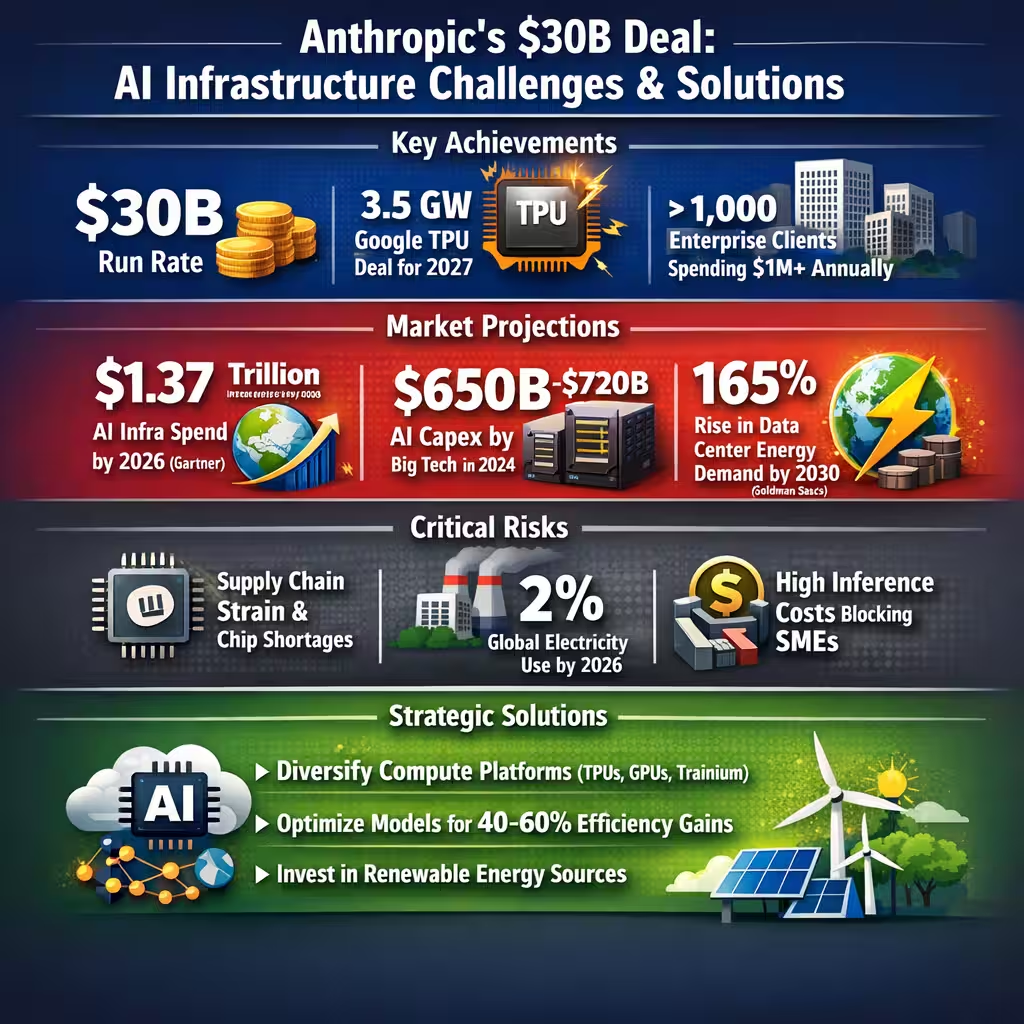
Global AI infrastructure spending is projected to reach $1.37 trillion in 2026 according to Gartner data. Big Tech hyperscalers plan $650 billion to $720 billion in AI-related capex this year alone. Anthropic’s $380 billion valuation after its $30 billion Series G round in February underscores investor confidence yet highlights the capital intensity required just to keep pace.
Broadcom reported $8.4 billion in AI semiconductor revenue for Q1 fiscal 2026, up 106 percent year-over-year. The company is now targeting over $100 billion in AI chip sales for 2027. This partnership diversifies Anthropic away from Nvidia GPU dominance while securing multi-gigawatt capacity through custom silicon.
Enterprise adoption of Claude has accelerated dramatically. Over 300,000 business customers now rely on the platform across coding, analysis, and workflow automation. The deal positions Anthropic to serve this base without the previous bottlenecks that forced competitors to ration access.
Yet the numbers reveal industry-wide strain. Data center electricity demand could surge 165 percent by 2030 per Goldman Sachs estimates. One gigawatt of AI compute often costs $20 billion to $25 billion to deploy at scale. Anthropic’s move signals a shift toward strategic infrastructure alliances as the only viable path forward.
L-Impact Solutions Critique: Risks and Gaps in Anthropic’s AI Scaling Strategy
At L-Impact Solutions we view Anthropic’s $30 billion run rate milestone as impressive yet riddled with unresolved risks that could undermine long-term viability. The Broadcom-Google partnership addresses immediate compute hunger but deepens dependency on hyperscaler ecosystems and third-party silicon. This creates vendor lock-in vulnerabilities that smaller AI firms cannot afford.
Capex demands remain staggering even with the new capacity. Training and inference costs for frontier models already consume billions annually per player. Global data centers could claim 2 percent of worldwide electricity by 2026 while grid infrastructure lags behind multi-gigawatt deployments. Profitability timelines keep slipping despite triple-digit revenue growth.
Supply chain concentration poses another critical gap. TSMC production limits and geopolitical tensions around chip manufacturing threaten delivery of promised TPUs. Earlier regulatory scrutiny from the U.S. Defense Department labeled Anthropic a supply-chain risk before the firm secured an injunction. Diversification helps but does not eliminate exposure.
Enterprise customers face parallel challenges. High inference costs limit widespread adoption beyond Fortune 500 budgets. Smaller businesses watch from the sidelines as AI productivity gains remain concentrated among cash-rich players. This widens the digital divide rather than closing it.
Sustainability receives insufficient attention in the current model. Energy-intensive training runs counter to net-zero commitments many enterprises demand. Without aggressive efficiency gains or renewable sourcing, AI growth risks backlash from regulators and investors alike. L-Impact Solutions sees these gaps as avoidable with proactive strategy.
| Related Analysis: Nvidia $216B AI Surge: AMD’s Fresh Growth Edge $375B AI Robotics Growth Projection: Solutions to Capitalize UiPath 87% Crash: Methods to Rebuild Automation Value |
Solutions to Overcome AI Infrastructure Challenges
If you lead a business scaling AI operations today you must prioritize multi-platform compute strategies immediately. Diversify across Nvidia GPUs, Google TPUs, and AWS Trainium to avoid single-supplier risks like those still facing many AI startups. This approach mirrors Anthropic’s own hybrid model and can cut dependency costs by 20 to 30 percent within the first year.
Next invest in model optimization tools that slash inference expenses without sacrificing performance. Techniques such as quantization, distillation, and sparse architectures reduce compute needs dramatically. Your teams can deploy these on existing infrastructure and realize 40 to 60 percent efficiency gains according to recent industry benchmarks.
Consider custom silicon partnerships or co-development agreements with chipmakers like Broadcom. Even mid-sized enterprises can access reserved capacity through cloud marketplaces or consortium models. Pair this with on-prem or edge deployments for sensitive workloads to balance cost and control.
Adopt advanced FinOps practices tailored to AI workloads. Real-time monitoring of GPU utilization and automated scaling prevent over-provisioning that wastes up to 50 percent of capacity. Integrate these tools with your ERP systems for precise budgeting and ROI tracking.
Finally build internal AI talent pipelines through targeted upskilling programs. Cross-train engineers on efficient model serving and infrastructure management. This internal capability reduces reliance on expensive external consultants and accelerates your time-to-value on AI initiatives.
Prevention Steps for Future AI Scaling Issues
To prevent recurring compute crises you should forecast infrastructure needs three to five years ahead using scenario planning tools. Model different growth trajectories against global supply projections and energy availability. Early visibility lets you lock in capacity reservations before shortages drive prices higher.
Establish renewable energy partnerships or direct power purchase agreements now. Data centers already strain grids in key regions and demand will only intensify. Securing clean power contracts today shields against future regulatory penalties and cost spikes.
Diversify your AI vendor ecosystem proactively rather than reactively. Maintain active evaluations of emerging accelerators from Intel, AMD, and startups in the XPU space. Annual RFP processes ensure you capture efficiency improvements as they emerge.
Invest in open-source efficiency frameworks and contribute to community standards. Collaborative development accelerates breakthroughs in low-power inference that benefit the entire industry. Your organization gains early access while building goodwill with regulators.
Finally embed AI governance and sustainability metrics into board-level reporting. Track carbon intensity per inference alongside traditional KPIs. This discipline prepares you for inevitable ESG regulations and appeals to talent and investors who prioritize responsible scaling.
L-Impact Solutions Key Takeaways for Sustainable AI Leadership
At L-Impact Solutions we believe Anthropic’s $30 billion run rate triumph proves one truth above all: compute is now the ultimate competitive moat in AI. Businesses that treat infrastructure as a strategic asset rather than an afterthought will dominate the next decade. Those who wait will find themselves locked out by capacity constraints and soaring costs.
The Broadcom deal highlights the power of proactive partnerships yet warns against complacency. True leaders will combine diversification, optimization, and sustainability into a single AI operating system. This integrated approach turns today’s pain points into tomorrow’s insurmountable advantages.
We urge every executive reading this to audit your AI roadmap against the $2.5 trillion global spending wave now reshaping markets. Act decisively on the solutions and prevention steps outlined here. Your future revenue run rate and enterprise value depend on it. L-Impact Solutions stands ready to guide your organization through this transformation with data-driven precision and proven execution frameworks.
Reference – Anthropic Tops $30 Billion Run Rate, Seals Broadcom Deal