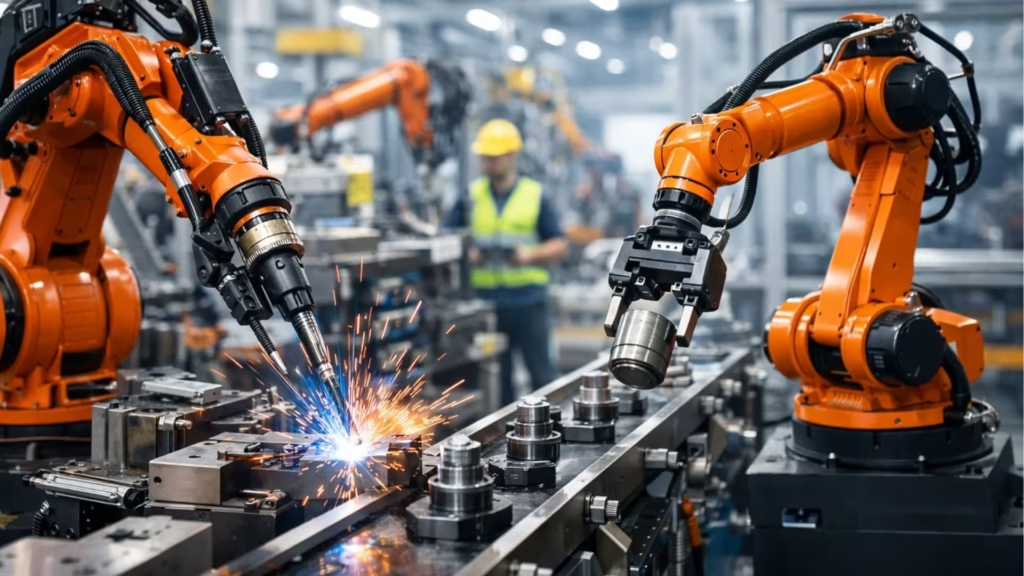
While some investors patiently wait for the AI bubble to burst, the global robotics market stands poised to reach $375.82 billion by 2035 at a steady 17.33% CAGR from its 2024 base of $64.8 billion. Recent March 2026 industry reports highlight Tesla and Amazon as prime candidates to capture outsized returns through humanoid and warehouse automation breakthroughs. At L-Impact Solutions, we see this not as hype but as a structural shift where early movers turn technological pain into massive financial opportunity.
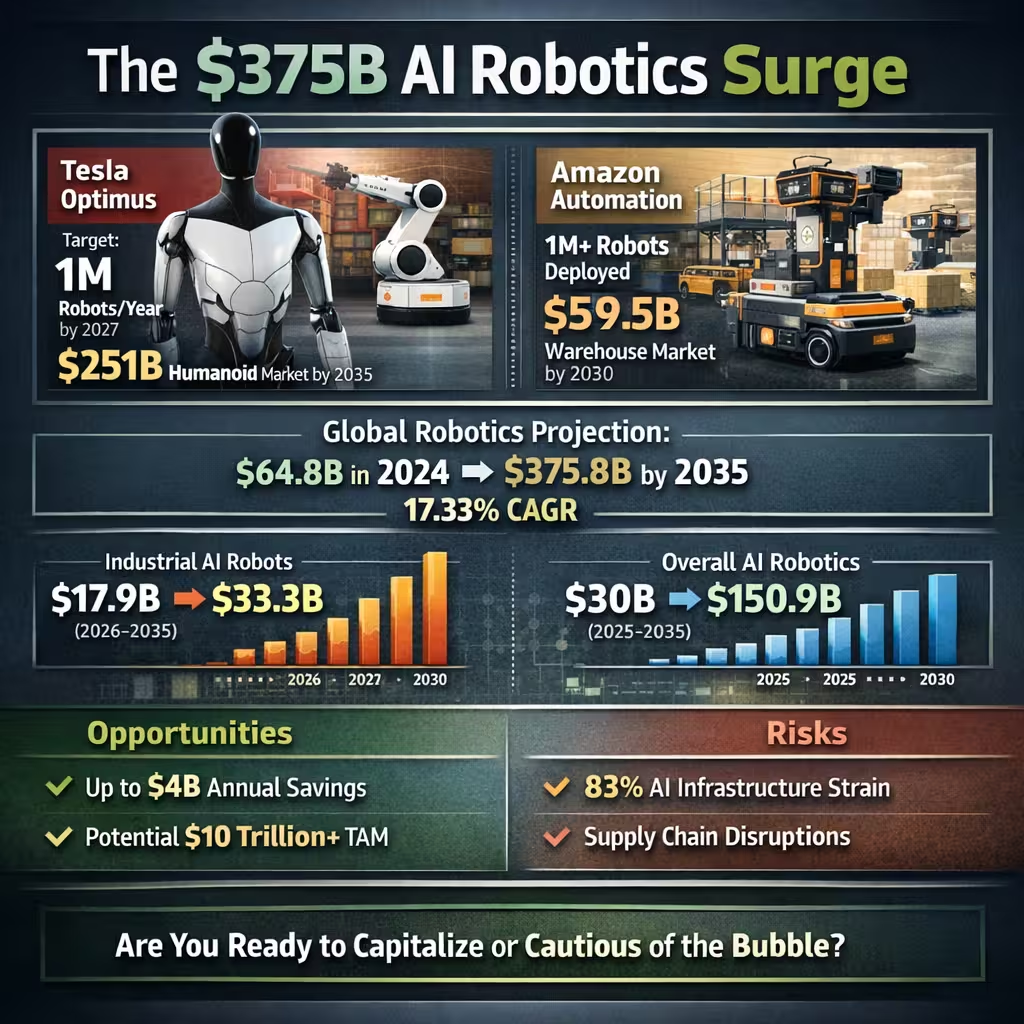
Tesla’s Optimus humanoid robot program already signals revolutionary scale. Production-intent prototypes of Optimus Version 3 target summer 2026 rollout, with mass production aiming for one million units annually by 2027 and long-term revenue potential exceeding $10 trillion. This positions Tesla to surpass its automotive business entirely, especially as humanoid robot markets explode from $4.87 billion in 2025 to $251.40 billion by 2035 at a blistering 48.36% CAGR.
Amazon has quietly built the world’s largest robotics fleet with over one million deployed robots across fulfillment centers as of early 2026. Next-generation automated warehouses promise $2 billion to $4 billion in annual savings by 2027 while avoiding the need to hire more than 160,000 additional U.S. workers. Warehouse automation spending now tops $30 billion globally in 2026 and grows at 18.7% CAGR toward $59.52 billion by 2030, underscoring Amazon’s edge in logistics efficiency.
The pain point remains real for cautious executives watching AI valuations. Overinvestment fears echo 2025 bubble warnings, yet robotics delivers tangible returns through labor shortages and productivity gains already visible in factory and warehouse data. Tesla and Amazon combine AI software with physical hardware in ways pure software players cannot match, creating defensible moats.
Broader AI-powered industrial robotics markets reinforce the momentum. These segments expand from $17.9 billion in 2026 to $33.3 billion by 2035 at 7.1% CAGR. Overall AI robots climb from $30 billion in 2025 to $150.91 billion by 2035 at 16.9%. Such layered growth across humanoid, industrial, and service categories validates the $375 billion headline projection.
High-authority analysis shows Tesla and Amazon are not riding hype but solving real bottlenecks. Tesla’s vertical integration in batteries and AI training data gives it cost advantages that could drop Optimus pricing below $20,000 per unit. Amazon’s DeepFleet AI optimizer already delivers 15% operating-cost reductions in pilot sites, proving measurable ROI that skeptical boards demand.
Current 2026 deployment data further strengthens the case. Global industrial robot installations hit a record $16.7 billion market value, with AI integration accelerating adoption in manufacturing and logistics. Companies ignoring this wave risk falling behind competitors who leverage robotics for 20 to 40% fulfillment-cost improvements.
L-Impact Solutions views the Tesla-Amazon duo as textbook examples of turning AI skepticism into strategic advantage. Their combined hardware-software approach addresses the very integration gaps that cause most robotics pilots to fail. This case study sets the stage for practical action you can take today.
L-Impact Solutions Critique: Hidden Risks and Gaps in the $375B Robotics Narrative
The $375.82 billion robotics projection excites investors, yet L-Impact Solutions identifies critical pain points that could derail returns if left unaddressed. Tesla’s Optimus production timelines have already slipped, with full mass output now eyed for late 2027 rather than earlier targets, exposing execution risks in scaling humanoid hardware. Amazon’s one-million-robot fleet, while impressive, still relies heavily on human oversight for complex tasks, revealing automation gaps that limit full cost capture.
Bubble-burst fears remain valid in 2026. Enterprise surveys show 83% of infrastructure leaders worry their data systems will fail under AI load within two years, while overinvestment in chips and data centers mirrors past cycles that ended in sharp corrections. Robotics faces the same capital-intensity trap, where $100 billion-plus annual capex by leaders like Amazon could sour if ROI timelines stretch beyond 2027 projections.
Supply-chain vulnerabilities compound these issues. Semiconductor shortages and rare-earth material dependencies threaten both Tesla’s battery-powered humanoids and Amazon’s mobile robot fleets. Geopolitical tensions already inflate component costs by 15 to 20% in key categories, creating margin pressure that pure growth forecasts conveniently overlook.
Workforce displacement adds ethical and operational risks. Amazon’s automation push could sideline 600,000 roles by 2033, yet retraining programs lag, risking labor unrest and regulatory backlash. Tesla’s $10 trillion Optimus vision sounds transformative but ignores potential job losses in manufacturing that could slow adoption if governments impose stricter AI labor rules.
Talent and integration gaps further weaken the narrative. Only a handful of firms possess the AI-edge expertise to fuse software agents with physical robots at scale. Most mid-market companies attempting similar plays report 70% of pilots failing due to poor data quality and cybersecurity blind spots, per 2026 industry benchmarks.
Regulatory uncertainty looms large. Evolving global standards on robot safety and autonomous decision-making could delay deployments by 12 to 18 months, especially in Europe and key U.S. states. Neither Tesla nor Amazon has fully disclosed compliance roadmaps, leaving investors exposed to sudden policy shifts.
L-Impact Solutions critiques the over-reliance on two dominant players. Market concentration in AI robotics hardware risks single-point failures, as seen in recent semiconductor disruptions. Diversification across suppliers and applications is essential, yet current hype focuses narrowly on Tesla and Amazon without stressing resilience planning.
Financial gaps also persist. While Amazon eyes $12 billion to $16 billion in decade-end savings, upfront robotics capex consumes 25% of its 2025 budget, pressuring free-cash-flow metrics. Tesla’s robot pivot diverts resources from core EV growth, potentially diluting near-term earnings if Optimus ramps slower than promised.
These risks and gaps demand balanced scrutiny. The $375 billion opportunity is real, but only for leaders who confront execution, ethical, and external challenges head-on rather than chasing headline CAGR alone.
What Most Leaders Get Wrong About Robotics ROI
Most executives underestimate the time-to-value curve in robotics deployments. While headline projections emphasize 20–40% cost reductions, real-world implementations with players like Tesla and Amazon show that meaningful ROI typically materializes only after integration stabilizes across data, workflows, and human oversight layers. Early-phase productivity often dips before compounding gains emerge, creating a false perception of underperformance in the first 6–12 months.
Another critical miscalculation lies in treating robotics as a standalone capital investment rather than a systems transformation. High-performing organizations align robotics with AI models, supply chain redesign, and decision intelligence platforms. Without this alignment, even advanced deployments fail to scale—explaining why up to 70% of pilots stall at the proof-of-concept stage despite strong initial metrics.
Finally, leaders frequently overlook the compounding value of operational data generated by robotics ecosystems. Beyond direct labor savings, companies leveraging robotics from firms like Tesla and Amazon are building proprietary datasets that enhance predictive maintenance, demand forecasting, and AI training loops. This second-order value often exceeds initial cost savings, redefining robotics not as an expense line—but as a long-term strategic asset.
Strategic Solutions to Capitalize on AI Robotics Growth
You can turn the $375 billion robotics opportunity into measurable advantage by following targeted solutions we recommend at L-Impact Solutions. Start by auditing your current operations for robotics-ready processes, then partner selectively with Tesla or Amazon suppliers to accelerate deployment without building everything in-house. This approach delivers 20 to 40% cost reductions in logistics or manufacturing within 18 months while minimizing capital outlay.
Next, invest in hybrid AI-human workforces that complement rather than replace employees. Train teams on robot oversight using Amazon’s proven DeepFleet tools or Tesla’s simulation platforms, which cut fulfillment costs by 15% in pilots. You gain productivity lifts without the full displacement backlash that pure automation strategies provoke.
Secure your supply chain through multi-vendor contracts and on-shore critical components. With semiconductor prices up 15% in 2026, locking in fixed-price deals for actuators and sensors protects margins as you scale toward the 17.33% industry CAGR. This tactic also reduces geopolitical risk that could otherwise stall your robotics timeline.
Leverage data infrastructure upgrades to prevent the 83% failure rate cited in recent executive surveys. Implement edge-computing layers compatible with Optimus or Amazon Sequoia systems so real-time decisions happen locally, avoiding cloud bottlenecks. You achieve reliable 24/7 uptime and unlock the full value of your $375 billion market bet.
Form cross-functional governance teams that blend finance, operations, and ethics leaders. These groups review every robotics pilot against ROI thresholds of 18 to 24 months, mirroring Amazon’s internal savings benchmarks of $2 billion to $4 billion annually. Transparent metrics keep projects on track and satisfy board-level scrutiny.
Explore joint ventures or licensing deals with Tesla for humanoid applications in your sector. Early access to Optimus Version 3 prototypes in 2026 positions you ahead of competitors targeting the $251 billion humanoid submarket by 2035. Revenue-sharing models convert capex into shared upside without full ownership risk.
Adopt modular robotics platforms that scale incrementally. Begin with 10 to 50 units in high-volume areas, measure output gains against the 48.36% humanoid CAGR, then expand based on proven metrics. This staged rollout mirrors Amazon’s million-robot journey and keeps cash flow healthy.
Finally, monetize your robotics data by creating proprietary training sets for AI agents. Sell anonymized insights back to the ecosystem or use them to negotiate better terms with Tesla and Amazon partners. You transform operational data into a new revenue stream that compounds your competitive edge.
These solutions empower you to capture robotics growth safely. By addressing integration, talent, and capital challenges directly, your business joins the leaders rather than watching from the sidelines.
Prevention Steps to Safeguard Against Future AI Robotics Pitfalls
You prevent future robotics setbacks by building resilience into every layer of your strategy from day one. Establish annual stress tests that simulate bubble-burst scenarios, including 30% capex cuts or 12-month regulatory delays, so your Tesla or Amazon-aligned projects survive market corrections. This discipline keeps your 17.33% CAGR participation intact even if broader AI sentiment sours.
Diversify robotics investments across at least three hardware providers and two software platforms. Avoid over-reliance on any single ecosystem like Tesla Optimus or Amazon’s fleet, which reduces single-point failure risk that plagued early AI pilots. Your portfolio stays balanced as the $375 billion market matures through 2035.
Mandate cybersecurity and safety certifications before any deployment scales. Require ISO-compliant protocols and third-party audits that address the data-infrastructure failures 83% of leaders fear. Prevention here protects your multimillion-dollar robot assets from downtime or regulatory shutdowns.
Create internal retraining funds equal to 5% of robotics capex. Redirect savings from Amazon-style 15% efficiency gains into upskilling programs that transition displaced workers into oversight or maintenance roles. You maintain workforce morale and avoid the labor disputes that could slow your 1-million-unit scale ambitions.
Monitor policy developments quarterly through dedicated regulatory trackers. Adjust timelines proactively when new humanoid safety rules emerge, preventing the 12-to-18-month delays that hit unprepared competitors. Early compliance becomes your moat in the $251 billion humanoid segment.
Build flexible exit clauses into all vendor contracts with Tesla, Amazon, or their suppliers. Include performance milestones tied to real output metrics rather than promised CAGR numbers, allowing you to pivot capital if production ramps slip beyond 2027 targets. This financial safeguard preserves cash for alternative automation paths.
Integrate ethical AI reviews into every project gate. Score initiatives on job impact, transparency, and fairness metrics before greenlighting expansion, mitigating reputational risks that bubble critics amplify. You future-proof your brand while still chasing the $150.91 billion AI robots market by 2035.
Finally, maintain a 20% cash reserve earmarked for robotics contingencies. This buffer covers unexpected semiconductor price spikes or integration overruns, ensuring you never pause momentum in the face of external shocks. Consistent liquidity turns potential crises into competitive advantages.
These prevention steps keep your robotics journey sustainable. By embedding caution alongside ambition, you protect the upside of the $375 billion opportunity for years ahead.
L-Impact Solutions Key Takeaways: Your Actionable Path Forward
The $375.82 billion robotics market by 2035 is no longer speculative—it is a proven growth engine already powering Tesla’s Optimus ambitions and Amazon’s million-robot reality. Yet only leaders who confront bubble risks, execution gaps, and ethical challenges will capture the 17.33% CAGR rewards. At L-Impact Solutions, we believe disciplined action today separates future winners from yesterday’s cautionary tales.
You now hold a complete playbook: audit operations, hybridize workforces, secure supply chains, and govern with clear ROI rules. Implement these solutions and prevention measures to transform the very pain points of AI skepticism into your greatest advantage. The window for early positioning with Tesla and Amazon partners narrows quickly in 2026.
Our strong opinion is clear. Robotics will not wait for the bubble debate to end. Businesses that move with data-backed confidence—leveraging real 2026 deployment numbers, cost-saving benchmarks, and production timelines—will dominate the next decade. Ignore the noise, embrace the hardware reality, and watch your returns compound alongside the market’s explosive trajectory.
Reference – Prediction: AI Robotics Will Be a $375 Billion Industry and These 2 Stocks Will Lead It