Netflix shares dropped 9% in after-hours trading Thursday, following its Q1 earnings release and a major governance shake-up. The company beat Wall Street expectations for revenue, reporting $12.25 billion for the first quarter, above the $12.18 billion expected by analysts polled by LSEG and 16% higher than the $10.54 billion it reported in the year-ago quarter. Thursday marked the company’s first earnings report since it walked away from its proposed acquisition of Warner Bros. Discovery’s streaming and film assets in February.
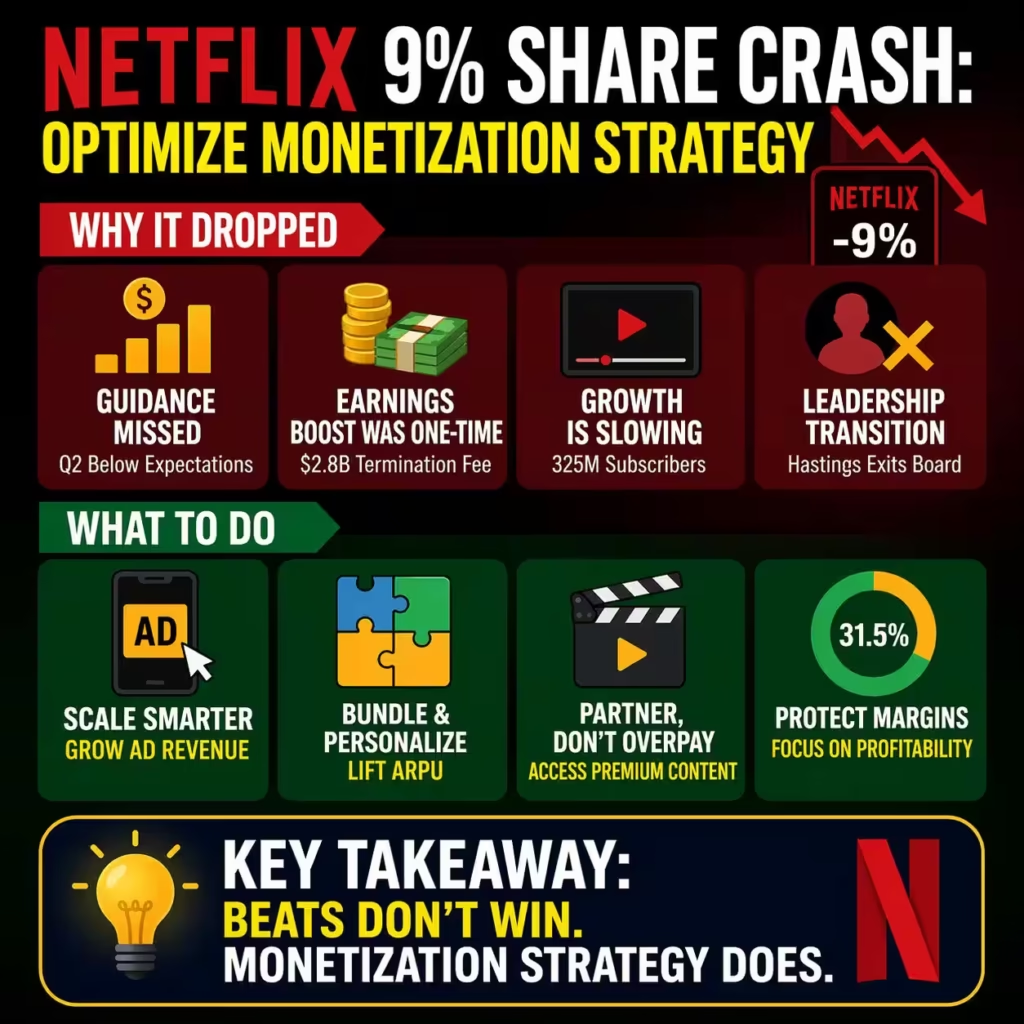
This sharp sell-off highlights a core pain point for streaming leaders. Investors punished the stock despite a solid top-line beat fueled by the $2.8 billion termination fee from the abandoned Warner deal and strong ad-tier momentum. Netflix ended 2025 with over 325 million global paid subscribers, yet forward guidance for Q2 revenue at $12.57 billion fell short of the $12.64 billion consensus.
Our deep analysis at L-Impact Solutions shows this reaction stems from broader industry signals. Global streaming subscriptions generated $157.1 billion in 2025—up 14% year-over-year and triple 2020 levels—as growth pivots from new subscribers to pricing power and ads. Netflix’s ad revenue topped $1.5 billion in 2025 and is poised to double in 2026—yet investors doubt if it offsets slowing subscriber adds in mature markets.
The governance shift adds another layer. Co-founder Reed Hastings’ departure from the board signals a leadership transition at a pivotal moment when the company reaffirms full-year 2026 revenue guidance of $50.7 billion to $51.7 billion. Competitors like Disney+ and Hulu combined reached 195.7 million subscribers by late 2025, intensifying pressure on content differentiation.
This case underscores volatility in a $177 billion total streaming market including ads. Netflix’s operating income rose 18 percent to nearly $4 billion in Q1, yet the 9 percent drop erased early 2026 gains of 15 percent. The abandoned Warner transaction, once valued at $82.7 billion enterprise, would have added massive library scale but risked integration costs in a regulatory-heavy environment.
High-authority data from recent filings reveals disciplined capital allocation. Netflix recognized the $2.8 billion fee in interest income, boosting diluted EPS to $1.23 versus the $0.76 estimate. Yet Q2 EPS guidance of $0.78 missed the $0.84 consensus, raising flags on content amortization and marketing efficiency.
The pain point is clear for B2B partners and investors. A revenue beat that should have lifted confidence instead exposed execution risks in a maturing market projected to reach $200 billion in subscription revenue by 2030. This sets the stage for targeted solutions and prevention strategies ahead.
L-Impact Solutions Critique of the Netflix Announcement
At L-Impact Solutions, we view Netflix’s Q1 results as a textbook example of market disconnects in streaming. The 9 percent share drop despite $12.25 billion revenue and a 16 percent year-over-year jump reveals investor skepticism over sustainable growth. Hastings’ board exit compounds this by highlighting governance gaps at a time when the company needs steady leadership to navigate ad-tier scaling and international expansion.
The abandoned Warner Bros. Discovery deal exposes strategic risks. Netflix walked away after Paramount Skydance’s superior $110.9 billion bid, securing a $2.8 billion fee that padded Q1 earnings. Yet this move underscores missed synergies in a $159.98 billion global video streaming market in 2025, where combined catalogs could have accelerated subscriber retention beyond the current 325 million benchmark.
Risks extend to forward guidance shortfalls. Q2 revenue projection of $12.57 billion trails estimates, signaling potential pressure from content costs projected near $20 billion for 2026. Churn remains a silent threat even as ARPU climbs above $12 in key regions through price hikes and ads, which generated $1.5 billion in 2025.
Gaps in transparency fuel the critique. Netflix moved away from quarterly subscriber updates, focusing on revenue and operating margin targets of 31.5 percent for 2026. This opacity leaves partners and analysts guessing about regional performance amid Disney’s 195.7 million combined base and rising competition from Amazon Prime.
Our consultancy analysis flags over-reliance on monetization levers. While ad revenue is set to double, it still represents only about 3 percent of 2025 totals, leaving vulnerability if economic slowdowns hit discretionary spending. The governance change risks eroding founder-driven innovation culture that drove 18 percent operating income growth in Q1.
These pain points create broader industry ripple effects. B2B stakeholders in content production and tech partnerships now face heightened uncertainty, as Netflix’s 9 percent reaction sets a precedent for punishing perceived softness despite beats. Without addressing these gaps, similar announcements could trigger repeated volatility in a market growing at 15 percent CAGR through 2032.
L-Impact Solutions sees this as a wake-up call. The critique centers on balancing short-term wins like the termination fee with long-term structural resilience against competitors and regulatory hurdles.
| Related Analysis: X-Energy IPO $2.3T Gap: Unlock SMR Growth Plan Qantas A$3.3B Fuel Cost Crisis: Deploy Hedge Strategy CarMax $1.9B Finance Slump: Diversify Your Funding Edge |
Solutions to Address Streaming Market Volatility
You face similar earnings pressure in your streaming or media operations. Start by accelerating ad-tier adoption with personalized bundles that lift ARPU without alienating core subscribers, mirroring Netflix’s path to doubling $1.5 billion ad revenue in 2026. This approach stabilizes revenue in a $157.1 billion subscription market while offsetting any Q2-like guidance misses.
Next, diversify content pipelines through targeted partnerships rather than full acquisitions. You can license premium libraries or co-produce originals with regional creators to boost engagement in high-growth Asia-Pacific markets, where Netflix added meaningfully in Q1. This reduces dependency on massive spends nearing $20 billion annually and builds resilience against deal fallout like the Warner exit.
Implement AI-driven personalization at scale to cut churn below industry averages. You should integrate recommendation engines that analyze viewing patterns across your 300 million-plus user base, driving retention and justifying price adjustments that lifted Netflix ARPU above $12. Data from 2025 shows this tactic supports 12-14 percent full-year revenue growth targets.
Expand B2B revenue streams by offering white-label tech platforms or enterprise licensing. You gain diversified income beyond consumer subs, much like Netflix’s focus on operating margins hitting 31.5 percent. This buffers 9 percent stock reactions by providing predictable cash flows to investors.
Strengthen governance with transparent succession frameworks. You can appoint independent directors with deep tech expertise early, avoiding the market jitters from Hastings’ exit and maintaining investor trust during transitions. Combine this with quarterly KPI dashboards on subs, ARPU, and ad performance for clearer communication.
Finally, scenario-plan M&A rigorously. You evaluate deals like the $82.7 billion Warner bid through net-value lenses, walking away when premiums exceed synergies as Netflix did. This discipline, paired with the $2.8 billion fee windfall, preserves balance sheets for organic growth in a market heading to $421 billion by 2032.
These solutions position you for compounded advantages. By executing them, you turn volatility into strategic edge, much as Netflix beat estimates yet must now prove long-term momentum.
Prevention Strategies for Future Governance and Acquisition Risks
You prevent future 9 percent drops by embedding robust investor relations protocols from day one. Publish detailed forward-looking metrics on ad revenue trajectories and regional ARPU monthly, building on Netflix’s 2026 guidance of $50.7 billion to $51.7 billion to reduce surprise reactions. This transparency counters gaps exposed in the Q1 announcement.
Establish independent governance committees focused on leadership continuity. You mandate succession planning reviews every six months, incorporating founder transitions like Hastings’ to avoid signaling instability during key earnings cycles. Pair this with board diversity targets that enhance strategic oversight in competitive landscapes.
Conduct preemptive M&A stress tests quarterly. You model integration costs, regulatory timelines, and synergy shortfalls for any deal above $50 billion, ensuring decisions like walking from Warner Bros. Discovery prioritize shareholder value over ego. This approach secured Netflix the $2.8 billion fee while sidestepping dilution risks.
Diversify monetization early to insulate against guidance misses. You roll out hybrid ad-sub models across all tiers and test live events or gaming add-ons, targeting the global streaming market’s 18.5 percent CAGR through 2035. Netflix’s $1.5 billion ad base doubling demonstrates how this prevents over-reliance on subs alone.
Build crisis simulation teams for earnings preparation. You rehearse market reactions to beats versus misses, refining language around content spend of $20 billion and subscriber benchmarks beyond 325 million. This minimizes volatility in a $177 billion ecosystem where competitors like Disney hold 195 million users.
Foster cross-functional risk dashboards company-wide. You track churn, engagement, and competitive share in real time, enabling swift adjustments before announcements trigger sell-offs. Regular third-party audits of governance practices further reinforce credibility with analysts and partners.
These prevention steps create lasting safeguards. You embed them now to navigate 2026’s projected $202 billion subscription revenue milestone with confidence and minimal disruption.
L-Impact Solutions Key Takeaways
Netflix’s 9 percent share drop after a $12.25 billion Q1 beat delivers a blunt message to every streaming executive. Strong numbers alone no longer guarantee market applause when guidance softens or governance shifts appear. You must treat every earnings cycle as a test of sustainable strategy rather than isolated performance.
At L-Impact Solutions, we opinionate strongly that discipline trumps ambition in this $157 billion subscription arena. Walking from the Warner deal while pocketing $2.8 billion proved prudent, yet the real win lies in doubling ad revenue and protecting 325 million subscribers through smarter monetization. Ignore this lesson and repeated volatility awaits.
The path forward demands relentless focus on transparency, diversification, and prevention. You implement the solutions and strategies outlined here to transform risks into durable advantages. Streaming leaders who do so will lead the next decade of growth.
Our final view is optimistic yet urgent. Netflix remains the category king with 16 percent revenue expansion, but only those acting on those insights will avoid similar painful drops. Partner with L-Impact Solutions to transform analysis into action and secure your position in this dynamic industry.
Reference – Netflix stock sinks despite earnings beat, streamer says Reed Hastings to exit board