Delta A350-1000 expert analysis reveals how a disciplined cash flow strategy may support long-haul growth and efficiency.
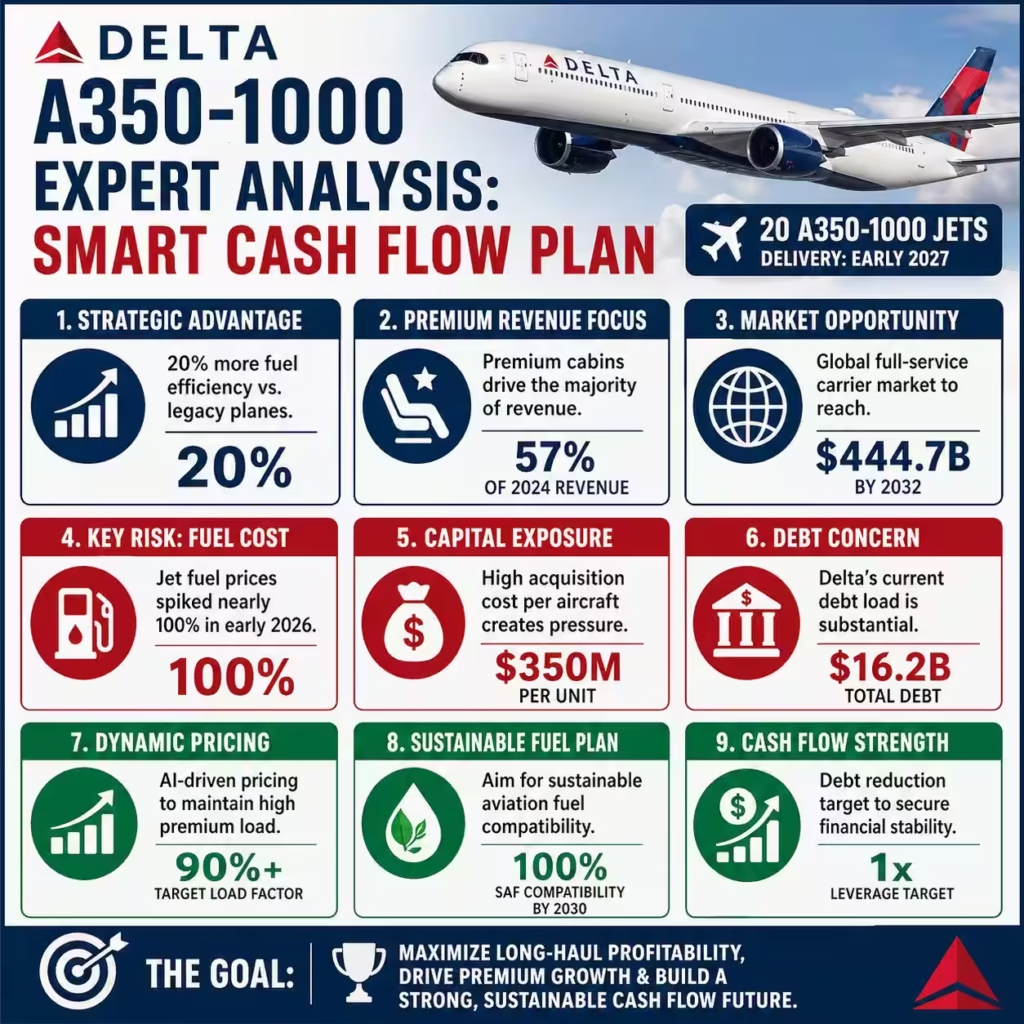
Delta Air Lines’ strategic acquisition of 20 Airbus A350-1000 widebody jets, scheduled for delivery in early 2027, addresses a critical $2 billion fuel-headwind risk by boosting efficiency by 20% over legacy frames. This fleet modernization pivot directly targets the high-yield long-haul sector, where premium revenues already account for 57% of Delta’s total $61.6 billion 2024 record performance. The core pain point for legacy carriers remains the volatility of jet fuel prices, which spiked nearly 100% in early 2026, threatening the profitability of older, inefficient twin-aisle aircraft.
By deploying the A350-1000, Delta aims to capture a global full-service carrier market projected to reach $444.7 billion by 2032 through aggressive premium-cabin segmentation. Our analysis suggests this move is a defensive buffer against rising operational costs and an offensive play for ultra-long-haul dominance. The A350-1000 offers a 40% increase in premium-category seating area compared to the A350-900, which is vital for maintaining Delta’s 9.7% operating margin.
Industry data shows that premium travel demand grew by 8% in 2024, while economy segments remained largely stagnant, signaling a permanent shift in consumer spending. Delta is leveraging this trend by configuring these aircraft with a 50% premium seat mix, including the next-generation Delta One Suites with six-and-half-foot flatbeds. High-authority financial reports confirm that international unit revenue recently improved by mid-single digits, largely driven by the Transatlantic entity’s 6% growth.
This flagship model serves as a standardized technological platform to unify the passenger experience across a global network of 800 destinations. The integration of this specific airframe allows Delta to optimize its route architecture for maximum yield on high-density international corridors. Consequently, the airline positions itself to dominate the lucrative corporate travel sector as global connectivity requirements escalate toward the 2030 milestone.
L-Impact Solutions: Critical Analysis of the 2027 Fleet Strategy
L-Impact Solutions views the 2027 delivery timeline as a high-stakes gamble against accelerating global supply chain disruptions and escalating geopolitical energy risks. While the 20% fuel efficiency gain is significant, the $350 million per-unit acquisition cost creates a massive capital expenditure burden during a period of 4.06% projected industry CAGR. We critique the current strategy for its reliance on the Rolls-Royce Trent XWB-97 engine, which, despite its power, concentrates technical risk into a single propulsion ecosystem.
There is a visible gap in the contingency planning for the expected $2 billion fuel cost increase that Delta already projected for the 2026 fiscal year. Failure to achieve the targeted 100% SAF compatibility by 2030 could also cause regulatory penalties as ICAO CO2 standards tighten. The primary risk lies in the “premium-only” bubble, where a 17% global increase in premium economy capacity might lead to yield dilution if economic downturns compress corporate travel budgets.
Delta’s current debt load of $16.2 billion requires consistent free cash flow, which could be jeopardized by delivery delays that have already pushed the initial 2026 debut to 2027. We identify a lack of diversification in the long-haul fleet, as the Boeing 787-10 rollout is not scheduled until 2031, leaving no immediate alternative if A350 production halts. The operational complexity of managing a 50% premium mix requires perfect load factors to avoid the “empty luxury” trap that has collapsed previous high-end ventures.
Our firm believes that the standardization of the onboard product, while efficient, may strip away the local brand differentiation needed in competitive Asian markets like Seoul and Singapore. Such a move risks alienating high-net-worth individuals who prioritize unique cultural service nuances over sanitized global consistency. Therefore, Delta must balance its drive for efficiency with a localized marketing strategy that addresses these regional sensitivities.
| Related Analysis: AAPL $4T Q2 2026: Capture Emerging Market Growth Avis 86.2% Short Crisis: Protect Your Capital TSLA $25B Capex Alert: Strengthen Cash Control Plan |
Solutions for Sustainable Long-Haul Profitability
To mitigate the financial strain of the A350-1000 acquisition, Delta must immediately implement an AI-driven dynamic pricing model for its premium suites to ensure 90%+ load factors. Integrating predictive analytics can optimize the 111-tonne payload capacity of these frames, allowing for high-margin belly cargo to offset seasonal passenger dips. The carrier should also accelerate its refinery hedging strategy to stabilize the $2 billion fuel price volatility that currently plagues the 2026-2027 transition period.
Diversifying the supply chain by securing multi-year SAF purchase agreements will ensure the fleet meets the 50% blend target at the time of entry-to-service. Furthermore, a “modular cabin” approach would allow for rapid reconfiguration between premium and main cabin seats based on shifting macroeconomic indicators. Developing a secondary MRO (Maintenance, Repair, and Overhaul) revenue stream for the Trent XWB-97 engine could turn a cost center into a profit generator, similar to Delta TechOps’ current success.
The airline must leverage its 1,200 Wi-Fi-enabled aircraft to create a personalized, data-centric loyalty ecosystem that captures non-ticket revenue through the Delta Studio platform. Strengthening joint venture partnerships in the Asia-Pacific region will provide the necessary feeder traffic to sustain the ultra-long-haul “trunk routes” the A350-1000 is designed to serve. Capitalizing on the $1.4 trillion international tourism market requires a shift from simple hub-to-hub flying to bespoke, high-yield experiential travel packages.
Finally, a rigorous debt-reduction plan aiming for a 1x leverage target will provide the balance sheet strength needed to weather any future aircraft delivery delays. Maintaining this fiscal discipline is essential for ensuring that the $7 billion total investment in new widebody frames does not compromise overall shareholder equity. By executing these strategic pivots, Delta can transform the A350-1000 from a massive capital risk into a resilient profit-driving engine.
Prevention Steps for Future Fleet Disruptions
Future fleet operational risks can be prevented by adopting a “dual-source” procurement strategy that balances Airbus and Boeing deliveries to avoid dependency on a single manufacturer’s production timeline. Implementing blockchain-based tracking for critical engine components will reduce the frequency of unscheduled groundings and improve dispatch reliability above the current 99% industry benchmark. To prevent yield erosion, Delta should establish a “Premium Elasticity Index” to monitor real-time shifts in consumer willingness-to-pay across its 5,000 peak-day flights.
Investing in early-stage hybrid-electric propulsion research will provide a long-term hedge against the eventual obsolescence of traditional turbofans. The airline must also institutionalize a “Resilience Audit” that simulates the impact of a 50% surge in jet fuel prices on its 10-year fleet plan. Continuous training for the 100,000-strong workforce on next-generation avionics will ensure that the transition to the A350-1000 does not cause a temporary drop in operational excellence.
Enhancing the “Shared Rewards” program to include fuel-saving incentives for pilots can further drive down the carbon intensity of every flight hour. To prevent brand stagnation, the airline should utilize its LA28 Olympic partnership to test innovative cabin features three years before the A350-1000’s debut. Establishing a dedicated “Supply Chain Task Force” will allow for the proactive identification of bottlenecks in composite material production before they cause delivery slippage.
Lastly, maintaining an investment-grade balance sheet is the ultimate prevention tool against the high interest rates that often accompany massive widebody orders. This proactive financial management ensures the airline can pivot quickly should market conditions shift during the five-year delivery window. Such comprehensive preventative measures are vital for securing Delta’s legacy as a pioneer in sustainable and profitable aviation.
L-Impact Solutions Key Takeaway
Our firm asserts that Delta’s 2027 A350-1000 launch is the only viable path to surviving a high-cost, high-competition aviation landscape. You must recognize that the transition from a 2023 revenue of $57 billion to a 2024 record of $61.6 billion was not accidental; it was a result of disciplined premium focus. The $2 billion fuel price threat is real, but the 20% efficiency gain of the A350-1000 provides the necessary armor to protect your future margins.
You should prioritize fleet commonality and premium-heavy layouts to ensure that every seat mile flown contributes to your long-term 1x leverage goal. Only through relentless modernization and AI-integrated operations can you maintain your position as the world’s most profitable legacy carrier. Your commitment to this 2027 delivery milestone will ultimately define the airline’s success for the next three decades of global flight.
FAQs:
Can Delta Air Lines realistically absorb a projected $2 billion fuel cost headwind in 2026 while committing nearly $7 billion to new widebody aircraft?
Delta’s strategy is bold, but without faster debt reduction and stronger fuel hedging, simultaneous cost inflation and capex pressure could strain margins more than management expects.
Will 20 Airbus A350-1000 jets delivering from 2027 with 20% better fuel efficiency be enough to offset aging fleet inefficiencies?
The efficiency gains are meaningful, yet relying on only 20 aircraft may be too gradual unless Delta accelerates retirement of its least economical legacy widebodies.
Is Delta overexposed to premium travel demand by pushing a 50% premium seat mix when premium demand rose only 8% in 2024?
Premium focus has driven profits, but if corporate travel softens during a downturn, excess luxury capacity could quickly become a yield-diluting liability.
How risky is Delta’s $16.2 billion debt load if A350-1000 deliveries slip again beyond the delayed 2027 timeline?
Another delay would be a serious balance-sheet stress test, making fleet diversification and tighter leverage targets urgent rather than optional.
Can Delta protect its 9.7% operating margin while standardizing cabins across 800 destinations and competing for high-yield global travelers?
Standardization improves scale efficiency, but Delta must preserve localized premium service or risk losing affluent travelers who value differentiated experiences over uniformity.
Reference – Here’s When Delta Air Lines Plans To Debut The Largest Airbus A350 Variant