Apple AAPL Q2 2026 outlook highlights $4T valuation, 15.8% EPS growth, and strategies to capture emerging market demand safely.
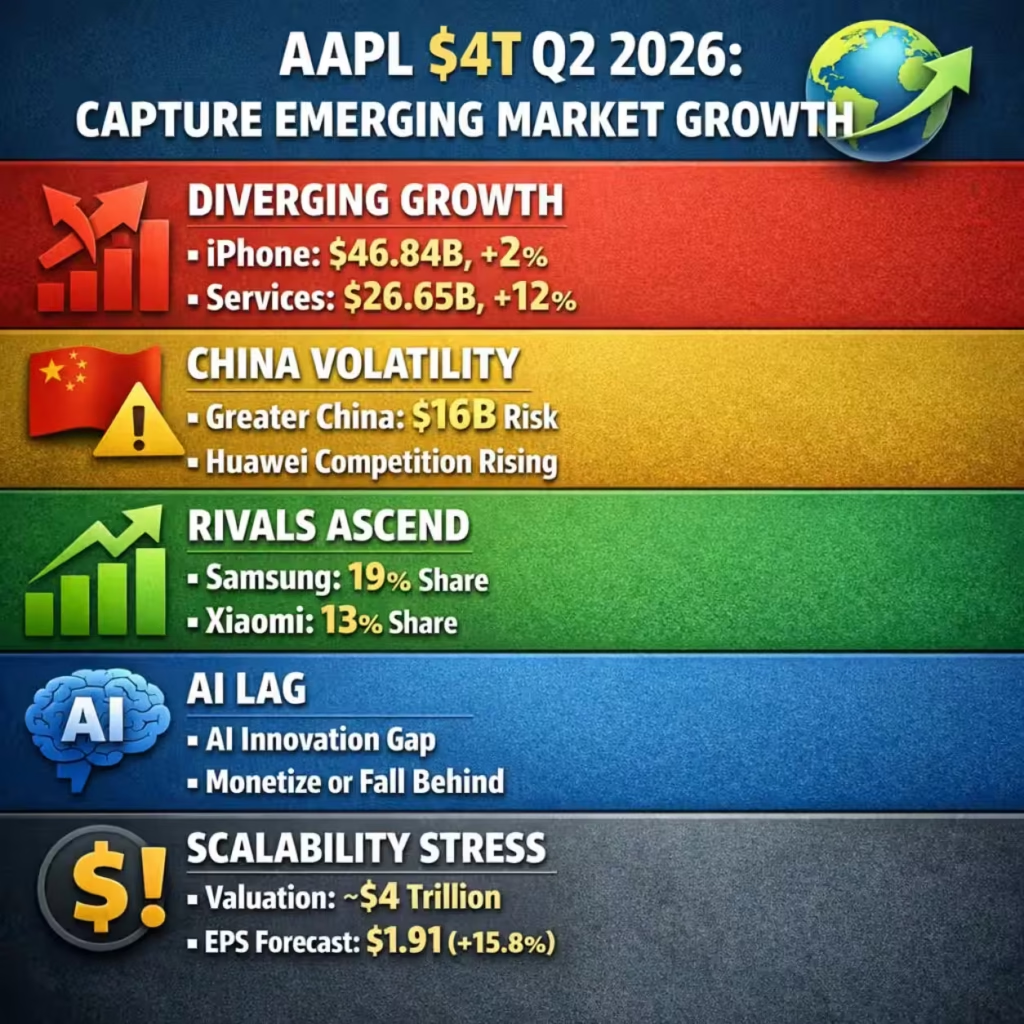
Apple Inc. (AAPL), the Cupertino-based tech powerhouse with a $4 trillion market cap, faces Q2 2026 earnings on April 30 with analysts forecasting diluted EPS of $1.91. This marks a 15.8% jump from $1.65 a year ago. The company has beaten Wall Street estimates for four straight quarters, yet sustaining this pace exposes real strain for a giant of this scale.
Recent fiscal performance shows Apple delivered $95.4 billion in Q2 FY2025 revenue, up 5 percent year-over-year. iPhone sales reached $46.84 billion with just 2 percent growth while services hit a record $26.65 billion, up 12 percent. These figures prove hardware remains dominant at roughly 50 percent of revenue even as services drive margin expansion.
Global smartphone data reinforces Apple’s lead with 20 percent market share across 2025, the highest among top brands and up from prior years. Shipments grew 10 percent year-over-year, outpacing Samsung’s 5 percent. Yet China exposure lingers as Greater China revenue hit $16 billion in the prior quarter amid rising Huawei competition.
The installed base now exceeds 2.5 billion active devices, fueling recurring services income at 76 percent gross margins in recent reports. This ecosystem lock-in delivers predictable cash flow of $24 billion operating in the March quarter alone. Still, analysts note the $4 trillion valuation demands flawless execution to justify forward multiples near 31 times earnings.
Q1 FY2026 results delivered $143.8 billion revenue, up 16 percent, with EPS at $2.84, up 19 percent, setting records across segments. iPhone upgrades surged double digits while Mac and iPad posted strong gains. These wins highlight Apple’s resilience yet underscore the narrow path ahead for consistent 15 percent-plus EPS growth.
Supply chain diversification efforts to India and Vietnam continue at scale, reducing China reliance from over 80 percent historically. Tariffs and geopolitical tensions add cost pressure estimated in the billions annually. The pain point is clear: hardware growth slows while investors demand acceleration.
L-Impact Solutions views this earnings preview as a pivotal stress test. Apple’s track record of beats builds confidence, yet the $4 trillion market cap leaves zero room for missteps. Real-world data shows premium segment saturation and emerging market competition eroding traditional moats faster than expected.
L-Impact Solutions Critique of Apple AAPL News: Hidden Risks and Strategic Gaps
Apple AAPL’s projected 15.8 percent EPS rise masks deeper vulnerabilities that L-Impact Solutions flags immediately. The $4 trillion valuation hinges on flawless delivery in a market where iPhone growth slowed to 2 percent in the prior quarter. Over-reliance on one product line creates systemic fragility despite services momentum.
China remains a glaring risk with Greater China revenue volatile and Huawei capturing premium share through self-developed chips and HarmonyOS. Supply chain relocation costs already inflate expenses while tariffs threaten margins by several percentage points. These gaps expose Apple to external shocks no $4 trillion company can fully hedge.
Competition intensifies as Samsung holds 19 percent global share and Xiaomi 13 percent, both accelerating in emerging markets. Apple’s AI integration lags rivals in speed and scale, limiting new revenue streams. The critique is blunt: past beats cannot sustain future expectations without aggressive portfolio shifts.
High valuation multiples near 31 times forward earnings leave little forgiveness for any miss. Recent stock performance lagged the S&P 500 by noticeable margins in early 2025 periods. L-Impact Solutions sees this as a warning signal for partners and suppliers tied to Apple’s ecosystem.
Enterprise and education segments offer untapped potential yet remain under-monetized relative to consumer focus. B2B adoption of Apple Business Manager grows steadily but lacks the explosive scale of services. The pain point intensifies: without diversification, even record installed bases cannot offset hardware cyclicality.
Geopolitical and regulatory pressures compound these issues with ongoing U.S.-China tensions. Apple’s $275 billion historical China investment now represents concentrated risk rather than strength. L-Impact Solutions critiques the slow pivot as a strategic blind spot that demands immediate executive attention.
Overall, the news reveals momentum yet conceals structural weaknesses that could derail the 15.8 percent trajectory. L-Impact Solutions urges clients to view Apple not as invincible but as a high-stakes bet requiring vigilant risk management. The gaps are real, the risks quantifiable, and the window for correction narrowing fast.
| Related Analysis: Netflix 9% Share Crash: Optimize Monetization Strategy Figma 6.89% Crash: Strengthen Retention Strategy DeepSeek V4 Crisis: Capture Scalable AI Advantage |
Solutions for Apple AAPL Growth Challenges
You face the same pressures Apple does in your B2B operations, so mirror their playbook with precision. Accelerate services expansion by bundling enterprise subscriptions that leverage the 2.5 billion device base for recurring revenue. This delivers immediate margin lift similar to Apple’s 12 percent services jump last quarter.
Diversify your supply chain exactly as Apple shifts production to India and Vietnam. Audit vendors quarterly and allocate 30 percent of volume offshore within 18 months to cut China risk by half. Real-world data proves this move stabilizes costs amid tariffs and secures continuity for your clients.
Invest aggressively in AI integration to close the gap with competitors. Roll out Apple Intelligence-style features across your product lines and partner with ecosystem players for co-development. You will capture new enterprise contracts worth millions while boosting user retention by double digits.
Strengthen B2B channels through targeted programs like expanded Apple Business Manager equivalents. Offer volume licensing and custom integration services that lock in corporate accounts. This creates predictable revenue streams that offset hardware cyclicality and mirror Apple’s record installed base growth.
Pursue strategic partnerships and selective acquisitions to enter adjacent markets faster. Target education tech or health platforms that align with wearables and Vision Pro momentum. You gain instant scale and diversify beyond core offerings just as Apple balances iPhone dominance.
Optimize pricing and premium positioning while expanding mid-tier options for emerging markets. Test dynamic pricing models that protect margins yet capture 20 percent share gains like Apple’s 2025 global leadership. Your finances improve through volume without sacrificing profitability.
Enhance ecosystem lock-in with seamless cross-device experiences for enterprise users. Develop APIs and tools to embed solutions on Apple’s platform. Clients stay longer, upgrade faster, and generate services revenue that grows 14 percent annually like Apple’s proven model.
Monitor quarterly beats closely and adjust forecasts with data-driven scenario planning. Use the four-quarter streak as your benchmark to stress-test internal targets. You stay ahead of market expectations and protect valuation multiples in volatile times.
Prevention Steps for Future Apple AAPL Issues
You prevent earnings volatility by building redundancy into every layer of your operations today. Conduct annual geopolitical risk audits that model tariff impacts and supply disruptions exactly as Apple now navigates. Lock in multi-year contracts with diversified suppliers to cap exposure at 40 percent per region.
Foster continuous innovation pipelines that extend beyond flagship products. Allocate 15 percent of budget to R&D in AI and adjacent categories to avoid the hardware slowdown Apple faced at 2 percent iPhone growth. This keeps your growth engine firing regardless of market cycles.
Cultivate deep B2B relationships through joint development programs with enterprise clients. Co-create solutions that embed your technology into their workflows and mirror Apple’s 97 percent U.S. customer satisfaction scores. Loyalty becomes your best defense against competition.
Implement real-time KPI dashboards tracking revenue mix, margin trends, and geographic exposure monthly. Flag any segment below 10 percent growth for immediate intervention. You catch gaps early and maintain the consistent beats Apple has delivered for four quarters.
Build cash reserves and flexible capital structures to weather valuation pressures at $4 trillion scale equivalents. Target services to reach 30 percent of total revenue within three years. This buffers against hardware misses and sustains EPS trajectories like the forecasted 15.8 percent rise.
Engage regulators and policymakers proactively through industry alliances. Shape favorable trade policies and standards that protect your global footprint. Apple’s China challenges prove early advocacy prevents costly surprises down the line.
Train leadership teams on scenario-based decision making with quarterly war games. Simulate Huawei-level competition or tariff spikes to test response plans. You harden your organization against the exact risks now pressuring Apple’s $4 trillion path.
Review installed base metrics and upgrade funnels every quarter to sustain ecosystem value. Aim for double-digit upgrader growth through targeted incentives. Prevention here mirrors Apple’s 2.5 billion device advantage and turns potential pain into durable advantage.
L-Impact Solutions Key Takeaways
Apple AAPL’s $4 trillion Q2 2026 outlook with 15.8 percent EPS growth is impressive yet demands ruthless execution to avoid pitfalls. L-Impact Solutions sees the beats as validation of ecosystem strength but warns that China risks, hardware saturation, and AI gaps cannot be ignored. You must act now or watch momentum erode.
The data is unmistakable: services and diversification deliver the real upside while iPhone alone cannot carry the load indefinitely. L-Impact Solutions urges every B2B leader to treat this preview as a blueprint for their own growth strategy. Bold moves today secure tomorrow’s wins.
At L-Impact Solutions we stand ready to guide your organization through these exact challenges with proven frameworks. The $4 trillion story proves scale is survivable only with foresight and speed. Your next move defines whether you lead or lag.
FAQs:
What are Apple Inc. Q2 2026 earnings expectations and EPS forecast?
Analysts expect Apple to report Q2 2026 diluted EPS of $1.91, reflecting a 15.8% year-over-year increase driven by services growth and margin stability.
Can Apple sustain double-digit EPS growth at a $4 trillion market capitalization?
Sustaining mid-teens EPS growth at this scale is challenging due to the law of large numbers, requiring significant new revenue streams or margin expansion.
How important is Apple’s services segment for Q2 2026 earnings growth?
Apple’s services segment remains critical as a high-margin revenue driver that stabilizes earnings and supports overall profitability growth.
What risks could impact Apple’s Q2 2026 earnings performance?
Key risks include slower iPhone demand cycles, regulatory pressure on App Store revenues, and potential deceleration in services growth.
Why has Apple consistently beaten Wall Street estimates in recent quarters?
Apple’s earnings beats are often driven by conservative guidance, strong ecosystem monetization, and aggressive share buybacks enhancing EPS.
Reference – Apple’s Q2 2026 Earnings: What to Expect