USA’s $4B rare earth sector gains momentum; strengthen resilient supply chains to reduce risk and secure growth ahead.
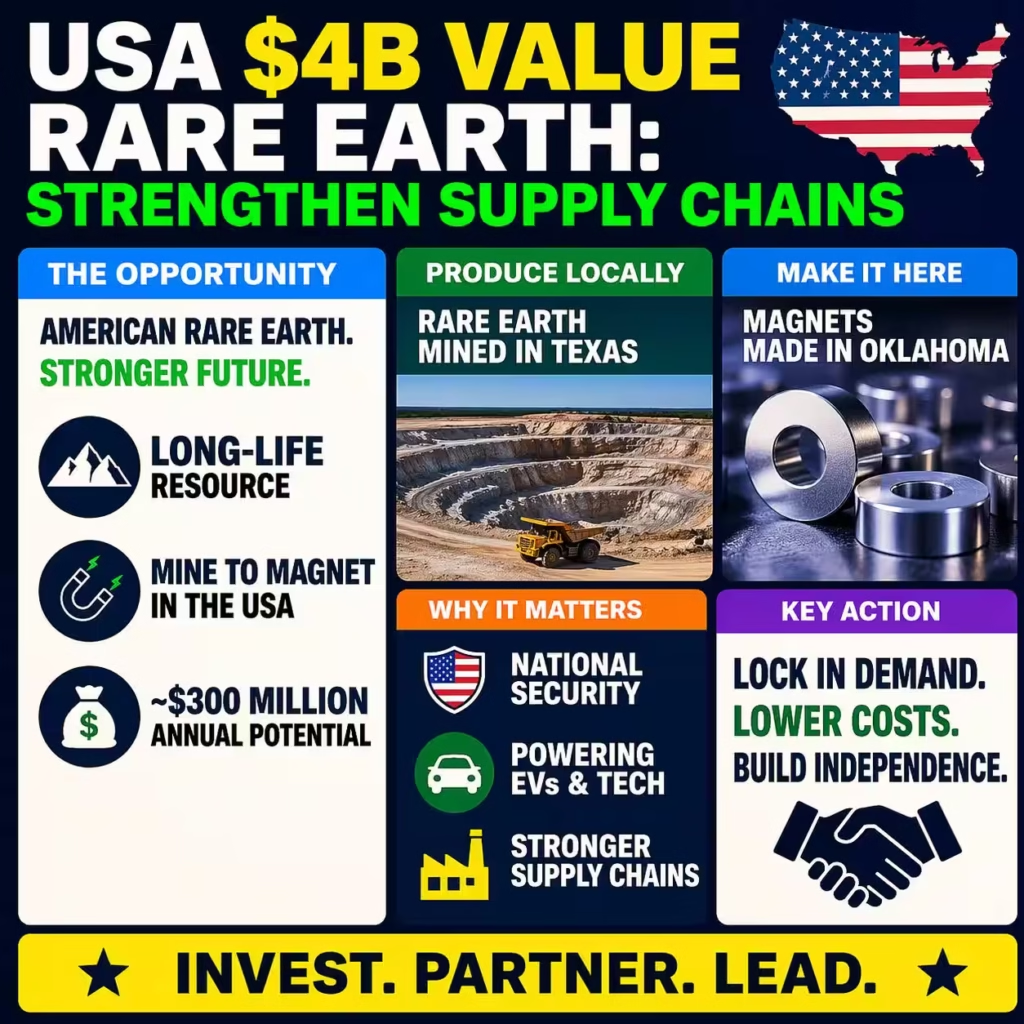
USA Rare Earth (USAR) holds a $4 billion market cap with its Round Top deposit in Texas projecting 20,000 tons of rare earth and critical mineral feedstock daily for up to 20 years and a potential mine life exceeding 100 years. This positions the company for $100 million in annual rare-earth revenue plus $200 million from aluminum and lithium co-products while its Oklahoma neo-magnet facility targets 5,000 tons of magnets yearly in a global market heading toward $30 billion by 2034. Yet high operational costs and inherent mining risks create urgent vulnerabilities that demand immediate strategic fixes.
Recent developments add momentum and scale. In March 2026 USAR completed a $73 million all-stock deal to acquire full control of Round Top making it the sole operator of North America’s richest known source of heavy rare earth elements gallium and beryllium. The company accelerated commercial production to late 2028 two years ahead of schedule and now plans nearly 40,000 metric tons per day of feedstock by 2030 under its Accelerated Mining Plan. These moves align with rising U.S. demand for domestic supply chains.
Global rare earth elements market context sharpens the opportunity. The sector reached approximately $14 billion in 2025 and is forecast to hit $41.1 billion by 2034 at a 12.3 percent CAGR driven by electric vehicles, renewables and defense applications. China controls 70 percent of mining output and over 90 percent of refining capacity leaving the U.S. with less than 2 percent domestic production and chronic import dependence exceeding 75 percent. Round Top’s heavy rare earth focus addresses a critical gap because these elements are vital for high-performance magnets where substitutes remain unavailable.
USAR’s integrated mine-to-magnet strategy stands out. Its 310,000-square-foot Stillwater Oklahoma facility commissioned Phase 1a production in March 2026 with plans to reach 600 tons of sintered neo-magnets annually by year-end scaling toward 1,200 tons in 2027 and full 5,000-ton capacity thereafter. This vertical integration could capture premium pricing and reduce exposure to Chinese magnet exports which fell 75 percent after 2025 . Export controls triggered widespread auto and defense disruptions. Early prototype shipments are already targeting defense automotive and industrial buyers.
Project economics reflects both promise and pressure. Preliminary assessments project strong margins from low-grade but voluminous ore processed via heap leach and advanced separation yet capital intensity remains high with historical estimates exceeding $600 million including contingencies. U.S. policy support including potential Department of Commerce and Defense funding streams offers tailwinds but execution risks around permitting environmental compliance and talent acquisition persist in a sector where only a handful of non-Chinese facilities operate at scale. Round Top therefore represents a pivotal test case for American mineral independence.
L-Impact Solutions Critique on USA Rare Earth Developments
At L-Impact Solutions we view USAR’s Round Top progress as bold yet fundamentally exposed to execution gaps that could erode its $4 billion valuation overnight. The accelerated 2028 production timeline sounds impressive but mining history shows most U.S. critical minerals projects face multi-year delays from permitting and technical hurdles leaving revenue projections overly optimistic. High operational costs tied to processing low-grade Texas rhyolite feedstock risk compressing the promised $300 million annual revenue if rare earth prices fluctuate as they did after China’s 2025 export curbs.
Supply chain concentration remains the core pain point. Even with full Round Top ownership USAR still operates in an ecosystem where China dominates 91 percent of global refining and 94 percent of permanent magnet manufacturing. A single policy shift in Beijing could flood markets or restrict heavy rare earth exports again as seen last year when European and U.S. automakers halted lines. This external vulnerability undermines claims of true U.S. mineral independence and exposes investors to geopolitical shocks beyond company control.
Operational and financial risks complicate criticism. Scaling the Oklahoma magnet facility from 600 tons this year to 5,000 tons requires flawless execution yet current Phase 1 output covers only a fraction of projected U.S. demand growth to $9 billion by 2034. Co-product revenues from aluminum and lithium sound attractive but face their own volatile markets and processing complexities that prior feasibility studies may have understated. Without tighter cost controls and diversified offtake agreements the $4 billion market cap could contract sharply on any earnings miss.
Talent regulatory and environmental gaps widen the critique further. The Texas desert location demands robust water management and community engagement yet few details address long-term reclamation costs or labor shortages in specialized hydrometallurgy. Recent $73 million stake consolidation improves governance but does not solve broader industry issues like underfunded feasibility studies or over-reliance on government incentives that can shift with administrations. At L-Impact Solutions we see these as structural weaknesses that turn high-upside potential into avoidable downside exposure for B2B partners and investors.
| Related Analysis: Realty Income $800M Notes: Build Safer Capital Structure Netflix 9% Share Crash: Optimize Monetization Strategy Figma 6.89% Crash: Strengthen Retention Strategy |
Solutions to Overcome Mining and Operational Challenges
If you lead a mining enterprise or critical minerals investment portfolio you can immediately strengthen USAR’s position by securing multi-year offtake contracts with defense and EV manufacturers to lock in revenue visibility. This de-risks the $300 million annual target and provides cash flow certainty while global rare earth demand grows at double-digit rates through 2034. Pair these agreements with government-backed financing such as the $1.6 billion Department of Commerce pathways already under discussion to fund both Round Top expansion and magnet line scaling without diluting equity.
You should also invest in advanced processing technologies that cut operational costs by 20 to 30 percent. Adopt continuous ion exchange and membrane separation at Round Top to boost recovery rates of heavy rare earths beyond current heap-leach benchmarks while co-producing higher-value lithium carbonate and aluminum sulfate. Integrate AI-driven predictive maintenance across the 40,000-ton-per-day operation by 2030 to minimize downtime and align output precisely with neo-magnet demand projected to reach thousands of tons domestically. These upgrades turn high-cost feedstock into a competitive advantage against Chinese suppliers.
Vertical integration offers another powerful lever. Expand the Stillwater facility beyond 5,000 tons of magnets by forming joint ventures with downstream auto and aerospace partners to co-develop customized NdFeB alloys. This captures margin across the full mine-to-magnet chain and hedges against 2025-style export disruptions that slashed magnet availability by 75 percent. At the same time build a recycling arm that recovers rare earths from end-of-life components to supplement primary production and meet ESG mandates from institutional investors.
You can mitigate price volatility through strategic hedging and diversified markets. Establish a dedicated trading desk to forward-sell rare earth oxides and magnets while exploring Asian and European buyers eager for non-Chinese supply after recent controls. Collaborate with peer U.S. producers like MP Materials to create a North American pricing benchmark that reduces reliance on volatile Chinese indices. These financial tools protect the $4 billion valuation and ensure stable returns even if global REE prices swing 30 percent year-over-year.
Finally you should pursue talent and digital transformation partnerships. Recruit hydrometallurgy specialists through targeted university alliances and deploy blockchain traceability across the supply chain to satisfy defense procurement rules. These steps close the talent gap, accelerate permitting and position your organization as a leader in secure domestic critical minerals production. Implementing this full suite of solutions transforms USAR’s risks into sustainable competitive edges within 24 to 36 months.
Prevention Steps for Future Rare Earth Supply Issues
To prevent recurrence of mining delays and cost overruns you must mandate rigorous pre-feasibility pilots at every stage before committing capital at Round Top scale. Conduct extended hydrometallurgy trials on representative ore samples to validate 40,000-ton-per-day throughput and refine cost estimates well ahead of the 2028 production target. This discipline avoids the multi-year slips that plague 70 percent of new U.S. critical minerals projects and protects your balance sheet from surprise capex inflation.
You should also build regulatory and community buffers early. Engage Texas stakeholders and federal agencies through transparent environmental impact forums and secure streamlined permitting via Defense Production Act priorities. Develop detailed reclamation plans and water-recycling systems from day one to eliminate future legal or reputational roadblocks that could halt operations mid-ramp. Proactive compliance turns potential delays into competitive speed advantages.
Diversify raw material and technology sources as insurance. Secure secondary feedstock from recycling partners and allied nations to supplement Round Top output during any permitting hiccups. Invest in modular separation units that can be redeployed across multiple sites so a single-site disruption never threatens the 5,000-ton magnet goal. This redundancy shields you from geopolitical shocks like the 2025 Chinese export restrictions.
You must embed scenario planning and financial buffers into every budget cycle. Model quarterly stress tests for rare earth price drops of 40 percent or sudden processing bottlenecks and maintain dedicated contingency funds equal to 18 months of operating costs. Require quarterly board reviews of supply chain exposure metrics so you can pivot faster than competitors when China adjusts quotas again. These disciplines keep your $4 billion valuation intact through market cycles.
Finally foster industry-wide collaboration to raise the entire U.S. rare earth ecosystem. Co-fund shared R&D with other domestic players on next-generation magnet alloys and advocated for consistent federal incentives that survive election cycles. By institutionalizing these prevention measures you create lasting resilience that safeguards not only USAR’s Round Top success but the broader American push for mineral independence through 2034 and beyond.
L-Impact Solutions Key Takeaways
At L-Impact Solutions we conclude that USA Rare Earth’s Round Top project delivers unmatched strategic value for U.S. supply chain security yet only disciplined execution will convert its $4 billion potential and 20,000-ton daily scale into durable shareholder returns. The $300 million revenue pathway and 5,000-ton magnet capacity are real but hinge on slashing costs hedging volatility and locking in offtakes today. Ignoring these imperatives and geopolitical or operational shocks will erode value as they did across the sector in 2025.
You now hold a clear roadmap to turn risks into leadership. Secure financing offtakes and technology upgrades immediately then layer in prevention protocols that future-proof every expansion phase. B2B executives who act on this analysis will capture premium margins in a $41 billion global rare earth market while competitors remain tethered to fragile foreign supply. The window for American mineral independence is narrow and USAR sits at its center.
Our final directive is simple: treat Round Top not as a speculative bet but as a national asset requiring rigorous governance and agile execution. Implement the solutions and prevention steps outlined here and you position your organization at the forefront of the next decade’s critical minerals boom. L-Impact Solutions stands ready to partner with forward-thinking leaders who demand results over rhetoric in this high-stakes arena.
FAQs:
What is USA Rare Earth’s projected annual rare earth production and revenue potential?
USAR’s Round Top project targets ~20,000 tons/day feedstock, supporting roughly $100M annual rare earth revenue plus ~$200M from co-products.
How does USAR’s vertical integration into neo-magnet manufacturing impact profitability?
Its Oklahoma magnet facility (5,000 tons/year) enables downstream value capture, improving margins compared to raw material sales.
What are the biggest operational risks facing USAR’s rare earth mining and processing model?
High capital intensity, complex extraction chemistry, and multi-stage execution risks can pressure margins and delay scalability.
How does the global rare earth magnet market growth support USAR’s long-term strategy?
With the magnet market projected to reach ~$30B by 2034, demand from EVs and defense strengthens USAR’s revenue visibility.
What strategic actions can USAR take to mitigate cost and commodity price volatility risks?
Phased scaling, long-term offtake agreements, and government-backed incentives can stabilize cash flow and reduce downside exposure.
Reference – The Best Small-Cap Stock to Buy Right Now for Explosive Long-Term Gains