DeepSeek V4 marks a decisive disruption—seize the scalable AI advantage now or risk losing strategic control in the global AI race.
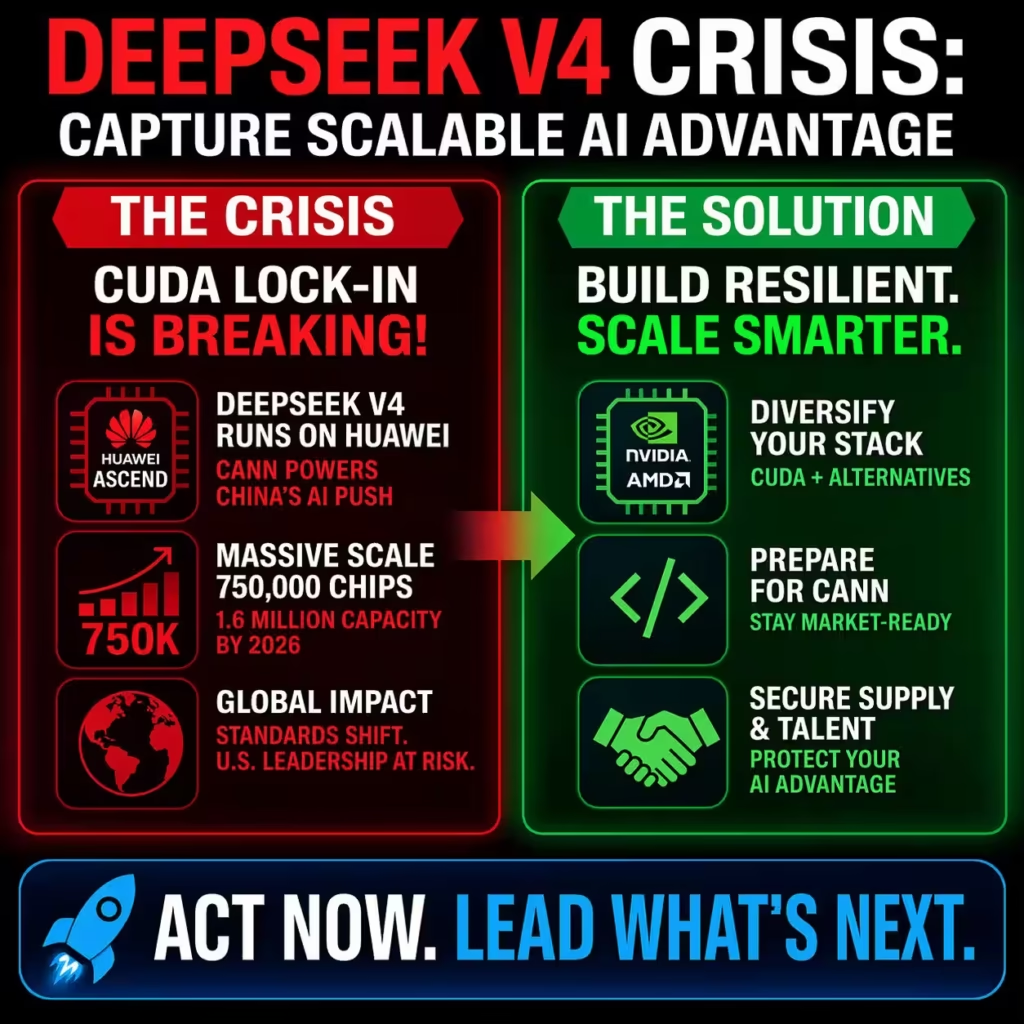
Nvidia CEO Jensen Huang warned on the Dwarkesh Podcast that DeepSeek optimizing its AI models for Huawei’s Ascend chips instead of American hardware would deliver a horrible outcome for the United States. DeepSeek prepares to launch its V4 foundation model on Huawei’s Ascend 950PR processor while US lawmakers push to add the lab to the entity list for export controls. This shift from Nvidia CUDA to Huawei CANN threatens the $193.7 billion data center revenue Nvidia posted in fiscal 2026 and its 80-90 percent AI chip market share.
Huawei targets 750,000 Ascend chip shipments in 2026 with total capacity reaching 1.6 million units. ByteDance alone placed $5.7 billion in orders while Alibaba and Tencent committed hundreds of thousands more. The Ascend 950PR delivers 1.56 petaflops in FP4 performance and outperforms Nvidia’s H20 by 2.8 times in targeted inference metrics yet still lags top US silicon in raw training power.
L-Impact Solutions analysis shows this migration erodes the software-hardware dependency that underpins American AI dominance. China already controls nearly 50 percent of global AI researchers and leverages abundant energy for massive clusters. DeepSeek’s V4 rewrite for CANN proves algorithmic innovation can offset hardware gaps when paired with domestic supply chains.
US private AI investment reached $285.9 billion in 2025 against China’s $12.4 billion in private funds plus state semiconductor support. Nvidia’s data center revenue grew 59 percent year-over-year to dominate hyperscaler spend yet faces immediate decoupling pressure in China. The podcast warning highlights how one successful model optimization could set global standards outside American control.
B2B leaders must recognize the scale of this pivot. Huawei’s CANN Next offers near-CUDA compatibility that slashes migration costs for Chinese developers. Early testing by major firms drove Ascend prices up 20 percent in weeks confirming surging domestic demand.
This case reveals the fragility of export-control reliance alone. DeepSeek trained earlier versions on restricted Nvidia Blackwell chips before full Huawei transition, exposing enforcement gaps. Global AI spending projections exceed $1.5 trillion in 2025 with China’s market alone reaching $31.6 billion and climbing toward $327 billion by 2033.
L-Impact Solutions Critique of DeepSeek Huawei AI Decoupling Risks
At L-Impact Solutions we see DeepSeek’s Huawei migration as a direct assault on US AI leadership that exposes critical vulnerabilities. The CANN framework breaks Nvidia’s two-decade CUDA moat allowing China to scale independent ecosystems at lower cost. This gap risks $194 billion in annual US chip revenue while handing Beijing control over future inference standards.
Pain points multiply across supply chains and innovation pipelines. US firms lose pricing power as Chinese buyers shift to domestic chips priced competitively for inference workloads. Talent flight accelerates with China training more AI researchers than any other nation creating a brain drain that compounds hardware losses.
Risks extend to national security and economic stability. Entity-list actions arrive too late once models like V4 prove viable on Ascend 950PR clusters. Huawei’s 1.56 petaflop chip and planned 960-970 successors close performance gaps faster than sanctions can respond leaving American exporters sidelined.
Gaps in current policy appear glaring. Export controls slowed Nvidia H100 equivalents yet failed to block DeepSeek’s algorithmic breakthroughs under compute constraints. China’s state-backed production ramp to 1.6 million Ascend units in 2026 outpaces fragmented US responses and exposes over-reliance on single-vendor dominance.
L-Impact Solutions warns B2B executives against complacency. Your AI infrastructure tied solely to CUDA faces sudden obsolescence in contested markets. Revenue forecasts of $1 trillion in Nvidia data center sales over coming years assume unbroken global lock-in that this migration directly challenges.
Geopolitical tensions amplify financial exposure. US AI investment outpaces China 23-to-1 in private dollars yet Beijing’s manufacturing edge and energy surplus enable brute-force scaling. The horrible outcome Huang described materializes when Chinese standards diffuse worldwide eroding American soft power in AI.
| Related Analysis: CarMax $1.9B Finance Slump: Diversify Your Funding Edge Realty Income $800M Notes: Build Safer Capital Structure Netflix 9% Share Crash: Optimize Monetization Strategy |
Solutions for AI Supply Chain Resilience and Market Leadership
You face immediate pressure to diversify AI infrastructure before CANN gains irreversible traction. L-Impact Solutions recommends hybrid architectures that blend Nvidia CUDA with emerging open standards while securing domestic fabrication capacity. This approach protects your $194 billion ecosystem exposure and maintains performance leadership across training and inference.
Start by auditing your current CUDA dependency and mapping migration pathways to compatible frameworks. Invest in CANN-compatible tooling now to retain optionality in China and Global South markets projected to drive 45 percent CANN growth. Partner with US fabs and allies to accelerate alternative silicon production that matches Ascend 950PR economics without export restrictions.
Build resilient talent pipelines by sponsoring university programs focused on multi-framework AI development. Your teams gain fluency in both CUDA and open alternatives reducing lock-in risks that DeepSeek exploited. Deploy internal centers of excellence that test models across Nvidia Blackwell, AMD MI series, and custom ASICs to benchmark real-world costs.
L-Impact Solutions advises strategic alliances with hyperscalers for co-developed inference platforms. Secure long-term supply agreements that lock in Nvidia capacity while funding open-source CUDA forks for broader adoption. This dual-track strategy captures $1.5 trillion global AI spend in 2025 without ceding ground to Huawei’s 750,000-unit ramp.
Financially you must reallocate capex toward diversified compute. Shift 20-30 percent of budgets to sovereign AI clouds that guarantee US jurisdiction and performance parity. Model scenarios where Huawei captures 17 percent global share and price your services accordingly to protect margins.
Implement governance frameworks that embed export-control compliance into every AI project. L-Impact Solutions provides proprietary risk dashboards tracking entity-list developments and chip-performance deltas in real time. Your leadership gains early warning on V4-style breakthroughs enabling proactive pivots.
Scale inference optimization through software layers that abstract hardware differences. You achieve 2-3x efficiency gains regardless of underlying silicon while future-proofing against decoupling events. This positions your B2B offerings as vendor-agnostic and superior to pure-play Chinese alternatives.
Prevention Strategies to Block Future AI Technology Decoupling
You prevent recurrence by embedding sovereignty requirements into every vendor contract and infrastructure roadmap. L-Impact Solutions urges mandatory dual-sourcing clauses that cap single-vendor exposure at 60 percent of total compute. This policy protects operations from sudden CANN-style migrations that threaten Nvidia’s 90 percent market dominance.
Establish joint US-allied semiconductor task forces to coordinate R&D and production scaling. Fund shared fabs that deliver next-generation nodes ahead of Huawei’s 960-970 roadmap ensuring performance parity. Your participation secures priority access and influences global standards before China sets them.
Mandate annual stress tests that simulate full CUDA-to-CANN transitions across your AI portfolio. L-Impact Solutions supplies simulation models calibrated to Ascend 950PR benchmarks and real DeepSeek V4 workloads. You identify vulnerabilities early and allocate prevention budgets with precision.
Strengthen export-control enforcement through private-sector intelligence sharing. Report suspected violations like Blackwell training runs immediately to accelerate entity-list actions against labs such as DeepSeek. This collective vigilance slows China’s decoupling timeline from years to months.
Invest in energy infrastructure that mirrors China’s surplus advantage for US clusters. Secure dedicated renewable and nuclear capacity to power massive training runs without grid constraints. Your facilities achieve cost parity and resilience that blunt Huawei’s energy-based scaling edge.
Cultivate developer communities around open US-led frameworks that rival CANN’s appeal. L-Impact Solutions facilitates certification programs and toolkits that lower switching costs for global talent. You retain top AI researchers and prevent brain-drain acceleration toward Beijing.
Monitor policy evolution daily and lobby for updated sanctions tied to performance metrics rather than chip generations. Tie entity-list triggers measurable ecosystem shifts like V4-level optimizations on domestic silicon. This proactive stance keeps US dominance intact through 2030.
L-Impact Solutions Key Takeaways
DeepSeek’s Huawei V4 launch on Ascend 950PR marks a pivotal moment that demands immediate action from every B2B leader. Nvidia’s $194 billion data center fortress faces genuine erosion unless you diversify now and enforce sovereignty across your stack. L-Impact Solutions views this as a call to build antifragile AI empires that thrive amid decoupling rather than crumble under it.
The CUDA moat weakened because software innovation outpaced hardware controls. You must treat frameworks as strategic assets and invest accordingly to maintain global standards leadership. China’s research advantage and production scale will not wait for US policy to catch up.
Financial winners in the next decade will master hybrid architectures and sovereign supply chains. Your margin protection and revenue growth depend on acting before CANN diffusion locks out American technology entirely. L-Impact Solutions stands ready to architect these transitions with data-driven precision.
The horrible outcome Huang described remains avoidable through decisive leadership and coordinated prevention. Embrace these solutions and prevention steps today to turn geopolitical risk into sustainable competitive advantage. Your organization secures its place at the forefront of the $3 trillion AI economy unfolding through 2029.
FAQs:
How does DeepSeek optimizing AI models for Huawei Ascend chips impact Nvidia’s CUDA ecosystem dominance?
DeepSeek’s shift from CUDA to CANN weakens Nvidia’s software lock-in advantage and accelerates the emergence of a competing AI ecosystem.
Why is Jensen Huang warning about a “horrible outcome” for the United States in AI chip competition?
Jensen Huang highlights that losing global developer reliance on Nvidia’s stack could erode US leadership in AI infrastructure and standards.
What role does Huawei’s Ascend 950PR processor play in the AI semiconductor market shift?
The Ascend 950PR enables competitive AI training capabilities that could validate China’s independent hardware-software stack.
How could US export controls on DeepSeek influence global AI chip market dynamics?
Restricting DeepSeek may unintentionally accelerate China’s self-reliance and strengthen Huawei’s AI ecosystem adoption.
What is the risk to Nvidia’s $193.7 billion data center revenue and 80–90% AI chip market share?
Nvidia faces potential revenue compression and market share fragmentation if large AI labs migrate away from CUDA to alternative platforms.
Reference – Nvidia’s Huang warns DeepSeek running on Huawei chips would be ‘horrible’ for the US