Google profit rises 81%, highlighting disciplined, efficient AI scaling strategies for sustainable enterprise growth and ROI.
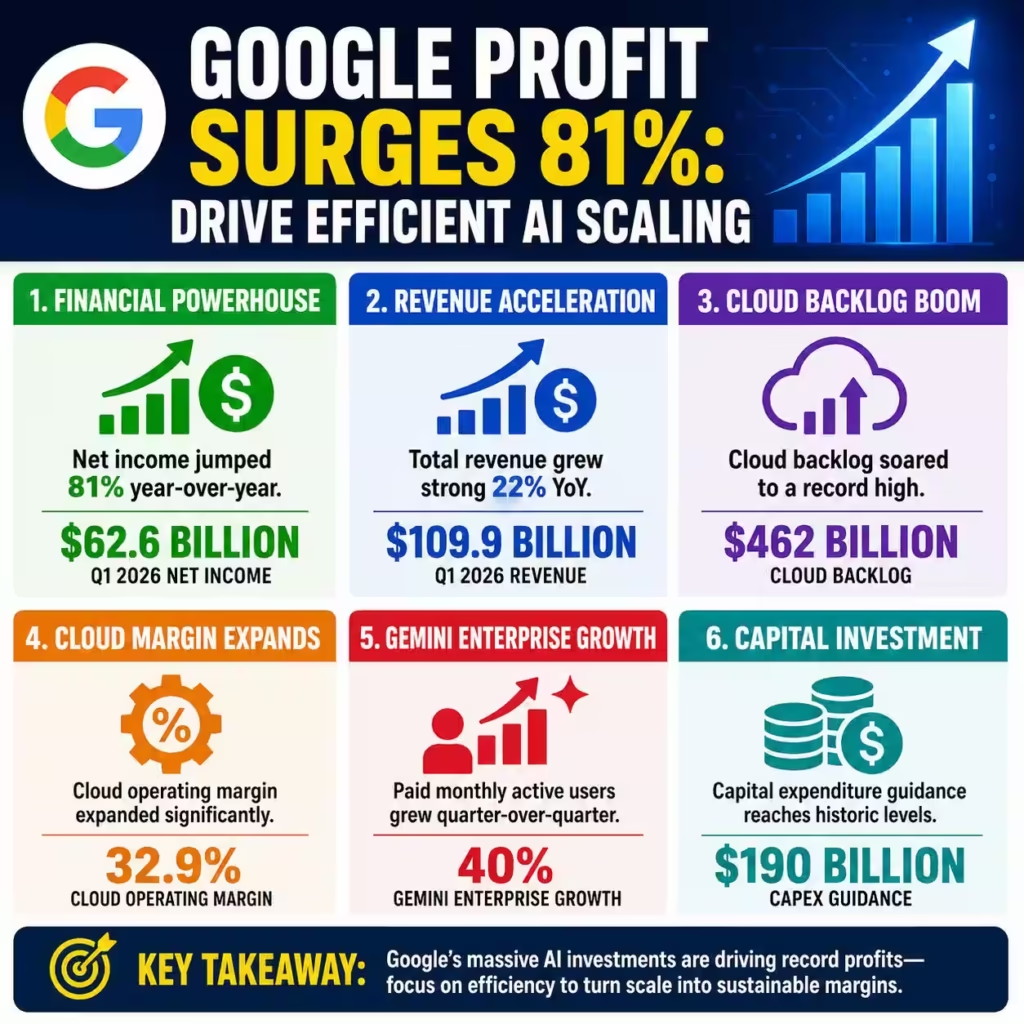
Alphabet’s $62.6 billion net income in Q1 2026 marks an 81% year-over-year explosion, signaling a definitive shift from AI experimentation to industrial-scale monetization. This fiscal dominance, fueled by a 22% surge in total revenue to $109.9 billion, highlights the critical “pain point” of escalating compute costs versus the necessity of staying competitive. While Google’s Cloud backlog has ballooned to $462 billion, our analysis outlines how to navigate the $190 billion capital expenditure war to ensure your enterprise achieves tangible operating margins.
Alphabet reported a monumental 81% jump in net income to $62.6 billion for Q1 2026, driven largely by a massive AI-centric cloud transformation. This result follows an 11th consecutive quarter of double-digit revenue growth, cementing Google’s position as the primary beneficiary of the generative AI infrastructure buildout. By growing its cloud backlog from $240 billion to $462 billion in just one quarter, Google has demonstrated a voracious appetite for long-term AI commitments from the Fortune 500.
Analyzing this performance reveals that Google is effectively using its custom Tensor Processing Units (TPUs) to decouple its growth from traditional GPU supply constraints. While competitors face 18-month lead times for high-end silicon, Google’s in-house hardware allows for a 32.9% operating margin in its cloud division, up from just 17.8% a year ago. The sheer scale of this investment—reaching a capital expenditure guidance of $190 billion—serves as a defensive moat against smaller cloud players and specialized AI startups.
The strategic pivot to a “Gemini-first” ecosystem has resulted in a 40% quarter-over-quarter increase in paid monthly active users for Gemini Enterprise. This surge in high-value B2B subscriptions provides a predictable recurring revenue stream that balances the inherent volatility of the $77.25 billion advertising business. Furthermore, the $32 billion integration of cloud security firm Wiz has fortified Google’s enterprise appeal by addressing the top C-suite concern: AI data leakage.
Search and Other revenue reached $60.4 billion this quarter, representing a 19% increase that defies early predictions of AI-driven search disruption. YouTube advertising followed with $9.9 billion in revenue, as the platform’s AI-powered “Creative Studio” tools increased ad-conversion rates by an average of 14% for enterprise marketers. Total Google Services revenue hit $89.6 billion, providing the massive cash flow necessary to fund the $35.7 billion in quarterly capital expenditures required to maintain leadership.
Strong Critique: L-Impact Solutions on the Risks of Hyper-Scaling
L-Impact Solutions views the Q1 2026 results as a triumph of engineering but a potential “Capex Hangover” risk for the broader B2B ecosystem. The primary gap in the current narrative is the staggering 25% of enterprises that have moved fewer than 40% of their AI experiments into production. We believe that the massive $190 billion spending spree creates a dangerous precedent of “capital intensity” that could crowd out future share buybacks if ROI cycles lengthen beyond 36 months.
The gap between infrastructure spending and actual business process redesign is the “silent killer” of enterprise AI adoption. Only 5% of companies are currently seeing substantial AI ROI, while 60% report minimal revenue gains despite massive cloud spending increases. There is also a high risk of technological obsolescence where today’s $180 billion infrastructure becomes tomorrow’s legacy debt as model efficiency improves.
Operational risks are mounting as the “relentless innovation cadence” mentioned by Sundar Pichai puts immense pressure on corporate culture and governance frameworks. We identify a critical gap in “Agentic AI” readiness, where 75% of companies plan deployment but only 23% have the necessary data security protocols in place. The market is currently rewarding “mentions” and “backlogs,” but the next phase of the cycle will ruthlessly punish those who cannot prove a 1.7x ROI on their cloud investments.
The current “AI-Gold Rush” mentality has led to a 44% surge in global AI spending, which is projected to hit $2.52 trillion by the end of 2026. However, the disconnect between “tokens processed” and “actual dollars saved” remains the most significant risk to the long-term viability of the B2B tech market. Without a strategy to mitigate these “utility bottlenecks,” enterprises risk becoming subservient to the pricing whims of $4 trillion market cap giants like Alphabet.
| Related Analysis: Buffett’s 226% Warning Research Article: Risk Exit Plan DARPA $54.6B Deep Research: Undersea Drone Growth Plan POET 47% Crash: Governance Fix for Stable Growth |
Comprehensive Solutions for B2B AI Integration
To navigate the high-stakes environment of 2026, enterprises must adopt a “Value-First” integration model that prioritizes workload optimization over raw compute volume. The first solution is the implementation of a centralized FinOps framework to manage the rising costs of specialized AI instances, which now carry a 30% premium. Organizations should leverage Google’s TPU availability to perform specific inference tasks, which can reduce operational costs by up to 15% compared to generic clusters.
A second critical solution involves the aggressive “cleaning” and “agentic-readying” of proprietary data sets to improve model accuracy and reduce token waste. Organizations that possess “AI-ready” data report a 26% improvement in business outcomes compared to those struggling with fragmented legacy silos. We recommend the appointment of a Chief AI Officer (CAIO) to bridge the gap between technical infrastructure teams and business unit leaders.
The third pillar of the solution set is the deployment of “Edge AI” for latency-sensitive applications in sectors like manufacturing and financial services. By processing data locally, firms can reduce cloud egress fees, which frequently account for 10-15% of a total monthly cloud bill. Utilizing Google’s new “distributed data center” hardware allows enterprises to maintain compliance while benefiting from the hyperscaler’s advanced orchestration tools.
Companies must move beyond “pilot purgatory” by establishing a three-tiered deployment roadmap that prioritizes low-hanging fruit with a 3.7x average ROI. Tier-one solutions should focus on customer support automation, which has demonstrated a 15% productivity boost for agents using GenAI tools in 2026. Tier-two initiatives should involve AI-powered supply chain forecasting, aiming for the 13x industry value increase projected over the next decade.
Future Prevention: Safeguarding Your Business Against Tech Volatility
Prevention of future AI-related financial crises begins with “Technological Decoupling” to ensure that your business logic remains portable across different cloud providers. Companies must invest in containerization and Kubernetes-native architectures to prevent the “gravity” of a $462 billion backlog from trapping them in unfavorable contracts. L-Impact Solutions advises that firms should limit their long-term cloud commitments to no more than 60% of their projected needs to maintain agility.
The second prevention step is the establishment of “Algorithmic Auditing” protocols to mitigate the risk of model bias and legal liability. As AI “lights up every part of the business,” the surface area for regulatory fines increases exponentially, particularly in the EU and North American markets. Investing in “Explainable AI” (XAI) frameworks ensures that automated decisions in credit, hiring, or supply chain are defensible in a court of regulatory law.
Thirdly, the risk of “Supply Chain Fragility” must be addressed by securing multi-year agreements with hardware and energy providers independent of your primary cloud host. While Google is spending $190 billion on data centers, the underlying power grid remains a significant bottleneck that could lead to service throttling in 2027. Businesses should explore “Sovereign Cloud” options for sensitive data to follow increasingly strict local data localization mandates.
Firms should also implement a “Technological Obsolescence Insurance” policy by favoring modular AI architectures that can swap out underlying LLMs as newer versions emerge. This prevents the “legacy debt” trap where a company is stuck paying for 2025-era token costs while competitors utilize 2027-era efficiency models. Ultimately, prevention is about maintaining the “Right to Pivot” in a landscape that changes faster than any previous industrial revolution in human history.
L-Impact Solutions Key Takeaway
The 81% profit jump for Alphabet is a clarion call that the era of “wait and see” is officially over for the B2B sector. You cannot ignore the $462 billion signal that the global elite is betting their entire balance sheets on AI-driven efficiency. This massive backlog indicates that nearly 50% of commitments will convert to revenue within 24 months, leaving no room for late adopters.
The 63% surge in Cloud revenue proves that the $190 billion infrastructure moat is widening the gap between leaders and laggards. We identify that Gemini Enterprise adoption grew 40% this quarter, highlighting that the value shift is moving from raw compute to high-level reasoning agents. You must bridge the gap between their massive 16-billion-token-per-minute compute power and your unique, proprietary business logic to survive this shift.
Strategic success in 2026 requires moving beyond the “vanity metrics” of AI pilots toward a disciplined focus on the 1.7x average ROI reported by market leaders. Enterprises that fail to implement “Governance as Code” and robust FinOps risk a 30% capital penalty on unoptimized cloud instances. Ultimately, your profitability depends on owning the value layer of AI while the hyperscalers own the infrastructure layer.
FAQs:
With Alphabet posting $62.6B profit (+81%) and $190B capex, why are only 5% of enterprises achieving real AI ROI?
Because most firms are scaling compute before redesigning core workflows, turning AI into a cost center instead of a value engine.
How does a $462B cloud backlog and 63% cloud growth still translate into 60% of companies reporting minimal revenue gains?
The backlog reflects commitments, not outcomes—without execution discipline, enterprises are prepaying for capacity they can’t monetize.
Why are enterprises paying a 30% premium for AI infrastructure while facing just 1.7x average ROI expectations?
Because weak FinOps governance allows unchecked experimentation, eroding margins faster than value realization.
With global AI spending projected at $2.52T (+44%), what is causing 25% of firms to keep over 60% of AI projects stuck in the pilot stage?
Organizations are over-indexing on tools and underinvesting in data readiness and change management, creating “pilot purgatory.”
How can $190B infrastructure investments risk becoming “legacy debt” amid rapidly improving AI model efficiency?
Without modular architectures, companies lock into today’s expensive compute stack and miss tomorrow’s efficiency gains, compounding sunk costs.