Viasat (NASDAQ: VSAT) surged nearly 19% on Thursday, leading a banner day for satellite stock investors as Globalstar emerged at the center of a concentrated acquisition effort reportedly valued near $9 billion with Amazon. The broader sector rallied on takeover speculation, underscoring the intense volatility that can lift shares overnight in a market hungry for consolidation plays.
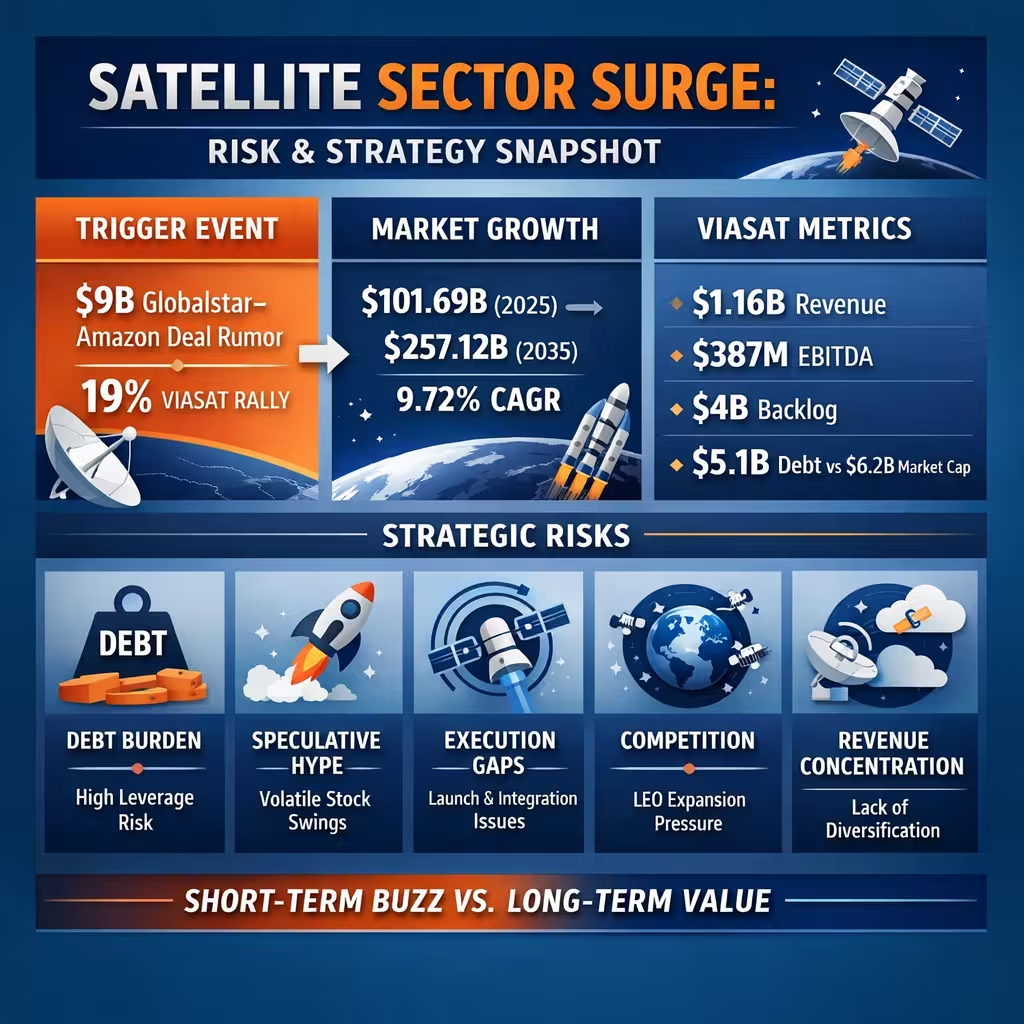
The global satellite communications market reached $101.69 billion in 2025 and now projects to hit $257.12 billion by 2035 at a 9.72% CAGR according to recent industry forecasts. Viasat itself reported Q3 fiscal 2026 revenue of $1.16 billion up 3% year-over-year with adjusted EBITDA at $387 million and a backlog nearing $4 billion. These figures reveal solid operational momentum yet the 19% single-day pop also highlights how rumor-driven sentiment can eclipse fundamentals in an instant.
Viasat’s market capitalization stands near $6.2 billion while net debt sits at approximately $5.1 billion following the 2023 Inmarsat acquisition worth $7.3 billion. The stock has climbed roughly 31% year-to-date from around $34 to current levels near $45 amid optimism over ViaSat-3 satellite deployments. Such rapid moves demonstrate the sector’s sensitivity to M&A headlines that promise scale against low-Earth-orbit giants like Starlink with its 10,000-plus satellite network.
L-Impact Solutions views this case as emblematic of broader satellite industry dynamics where acquisition buzz can deliver quick wins for shareholders. The Globalstar talks spotlight Amazon’s push to rival SpaceX ahead of its potential IPO valued up to $1.75 trillion. Yet the surge also exposes the pain of fleeting gains that leave companies vulnerable once the hype fades without deeper strategic execution.
L-Impact Solutions Critique: Pain Points Risks and Gaps Exposed by Viasat News
At L-Impact Solutions we see the Viasat 19% rally as a classic symptom of deeper pain points that plague satellite stocks during acquisition waves. High debt loads like Viasat’s $5.1 billion net debt against a $6.2 billion market cap create fragility especially after large deals such as the Inmarsat integration. This leverage restricts flexibility and raises interest coverage concerns even as free cash flow turned positive at roughly $440 million in the latest quarter.
Speculative rallies fueled by Globalstar takeover rumors introduce significant risks of sharp reversals once details emerge or negotiations stall. Satellite operators face execution gaps around next-generation constellations like ViaSat-3 where launch delays could erode the very momentum that drove Thursday’s gains. Broader sector competition from Starlink’s massive low-Earth-orbit presence adds pressure that rumor-driven optimism often masks in the short term.
Regulatory and geopolitical gaps further complicate the picture for firms riding M&A waves. Spectrum allocation scrutiny and cross-border deal approvals can delay or derail transactions as seen in recent SES-Intelsat $3.1 billion consolidation. Viasat and peers also grapple with integration challenges post-acquisition where synergies from Inmarsat have yet to fully offset the debt burden accumulated since 2023.
Our analysis at L-Impact Solutions flags the absence of diversified revenue streams beyond broadband services as a critical vulnerability. Defense contracts offer stability yet many players remain overly exposed to commercial volatility in a $101.69 billion market growing at 9.72% CAGR. These gaps risk turning temporary 19% surges into long-term value destruction if companies fail to address underlying structural weaknesses proactively.
Capital Structure Discipline as the True Differentiator in Satellite Consolidation
The current surge in satellite stock valuations masks a critical reality: capital structure, not capacity, will ultimately determine long-term winners. With leverage levels approaching parity with market capitalization in cases like Viasat, balance sheet resilience becomes the primary constraint on strategic agility. Companies entering consolidation cycles without optimized debt profiles risk being structurally sidelined, regardless of technological capability or backlog strength.
From a financial engineering standpoint, the sector is transitioning into a phase where cost of capital arbitrage and refinancing strategy directly influence competitive positioning. Firms that proactively align debt maturities with cash flow inflection points—such as satellite deployment milestones—can unlock disproportionate value. In contrast, those carrying legacy acquisition debt without restructuring will face margin compression and reduced optionality in future M&A participation.
Therefore, leadership teams must elevate capital allocation to a board-level strategic priority, integrating dynamic leverage thresholds, scenario-based liquidity planning, and covenant-sensitive growth modeling into their operating frameworks. In an environment driven by episodic valuation spikes, disciplined capital structure management is no longer a defensive tactic—it is a decisive offensive advantage that separates transient performers from enduring market leaders.
Solutions: Strategic Moves You Can Take to Capitalize on Satellite Opportunities
As a business leader in the satellite sector you can start by conducting a thorough debt refinancing review to ease the pressure Viasat faces with its $5.1 billion net debt load. Partner with investment banks to secure lower-interest facilities tied to ViaSat-3 revenue milestones and free up capital for growth initiatives. This step stabilizes your balance sheet while preserving the momentum from recent rallies like the 19% Viasat surge.
You should also accelerate strategic partnerships that diversify beyond traditional broadband into direct-to-device services and defense applications. Explore alliances similar to those boosting Viasat’s backlog to nearly $4 billion in Q3 fiscal 2026 by targeting government contracts that deliver predictable cash flows. Such moves position your firm to capture share in the satellite communications market expanding from $101.69 billion in 2025 toward $257.12 billion by 2035.
Next evaluate your constellation rollout timeline with a focus on ViaSat-3 execution to convert acquisition hype into tangible capacity advantages. Benchmark against competitors like Starlink’s 10,000-satellite scale and prioritize high-throughput deployments that support Amazon-style Globalstar deals. You will unlock higher margins and reduce reliance on rumor-driven stock pops that can evaporate quickly.
You can implement robust M&A due diligence frameworks that stress-test targets like Globalstar for spectrum value and integration risks before jumping into bidding wars. Assemble cross-functional teams to model post-deal synergies against real-world benchmarks such as Viasat’s Inmarsat experience since 2023. This disciplined approach turns volatile 19% rallies into sustainable value creation across the sector.
Finally invest in advanced analytics tools to monitor real-time market signals and competitor moves in the low-Earth-orbit space. You should allocate a budget for AI-driven scenario planning that anticipates SpaceX IPO impacts and regulatory shifts. These solutions empower you to lead rather than react when acquisition efforts ignite the next satellite stocks wave.
Prevention Steps: Safeguarding Your Business Against Future Satellite Issues
To prevent recurrence of rumor-fueled volatility you must establish ongoing debt monitoring protocols that flag risks early before levels approach Viasat’s current $5.1 billion net position. Schedule quarterly stress tests tied to interest coverage and free cash flow metrics like the $440 million positive print in recent results. This vigilance keeps your capital structure resilient amid market swings.
Build diversified revenue pipelines by mandating at least 30% of new contracts from defense and enterprise segments to buffer against commercial broadband cycles. Track industry benchmarks such as the 9.72% CAGR in the $101.69 billion satellite communications market and adjust allocations proactively. You avoid overexposure that amplifies pain during acquisition hype periods.
Institute rigorous scenario planning exercises that simulate Globalstar-style takeover talks alongside Starlink competitive pressures and regulatory hurdles. Conduct annual tabletop reviews with legal and finance teams to map outcomes for deals valued near $9 billion or larger. These steps strengthen your organization against execution gaps that erode gains after 19% rallies.
Foster internal governance standards for M&A participation that require board-level approval only after independent third-party valuations confirm synergies. Reference past integrations like Viasat’s Inmarsat transaction to set clear success thresholds on backlog growth toward $4 billion targets. Prevention here stops reactive decisions that invite long-term financial distress.
Finally cultivate a culture of continuous technology investment in next-generation satellites and ground infrastructure to stay ahead of low-Earth-orbit disruptions. Allocate dedicated R&D funds scaled to your market cap size around $6 billion levels and benchmark against peers launching ViaSat-3 equivalents. This proactive stance ensures future issues never derail the sustainable growth your satellite business deserves.
L-Impact Solutions Key Takeaway on Satellite Stocks and M&A Dynamics
In our strongly held view at L-Impact Solutions the Viasat 19% rally on Globalstar acquisition news signals a pivotal moment where satellite leaders must choose disciplined execution over fleeting speculation. With the market barreling from $101.69 billion toward $257 billion you cannot afford to chase hype without first fortifying debt positions, backlog pipelines and competitive moats against Starlink dominance. The real winners will emerge by turning volatility into strategic advantage through the solutions and prevention steps outlined here.
We believe companies that act now on refinancing partnerships and rigorous due diligence will not only survive but thrive in this high-stakes consolidation era. Ignore the gaps we critiqued and risk repeating the cycle of sharp surges followed by painful corrections that have defined the sector for years. L-Impact Solutions stands ready to guide your organization toward resilient profitable growth in the satellite communications landscape.
Our final opinion is clear: embrace these insights today and transform acquisition-driven opportunities into lasting enterprise value that outpaces any single-day 19% move. The future belongs to prepared leaders who prioritize fundamentals over frenzy in this rapidly expanding industry.
Reference – Why Viasat Stock Soared Almost 19% Higher Today