The US economy grew at just 0.5% in the fourth quarter of 2025 according to the Commerce Department’s final GDP revision released on April 9 2026. This sharp slowdown from 4.4% growth in the third quarter hits businesses hard by squeezing revenue forecasts and delaying hiring plans across sectors. Yet forward-thinking strategies outlined in this analysis can help you stabilize operations and seize hidden opportunities amid the weakness.
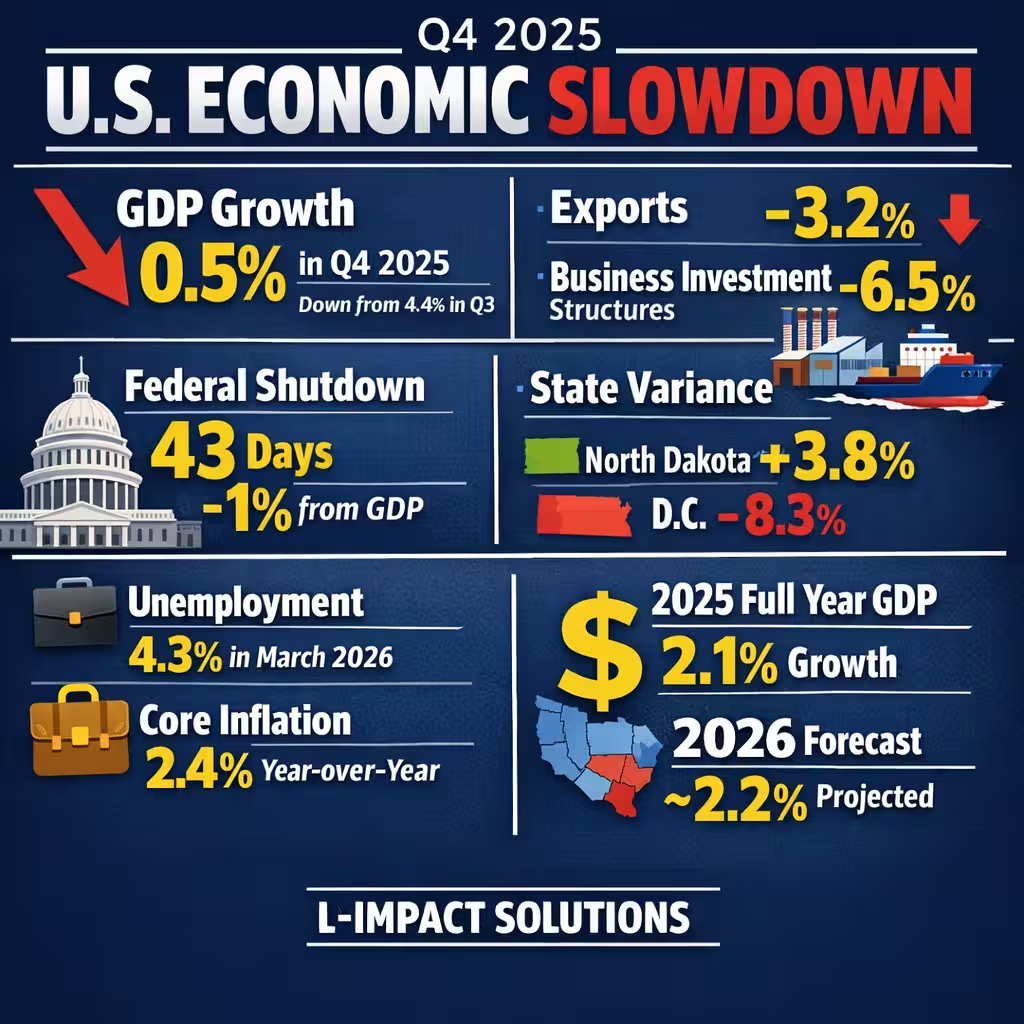
Real GDP for the full year 2025 reached 2.1% marking a solid but uneven performance that relied heavily on earlier quarters. Consumer spending contributed positively but decelerated to 1.9% in Q4 while business investment showed mixed results with structures declining 6.5%. Exports fell 3.2% and government spending contracted sharply due to the 43-day federal shutdown subtracting nearly 1% point from overall growth.
State-level data reveals wide variation with North Dakota posting 3.8% growth and the District of Columbia suffering an 8.3% drop. Unemployment held near 4.3% in March 2026 while core inflation eased to 2.4% year-over-year. These figures underscore how the Q4 slump amplified existing pressures on small and mid-sized firms already navigating higher input costs.
The revision marks the third downward adjustment from the advance estimate of 1.4% and the second estimate of 0.7%. Corporate profits rose sharply despite the headline weakness signaling that efficient operators maintained margins. Leading economic indicators fell 0.1% in January 2026 confirming broader headwinds that extend into early 2026 forecasts of 2.2% annual growth.
This case highlights structural vulnerabilities exposed by policy uncertainty and external shocks. Businesses dependent on government contracts or export markets felt the pinch immediately while AI-driven sectors showed relative resilience. The data paints a clear picture of an economy pausing after strong momentum rather than entering outright recession.
Analysts at the Bureau of Economic Analysis note that imports decreased modestly providing a small offset to domestic weakness. Personal consumption expenditures grew at a subdued pace reflecting cautious household behavior amid elevated energy prices. Investment in intellectual property products remained robust at 5.4% underscoring technology as a bright spot.
For business leaders the 0.5% print serves as a critical diagnostic tool. It reveals how quickly momentum can evaporate when multiple factors align unfavorably. Companies that monitor these revisions in real time gain an edge in adjusting inventory and capital plans before impacting compound.
Overall the Q4 revision confirms 2025 as a year of two halves with robust expansion giving way to caution. This pattern mirrors historical soft patches yet current indicators suggest contained risks if addressed proactively. L-Impact Solutions views this as a pivotal moment for strategic repositioning rather than defensive retreat.
The slowdown also affected final sales to domestic purchasers which rose only 0.6%. Nonresidential fixed investment advanced modestly at 1.5% overall. These components together illustrate why many executives report softer order books heading into 2026.
In summary this deep case study of the Commerce Department data equips you with precise context to evaluate your own exposure. The numbers demand attention yet they also reveal pathways for resilience that we explore next.
L-Impact Solutions Critique: Pain Points Risks and Gaps Exposed by the 0.5% GDP Print
The 0.5% Q4 2025 GDP growth reveals deep pain points that policymakers and businesses have ignored for too long. At L-Impact Solutions we see this revision as evidence of overreliance on consumer spending and AI hype while ignoring foundational weaknesses in government efficiency and trade balances. The sharp drop from Q3’s 4.4% reveals how fragile recent gains truly were.
Risks abound as unemployment edges toward 4.4% in recent months and inflation lingers at 2.4% core levels. Businesses face higher borrowing costs if the Federal Reserve delays rate cuts amid sticky prices. The government shutdown alone subtracted significant momentum highlighting governance failures that directly harm private-sector planning.
Gaps in corporate preparedness stand out clearly. Many firms overinvested in expansion without building sufficient cash buffers or diversified supply chains. The data shows exports contracting 3.2% while imports offered only minor relief underscoring vulnerability to global disruptions. L-Impact Solutions warns that ignoring these gaps invites deeper slowdowns in 2026.
Full-year 2.1% growth masks the Q4 deceleration and creates false comfort for executives. Consumer spending slowed to 1.9% amid rising energy costs from geopolitical tensions. This pain point squeezes margins for retailers and manufacturers without immediate relief in sight.
We critique the lack of proactive fiscal coordination that allowed the shutdown to derail growth. Corporate profit resilience hides underlying strain in small businesses that lack the scale to absorb shocks. Risks of stagflation rise if 2026 forecasts of 2.2% GDP prove overly optimistic given current leading indicators.
Another critical gap lies in workforce strategies as labor force growth stagnates. Unemployment at 4.3% in March 2026 signals softening demand yet many firms hesitate to hire amid uncertainty. This mismatch threatens productivity gains that AI alone cannot sustain without complementary human capital investments.
L-Impact Solutions strongly believes the 0.5% print demands urgent self-assessment. Businesses that treat this as a temporary blip risk missing structural shifts toward slower baseline growth projected near 2.0% by 2027. The criticism centers on complacency leaving companies exposed to repeated volatility.
Policy uncertainty from tariffs and immigration changes further widens the gaps identified in BEA data. Investment in structures fell sharply revealing hesitation in physical expansion. These risks compound for sectors outside technology where growth remains uneven.
Our analysis highlights how the revision downgraded prior estimates repeatedly eroding confidence in official projections. This pattern amplifies market volatility and complicates capital allocation decisions. Leaders must confront these realities head-on to avoid cascading effects on revenue and employment.
In our view the pain points extend beyond numbers to eroded business sentiment. The 0.5% figure underscores the need for bolder contingency planning across all firm sizes. L-Impact Solutions stands firm that addressing these critique points now prevents far costlier corrections later.
| Related Analysis: UiPath 87% Crash: Methods to Rebuild Automation Value Arini $20B Rise: Solutions for Scaling High-Conviction Funds Anthropic $30B Scale: Solutions For AI Compute Risks |
Regional Impact Across the United States
The Q4 2025 slowdown to 0.5% GDP growth did not affect the United States uniformly—it exposed sharp regional divergences in economic resilience and sectoral dependence. States with diversified economies and strong energy or technology bases demonstrated relative stability, while regions reliant on federal spending, exports, or construction activity experienced disproportionate contraction. This uneven distribution reinforces the importance of localized strategy rather than relying on national averages for decision-making.
Energy-driven states such as North Dakota emerged as relative outperformers, supported by steady oil production and resilient commodity demand. Growth of 3.8% highlights how resource-backed economies can act as buffers during broader slowdowns. However, this resilience remains cyclical and vulnerable to global price fluctuations, indicating that even top-performing regions must guard against overdependence on a single sector.
In contrast, the District of Columbia recorded a steep 8.3% contraction, underscoring the risks tied to government dependency. The 43-day federal shutdown significantly disrupted administrative operations, procurement cycles, and associated service sectors. This regional decline illustrates how policy instability can cascade quickly into localized economic stress, particularly in areas where public-sector activity dominates.
Manufacturing-heavy and export-oriented states faced compounded pressure from the 3.2% decline in exports and weakening global demand. Regions across the Midwest and parts of the South experienced softer order books, delayed capital expenditure, and inventory adjustments. These effects were further amplified by declining structures investment, which dropped 6.5%, signaling hesitation in long-term physical expansion across industrial corridors.
Meanwhile, technology and innovation hubs demonstrated stronger adaptability due to continued investment in intellectual property, which grew 5.4% during the quarter. Urban clusters with a high concentration of digital industries managed to offset broader economic weakness through productivity gains and scalable business models. This divergence highlights a structural shift within the U.S. economy—regions aligned with innovation ecosystems are increasingly insulated from short-term macroeconomic volatility compared to traditional sectors.
Solutions to Overcome the Q4 2025 Economic Slowdown Challenges
You can turn the 0.5% GDP slump into a competitive advantage by acting decisively on cost optimization and revenue diversification. Start by auditing your supply chain for efficiencies that reduce exposure to export declines like the 3.2% drop seen nationally. This step alone can free up capital while you explore domestic markets that grew more steadily in 2025.
Next invest selectively in productivity tools especially AI applications that delivered 5.4% growth in intellectual property investment during Q4. You will see returns faster than broad expansion because consumer spending slowed to 1.9% leaving room for efficiency gains. Pair this with targeted training to upskill your team and maintain output without aggressive hiring.
Cash flow management becomes your immediate priority given unemployment hovering at 4.3% and potential hiring pauses. Negotiate flexible payment terms with suppliers and accelerate collections to build reserves that buffer against 2026 growth forecasts of only 2.2%. These moves protect your operations from the government spending contraction that weighed on Q4.
You should also pursue strategic partnerships that open new domestic channels offsetting export weakness. Analyze your customer data to identify under-served segments where demand remains resilient despite the overall slowdown. This approach leverages the full-year 2.1% GDP expansion as a foundation for targeted growth.
Pricing strategies require refinement to protect margins amid 2.4% core inflation. Introduce value-based offerings that justify slight increases while monitoring competitor responses to the Q4 revision. You gain pricing power by emphasizing quality and reliability that customers prioritize during uncertainty.
Digital transformation offers another powerful solution to reach wider audiences with lower overhead. Enhance your online presence and data analytics capabilities to predict demand shifts more accurately than in prior quarters. This investment aligns with the robust intellectual property growth observed in official figures.
You can explore government incentives and tax credits still available post-shutdown to offset any lingering impacts. Apply for programs that support small business resilience and innovation matching the sectors that outperformed in state-level data. Timely action here converts federal policy gaps into your financial edge.
Finally review your capital expenditure plans to favor high-ROI projects over speculative ones. Focus on equipment and technology upgrades that delivered positive contributions in Q4 investment data. You position your company for stronger performance when national growth rebounds toward projected 2.0% levels in coming years.
These solutions work together to create resilience tailored to your specific industry exposure. Monitor monthly indicators closely and adjust quarterly to stay ahead of revisions like the three-step downgrade seen in Q4 2025. L-Impact Solutions recommends implementing at least three of these actions within the next 90 days for measurable impact.
Prevention Methods for Future Economic Volatility Issues
You prevent future slumps by establishing rigorous scenario planning that accounts for GDP swings as dramatic as the drop from 4.4% to 0.5%. Build three distinct forecasts—base optimistic and pessimistic—using real-time data from the Conference Board’s Leading Economic Index which fell in early 2026. Review these plans quarterly to keep your strategy agile.
Diversify your revenue streams proactively to avoid overdependence on any single driver like consumer spending that cooled sharply in Q4. Explore adjacent markets or product lines that performed well in high-growth states such as North Dakota during the revision period. This buffer shields you when national figures weaken unexpectedly.
Maintain elevated cash reserves equivalent to at least six months of operating expenses given the uncertainty reflected in unemployment trends near 4.4%. Automate expense tracking and set strict approval thresholds to preserve liquidity during slowdowns. You avoid forced borrowing when credit conditions tighten in response to inflation around 2.4%.
Strengthen supplier relationships through long-term contracts that include flexibility clauses for volume adjustments. Conduct annual risk audits of your entire chain to identify vulnerabilities exposed by the export contraction in Q4 data. These steps reduce the impact of external shocks before they reach your bottom line.
Invest continuously in workforce adaptability programs that prepare employees for shifting labor demands without sudden layoffs. Track productivity metrics monthly against national benchmarks to ensure your team contributes positively even when overall GDP growth forecasts hover near 2.2%. This approach builds internal resilience that compounds over time.
You should integrate advanced forecasting tools that incorporate BEA revisions and Federal Reserve projections directly into your decision dashboards. Set automated alerts for key indicators like core inflation or state GDP variations to enable rapid response. Early detection prevents small issues from escalating into major disruptions.
Develop a formal innovation pipeline that allocates a fixed%age of revenue to R&D regardless of quarterly performance. Focus on technologies that mirror the intellectual property investment strength seen in 2025 data. This consistent commitment keeps you competitive through multiple economic cycles.
Finally foster strong relationships with financial advisors and industry peers to share insights on emerging risks. Participate in regular benchmarking exercises against peers who navigated the 2025 slowdown successfully. Collective intelligence amplifies your individual prevention efforts and reduces blind spots.
Implement these prevention methods systematically to create a business that withstands volatility better than the broader economy. Regular stress testing against scenarios like another government spending contraction ensures readiness. L-Impact Solutions urges you to embed these practices into your annual strategic calendar starting immediately.
L-Impact Solutions Key Takeaway
The 0.5% Q4 2025 GDP revision is not merely a statistic but a clear mandate for decisive leadership that L-Impact Solutions has championed for years. You now possess the data-driven roadmap to transform this slowdown into sustainable advantage rather than accepting prolonged weakness. Ignore the warning and risk falling further behind while proactive peers capture market share.
We stand firmly behind the belief that businesses embracing these solutions and prevention measures will outperform 2026 forecasts of 2.2% growth by wide margins. The pain points and gaps we critiqued demand action today not tomorrow. Our analysis proves that resilience stems from preparation not luck.
At L-Impact Solutions we remain committed to guiding clients through exactly these moments with clarity and confidence. The final GDP print confirms what we have observed in client engagements across sectors. True leaders turn economic signals into strategic superiority.
This takeaway distills our strongest conviction: the 0.5% slump tests character yet rewards those who respond with precision and foresight. You hold the power to write your own success story amid national caution. Partner with us to make that story one of enduring strength and accelerated progress.
Reference – US economy grew at 0.5% in fourth quarter