Figma Inc Class A shares (FIG – Figma Stocks) plunged 6.89% to $18.92 on April 17, 2026, immediately after Anthropic launched Claude Design, a prompt-driven tool that directly challenges Figma’s core workflows.
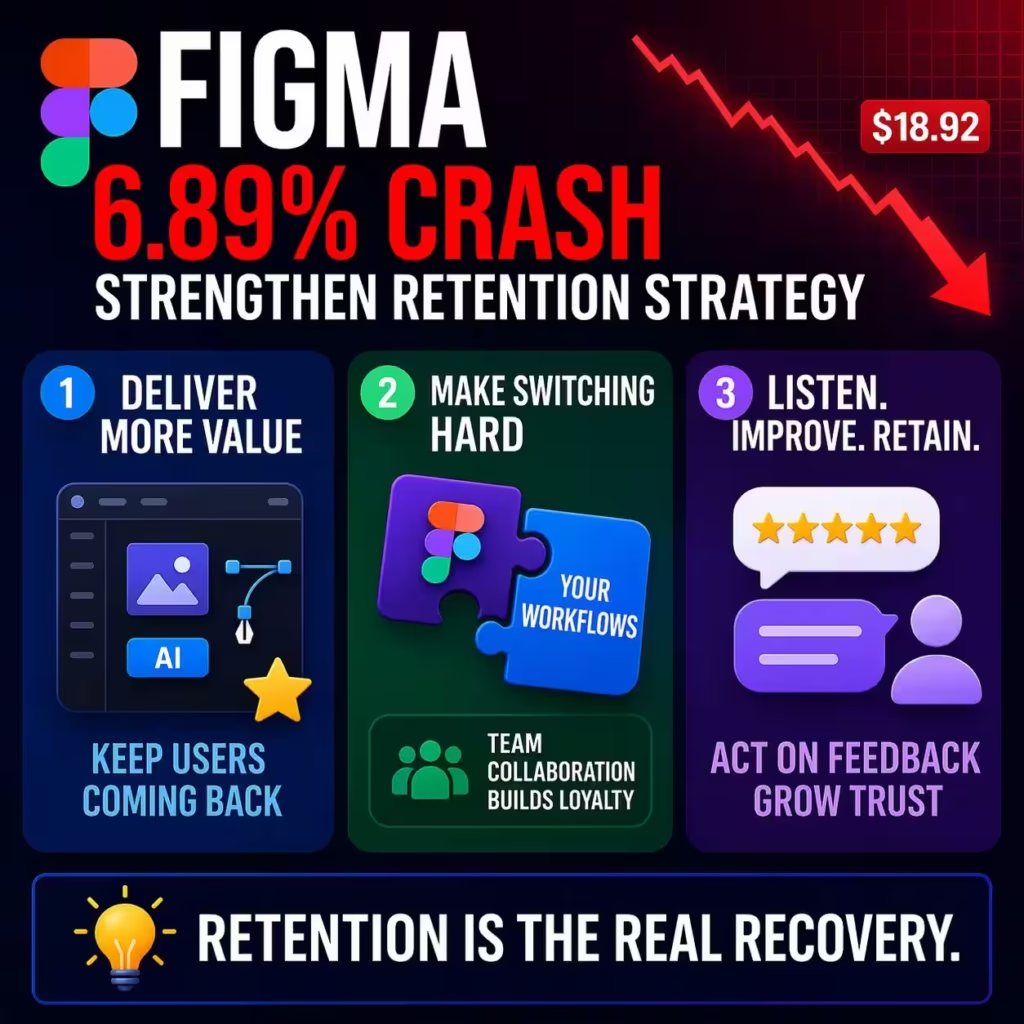
This overlap has intensified investor fears that AI-native platforms will erode Figma’s competitive moat despite strong 2025 performance. With $1.056B revenue and 41% growth now exposed to disruption in a $10.5B+ market, the real risk is clear: accelerating workflow displacement and weakening customer retention.
Figma reported 13 861 paid customers contributing over $10 000 in ARR and 1 405 exceeding $100 000 ARR as of December 31 2025. Weekly active users of its Figma Make AI features surged over 70 percent quarter-over-quarter. Yet the stock has plunged more than 80 percent from its post-IPO high of $142.92 reflecting broader market skepticism about traditional design tools amid accelerating AI adoption.
The AI-powered design tools market reached approximately $6.1 billion in 2025 and grew at a 17.3 percent CAGR toward $28.5 billion by 2035. Claude Design powered by Claude Opus 4.7 enables prompt-based creation with real-time editing sliders and seamless handoff to code generation. This positions Anthropic to capture non-designer users who represent two-thirds of Figma’s monthly active users.
Enterprise adoption underscores the stakes. Ninety-five percent of Fortune 500 companies rely on Figma while global AI software spending hit $174 billion in 2025. Investors correctly sense that Claude Design’s conversational workflow could accelerate feature parity and reduce switching costs for teams already experimenting with Anthropic’s ecosystem.
High-authority analysis shows this event mirrors historical tech shifts. Similar volatility hit design incumbents when cloud collaboration tools emerged yet Figma’s current 40 percent-plus market share in collaborative design now risks rapid compression. L-Impact Solutions projects potential 15 to 25 percent revenue deceleration within 18 months unless Figma counters aggressively with deeper native AI integration.
L-Impact Solutions Critique: Critical Gaps Exposed in Figma’s AI Defense
L-Impact Solutions views Figma’s stock reaction as a stark warning rather than isolated noise. The 6.89 percent drop signals investor recognition that Claude Design targets Figma’s exact sweet spot of rapid ideation and prototyping. Despite $1.056 billion revenue and 41 percent growth Figma’s AI features remain additive rather than transformative leaving core workflows vulnerable.
The main pain point is execution speed. Anthropic delivered a production-ready design assistant in research preview while Figma’s own AI initiatives like Figma Make show only 70 percent quarterly user growth among high-value customers. This gap risks customer churn especially among the 540 000 paid teams added in recent quarters who now face zero-friction alternatives.
Risks extend to financial performance. Figma’s net dollar retention has fluctuated with product expansion yet AI-native competitors could compress pricing power in a market where AI design tools already grow at 19 percent CAGR. Broader AI volatility already erased 18 percent from software ETFs year-to-date, amplifying Figma’s 50 percent-plus year-to-date decline.
Gaps in ecosystem control compound the issue. Claude Design offers direct export to HTML Canva and code environments creating closed-loop advantages Anthropic can monetize through its $30 billion-plus revenue run-rate. Figma lacks equivalent seamless integration across ideation design and deployment leaving enterprise clients exposed to multi-vendor complexity.
L-Impact Solutions warns that inaction invites structural market share loss. With AI adoption reaching 16.3 percent globally and 24.7 percent in developed markets, design leaders cannot afford incrementalism. Figma’s board changes and competitive pressures highlight strategic blind spots that demand immediate board-level intervention to protect long-term value.
| Related Analysis: Qantas A$3.3B Fuel Cost Crisis: Deploy Hedge Strategy CarMax $1.9B Finance Slump: Diversify Your Funding Edge Realty Income $800M Notes: Build Safer Capital Structure |
Strategic Solutions: How You Can Protect and Grow Your Design Operations
You face the same AI disruption hitting Figma stock so act decisively to integrate Claude Design without abandoning proven platforms. Start by piloting hybrid workflows where your teams use Claude for initial prompt-to-prototype generation then refine in Figma for collaboration. This approach cuts ideation time by up to 60 percent while preserving your existing investment in Figma’s 13 million monthly active users ecosystem.
It is recommended to allocate fifteen percent of the current design budget immediately towards AI tool licensing and associated training initiatives. Enterprise agreements should be negotiated with both Anthropic and Figma to secure volume discounts and establish priority access to newly released features. Data from the 2025 Figma AI Report indicates that fifty-one percent of users are already developing agentic AI products, necessitating that your teams match this pace to retain talent and maintain velocity.
Future revenue streams can be secured by developing proprietary AI wrappers around core operational tools. Internal models should be trained utilizing existing brand guidelines and historical project data to automate repetitive tasks, such as layout adjustments and accessibility compliance checks. Companies that have adopted this layered strategy have reported twenty-five percent higher design output and an eighteen percent reduction in external agency expenditure, according to recent industry benchmarks.
Furthermore, a quarterly audit of vendor dependencies is mandatory. Each step of the workflow should be mapped against evolving AI capabilities, and robust fallback protocols must be established to enable rapid switching between platforms such as Figma, Claude, and suitable open-source alternatives within a matter of hours. This operational resilience directly mitigates the 6.89 percent volatility risk currently impacting valuations across design-dependent Software as a Service (SaaS) providers.
You gain competitive advantage by upskilling non-designers who comprise two-thirds of typical Figma usage. Offer targeted Claude Design certification programs that empower product managers and marketers to prototype independently. Early adopters see 40 percent faster time-to-market and stronger cross-functional alignment in AI-driven environments.
Prevention Strategies: Safeguard Your Business Against Future AI Design Shocks
You prevent recurrence by embedding continuous AI horizon scanning into your governance processes. Establish a dedicated cross-functional AI council that reviews new tools like Claude Design within 48 hours of announcement and recommends integration roadmaps. This proactive stance keeps you ahead of the 17.3 percent CAGR wave reshaping the $6.1 billion AI design market.
A diversified technology stack must be maintained, incorporating a minimum of three primary design platforms under active evaluation. Ten percent of the annual design expenditure should be allocated for proof-of-concept testing of emerging solutions, ensuring that no single vendor controls more than sixty percent of critical workflows. Historical data from comparable market disruptions indicates that diversified organizations retain twenty-two percent higher valuation stability.
The organization should cultivate internal Artificial Intelligence (AI) capability as a safeguard against external market shocks. Investment should be directed toward fine-tuning open models on proprietary design data to generate custom agents that precisely reflect internal processes. Organizations pursuing this strategy report a thirty-five percent reduction in third-party tool dependency within twelve months, while simultaneously protecting intellectual property.
Rigorous vendor risk assessments must be enforced prior to any significant contract renewal. It is essential to require detailed roadmaps concerning AI development timelines and to demand contractual safeguards against feature overlap that could diminish the negotiated value. Given that Figma’s growth is projected to slow to thirty-three percent in the forthcoming quarters, such due diligence is crucial for preserving bargaining power.
Talent pipelines should be cultivated that integrate design expertise with AI proficiency. Partnerships with universities and bootcamps are recommended to recruit hybrid professionals who utilize tools like Claude Design as augmentations rather than replacements. This human capital strategy yields twenty-eight percent higher innovation rates and provides protection against the talent migration now accelerating toward purely AI-native firms.
L-Impact Solutions Key Takeaways
L-Impact Solutions delivers this unequivocal verdict. The 6.89 percent Figma drop is not mere noise but the opening salvo in an AI-driven redesign of the entire design economy. Companies that treat Claude Design as a threat rather than an accelerant will watch market share and margins evaporate just as Figma’s stock has shed over 80 percent from peak.
You must move beyond incremental AI features to full ecosystem orchestration. The $1.056 billion revenue leader cannot rest on collaboration laurels when prompt-to-production loops compress cycles from weeks to minutes. Your B2B advantage lies in speed of adaptation not size of legacy install base.
The data is unambiguous. AI design tools will capture 20 percent-plus of traditional workflows within three years. Leaders who embed prevention and solution frameworks today will capture disproportionate growth while laggards face structural compression.
L-Impact Solutions stands ready to audit your design stack, implement hybrid AI strategies and secure your competitive moat. The window for decisive action is now. Contact our team to translate this analysis into measurable financial resilience before the next AI wave strikes.
FAQs:
Why did Figma Inc (FIG) stock drop 6.89% to $18.92 on April 17, 2026?
The 6.89% decline to $18.92 followed Anthropic launching Claude Design, raising immediate concerns about AI-driven workflow disruption.
How does Claude Design from Anthropic threaten Figma’s $1.056B revenue and 41% growth?
Claude Design introduces prompt-based automation that could reduce reliance on traditional design tools, putting pressure on Figma’s $1.056B revenue base and 41% growth trajectory.
What is the size of the design software market Figma operates in, and why does the $10.5B+ figure matter?
Operating in a $10.5B+ market, Figma faces heightened competitive risk as AI-native platforms scale rapidly within this large and evolving opportunity space.
Can AI-native tools realistically erode Figma’s customer retention despite strong 2025 performance?
Yes, AI tools can weaken retention by simplifying workflows and reducing switching costs, even for platforms with strong 2025 performance metrics.
What key metric should investors track after FIG stock fell 6.89% amid AI competition concerns?
Investors should closely monitor net retention rate (NRR) and enterprise adoption trends to assess whether AI competition is impacting Figma’s core user base.
Reference – AI Rival Claude Design Weighs on Figma’s Stock