Spirit Airlines’ $500M bailout failure reveals critical pricing flaws, offering a resilient blueprint for sustainable airline economics.
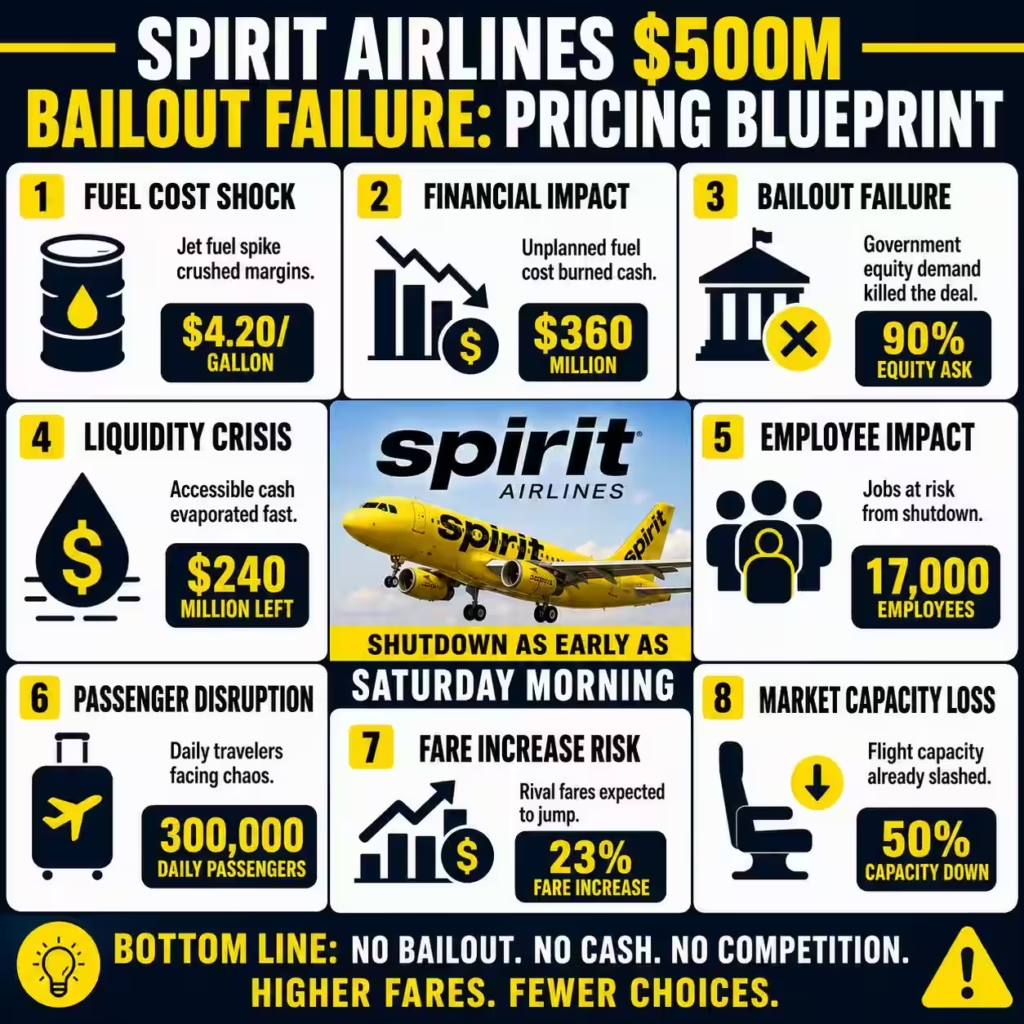
Spirit Airlines is preparing to shut down as early as Saturday morning after failed $500 million federal bailout talks with the Trump administration. This catastrophic collapse is fundamentally driven by jet fuel prices reaching $4.20 per gallon, nearly double the $2.20 per gallon forecast utilized in the carrier’s initial restructuring models. Such a massive divergence added $360 million in unanticipated operating costs, forcing a 20-cent loss for every revenue dollar generated during the peak second quarter.
You must realize that this second bankruptcy filing in under two years signals a terminal liquidity event for the Dania Beach-based operator. Real-world data confirms that while major legacy carriers like Delta or United hold massive cash buffers, Spirit’s ultra-low-cost carrier (ULCC) model possesses zero margin for error in a high-inflation energy environment. Professional analysis indicates that without a federal backstop, the carrier’s $1.2 billion in annual losses has finally exhausted the patience of its primary bondholders.
The operational vacuum created by this shutdown directly impacts 17,000 employees and approximately 300,000 daily passengers who rely on Spirit’s 9,000 scheduled flights through May. You should note that Spirit’s flight capacity has already dwindled by 50% compared to two years ago, leaving travelers with severely restricted options. Historical precedent from smaller carrier exits suggests that rival airfares will jump by 23%—roughly $60 per round-trip—on routes where Spirit formerly provided price discipline.
Furthermore, total passenger volume in these specific markets typically declines by 20% as price-sensitive travelers are priced out of the sky. This creates a supply-side shock that allows larger competitors to expand their margins at the expense of consumer accessibility. High-authority analysis suggests that the “Spirit Effect”—which historically forced the Big Three to offer Basic Economy tiers—is now effectively dead.
The failure of the $500 million bailout deal hinged on a proposed 90% government equity stake that existing creditors found unpalatable. This impasse occurred despite the Trump administration’s stated desire to protect jobs, highlighting a deep disconnect between political intent and financial feasibility. Creditors argued that a government takeover would prioritize employment metrics over debt recovery, leading to a breakdown in the $240 million restricted cash release.
Consequently, the airline’s liquidity has evaporated, leaving it unable to fund day-to-day operations past the current weekend. We see this as a watershed moment where the ULCC model proved unable to absorb external geopolitical shocks. The closure represents not just the end of a brand, but the removal of a structural floor for domestic airfare pricing.
L-Impact Solutions Critique: Risks and Systemic Gaps
L-Impact Solutions views the Spirit Airlines collapse as a profound failure of risk mitigation and over-reliance on debt-driven expansion. The carrier’s primary pain point was its inability to hedge against the fuel spike to $4.20 per gallon, a vulnerability that legacy carriers addressed through diversified revenue streams. We identify a massive gap in Spirit’s “unbundled” revenue model, which fails when the cost of the core service (flying) exceeds the price of the “bundles” sold.
This creates an inverted margin structure where more passengers actually lead to higher net losses. The risk here is systemic; if one ULCC fails due to energy shocks, others like Frontier or Allegiant may face similar contagion risks. The refusal of the $500 million bailout highlights a critical gap in the US aviation “too big to fail” doctrine.
Unlike the 2008 or 2020 interventions, the current administration’s demand for 90% equity created a “poison pill” for private investors. L-Impact Solutions critiques this approach as it effectively nationalizes a failing business model rather than fixing the underlying cost structure. The risk to the broader economy is clear: losing 17,000 jobs and eliminating 300,000 daily seats will stifle regional economic mobility.
We believe the administration underestimated the speed at which fuel costs would erode Spirit’s remaining $240 million in accessible liquidity. Furthermore, we point out the strategic gap left by the blocked JetBlue merger, which would have provided Spirit with much-needed capital and scale. By blocking the $3.8 billion deal on antitrust grounds, regulators inadvertently doomed the very competition they sought to protect.
L-Impact Solutions maintains that a smaller, healthier JetBlue-Spirit hybrid would have been better for the market than a liquidated Spirit. The current situation leaves a gaping hole in the Eastern Seaboard and Florida markets that cannot be filled overnight. This creates a “monopoly by attrition” where the Big Three benefit from the disappearance of their most aggressive price competitor.
| Related Analysis: POET 47% Crash: Governance Fix for Stable Growth Robinhood Stocks 7% Plummet: Diversified Growth Map Google Profit Surges 81%: Drive Efficient AI Scaling |
Optimized Solutions for Market Stabilization
To address the immediate fallout of the Spirit shutdown, you must implement aggressive “rescue fare” partnerships between remaining carriers and the Department of Transportation. These agreements should mandate that carriers absorbing Spirit’s routes provide capped-rate seating for stranded travelers through the end of May. Utilizing real-time data from Cirium, airports can reallocate gates and slots to airlines like Southwest or JetBlue to maintain at least 80% of current capacity levels.
This prevents the projected 23% fare spike from becoming a permanent fixture of the regional economy. You must prioritize the use of “wet-lease” agreements to keep Spirit’s 17,000-person workforce active under different operators. A secondary solution involves creating a “Private-Public Liquidity Bridge” that avoids the 90% equity trap of the failed federal deal.
Private equity firms specializing in distressed aviation assets could provide $300 million in senior-secured financing if the government offers a partial loan guarantee. This would allow Spirit to operate a “skeleton schedule” of its most profitable 20% of routes, preserving some competitive pressure. Such a move protects the $360 million in fuel-related cost overruns from spiraling into total liquidation expenses.
By focusing on high-density routes, you can mitigate the 20% volume drop seen in previous market exits. Thirdly, the industry must adopt “dynamic fuel surcharge transparency” to help low-cost carriers survive $4.20/gallon environments. Rather than hiding fuel costs in base fares, ULCCs should be permitted to use a floating fuel surcharge that adjusts automatically with oil prices.
This would have prevented the 20-cent loss per revenue dollar that Spirit suffered during the fuel spike. It allows the consumer to understand why prices are rising while ensuring the airline remains solvent during energy crises. You should advocate for this regulatory change to ensure future budget carriers have a survival mechanism against volatile overhead.
Future Prevention Steps for Aviation Resilience
To prevent a repeat of the Spirit Airlines catastrophe, you must mandate that all Part 121 carriers maintain a “Minimum Liquidity Buffer” (MLB) equal to six months of operating expenses. This buffer would act as a shock absorber during periods like 2026, where fuel costs doubled in less than a quarter. Had Spirit been required to hold such reserves, the $360 million fuel shock would not have triggered a terminal bankruptcy.
We recommend that the FAA link slot allocations to financial health metrics to ensure market participants are viable long-term operators. This shifts the focus from aggressive growth to sustainable, resilient operations. Furthermore, future administrations must develop a “Pre-Packaged Merger Framework” for struggling carriers that provides a clear path to consolidation before liquidation becomes the only option.
The Department of Justice should adopt a “failing firm” defense more readily when a carrier shows signs of terminal decline, such as Spirit’s 50% capacity reduction. This allows for market-driven solutions like the JetBlue-Spirit deal to proceed with conditions, rather than letting the airline die. Preventing total shutdowns saves the taxpayer from the massive unemployment costs associated with 17,000 sudden job losses.
You should support legislation that prioritizes market continuity over rigid antitrust enforcement in distressed sectors. Finally, the industry must transition toward “Energy Hedging Cooperatives” for smaller carriers that lack the scale to manage individual fuel contracts. By pooling their fuel purchasing power, ULCCs can lock in rates below $3.00/gallon even when market prices hit $4.20.
This collective bargaining power neutralizes the primary advantage held by legacy carriers and stabilizes the 20 cents loss per revenue dollar issue. You must recognize that in a volatile global economy, isolated small players are easy targets for macro shocks. Building a cooperative shield ensures that budget travel remains a permanent and stable fixture of American infrastructure.
Key Takeaways from L-Impact Solutions
The collapse of Spirit Airlines is a self-inflicted wound caused by rigid regulatory oversight and a failure to adapt to a $4.20/gallon fuel reality. You should view this as a warning that “cheap” is not a sustainable strategy if it isn’t backed by a robust, hedged balance sheet. L-Impact Solutions firmly believes that the government’s 90% equity demand was a tactical error that destroyed $500 million in potential rescue value.
The resulting 23% fare hike and 20% volume loss are the direct costs of this policy failure. Moving forward, the aviation sector must prioritize liquidity buffers and smarter consolidation to protect the 17,000 jobs and 300,000 daily travelers currently at risk. These strategic pivots are essential to ensure the long-term viability of the American budget aviation market.
FAQs:
How did $4.20/gallon fuel (vs $2.20 forecast) trigger a $360M cost overrun and 20¢ loss per revenue dollar?
The unhedged cost structure resulted in fuel volatility directly eroding profit margins, thereby exposing a vulnerable business model where losses escalate proportionally with each incremental passenger.
Why did the $500M bailout fail despite 17,000 jobs and 300,000 daily passengers at risk?
A 90% government equity demand acted as a financial “poison pill,” prioritizing control over viability and pushing creditors away from a workable rescue.
What does a projected 23% airfare hike (~$60 per ticket) reveal about market dependency on ULCCs?
It proves budget carriers were the only real price discipline force, and their collapse exposes how quickly competition evaporates into consumer pain.
Why did a second bankruptcy within 2 years signal a terminal liquidity failure despite $240M restricted cash?
Restricted liquidity, especially when coupled with inflexible access, is demonstrably detrimental and operationally senseless, unequivocally signaling deficient treasury structuring within a high-burn rate environment.
How did a 50% capacity drop and $1.2B annual losses accelerate bondholder exit?
Sustained shrinkage combined with escalating losses destroyed any credible turnaround narrative, forcing capital markets to cut off further risk exposure.