Granite Construction’s 30.4% Q1 revenue surge reveals margin pressures and outlines strategies to protect your margins.
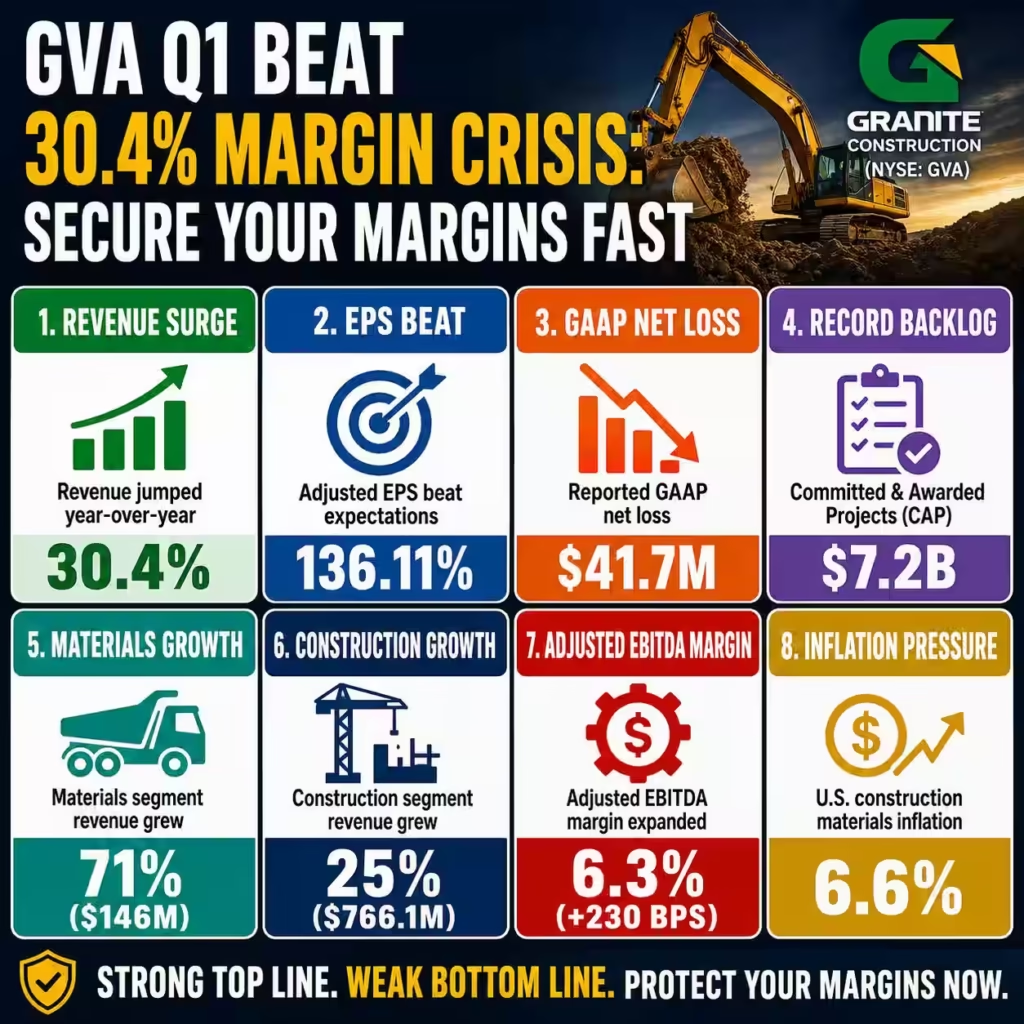
Granite Construction (NYSE:GVA) reported Q1 2026 revenue of $912.5 million, marking a 30.4% year-over-year surge that dismantled Wall Street’s $782.26 million consensus estimate. This explosive growth highlights a massive shift in infrastructure demand, but it simultaneously exposes the industry’s most painful bottleneck: the struggle to convert a $7.2 billion record backlog into GAAP-compliant bottom-line profitability. While the adjusted earnings of $0.26 per share signal operational efficiency, the gap between top-line expansion and realized net income—notably reflected in a $41.7 million GAAP net loss—suggests a systemic friction in project delivery.
Real-world data confirms that the U.S. construction materials market is currently battling a 6.6% inflation rate, which directly threatens the margins of fixed-price heavy civil contracts. High-authority analysis reveals that firms like Granite are now entering a “scale-up trap” where massive revenue growth actually increases the financial risk profile if material costs and labor shortages are not aggressively hedged. In the current Q1 2026 climate, the materials segment specifically grew by 71% to $146 million, proving that vertical integration is the only shield against market volatility.
However, the construction segment, while growing 25% to $766.1 million, faces the brunt of “burn rate” pressures where the $7.2 billion Committed and Awarded Projects (CAP) must be processed through an increasingly tight labor filter. With the industry requiring 499,000 new workers this year alone, the velocity of this backlog execution is under threat. We observe that while top-line beats excite investors, the fundamental B2B challenge remains the 15-35% price spikes in critical inputs like steel and aluminum.
Critical Opinion and Gap Analysis
L-Impact Solutions views the current trajectory of Granite Construction as a high-stakes balancing act between strategic acquisition and operational dilution. The 136.11% beat on adjusted EPS is impressive on paper, yet it masks a persistent GAAP net loss that suggests internal overhead and debt servicing are outstripping organic efficiency gains. We identify a critical risk in the “Tactical Infrastructure” sector, which now accounts for $1.3 billion of Granite’s CAP, specifically including $640 million in schedule-intensive federal projects.
These federal projects are notorious for stringent compliance requirements and razor-thin margin for error, particularly when subcontracted labor accounts for a significant portion of execution. The industry is currently facing a structural deficit of 500,000 skilled workers, a gap that cannot be bridged simply by raising revenue guidance to $5.3 billion. We critique the heavy reliance on “bolt-on” acquisitions like Kenny Seng Construction and Warren Paving as a primary growth lever, noting that Seng alone added 45 million tons of aggregate reserves.
While these additions provide immediate revenue, they create integration friction and increase Selling, General, and Administrative (SG&A) expenses, which reached $141 million this quarter. The 230 basis point expansion in adjusted EBITDA margin to 6.3% is a positive indicator, but it remains far below the 10-12% benchmarks required for long-term sustainability in the materials sector. Our analysis indicates that the current bidding environment is robust, but the quality of the backlog is being tested by logistics costs that have surged 12% in the last six months.
Furthermore, the cancellation of a $300 million California contract during this quarter serves as a warning sign of project volatility. When huge chunks of a $7.2 billion backlog vanish due to regulatory or funding shifts, the overhead costs of specialized teams remain fixed, leading to rapid margin erosion. We find a significant gap in how these “tactical” projects are being bid, often ignoring the 20-30% overtime premiums required to meet their aggressive schedules.
The reliance on M&A to buy market share rather than fixing internal labor efficiency is a short-term strategy that risks long-term liquidity. Scaling through acquisition without solving the underlying execution inefficiencies often leads to a “hollowed-out” balance sheet during economic contractions. L-Impact Solutions stresses that the $1.3 billion federal allocation requires immediate digital oversight to prevent catastrophic cost overruns.
| Related Analysis: Robinhood Stocks 7% Plummet: Your Aid For Structural Threats Google Profit Surges 81%: Now Drive Efficient AI Scaling SanDisk $2.6B AI Storage Surge: Deploy Smart Orchestration |
Solutions for Infrastructure Scalability
To resolve the friction between massive backlogs and net profitability, B2B entities must prioritize Digital Project Delivery (DPD) as a non-negotiable operational standard. Standardizing on unified platforms where cost data, field execution, and integrated scheduling operate in a single source of truth can reduce rework by 15%, according to recent industry benchmarks. Firms should move away from reactive spot-market purchasing and implement “Not Ready for Release” (NRFR) procurement tactics.
This allows you to lock in material pricing via Purchase Orders today while scheduling deliveries for 12 months out, effectively hedging against the projected 25-50% surge in copper and asphalt costs. Vertical integration must be treated as a financial hedge rather than just an operational convenience. By self-sourcing 70% or more of aggregate and hot-mix asphalt needs—mirroring Granite’s strategy with the Kenny Seng acquisition—you can internalize the 20% profit margins that are usually lost to third-party suppliers.
We recommend the immediate implementation of “Index-Linked Contracts” for all new public sector bids to combat the 8.6% average increase in construction input prices. These clauses allow for price adjustments based on the Producer Price Index (PPI), protecting your firm from the sudden 30% jump in fuel or liquid asphalt costs that can occur mid-build. Furthermore, you must transition to “Performance-Based Subcontracting” where bonuses are tied to schedule acceleration and waste reduction.
This aligns the incentives of your workforce with your bottom line, potentially reclaiming 5% of project margin previously lost to administrative delays. Invest in automated plant technology, as automated aggregate processing has shown to increase output by 22% while reducing energy costs by 15%. Lastly, establish a “Material Arbitrage Fund” to buy bulk commodities during Q1 seasonal lows, ensuring your project sites are never stalled by the supply chain bottlenecks that affected 36% of HVAC and structural steel orders this year.
Future Prevention and Risk Mitigation
Preventing future margin erosion requires a total overhaul of the preconstruction phase through Generative AI and 3D clash-detection modeling. These tools allow project managers to identify structural conflicts before a single yard of concrete is poured, potentially saving 8-12% in total project volume. You must establish a “Strategic Materials Reserve” by leveraging excess cash flow to stock up on high-volume, small-footprint items like MEP consumables and specialty fittings during seasonal price dips.
This inventory arbitrage turns storage costs into a profit-protecting asset that buffers against global supply chain disruptions. Furthermore, the labor crisis necessitates a shift toward modular construction and off-site prefabrication for at least 20% of project components. This strategy reduces the need for on-site man-hours and provides a more controlled environment for quality management, effectively insulating the project from local labor shortages.
Comprehensive “Scenario Planning” should be integrated into every bid, modeling for 10%, 25%, and 50% cost-escalation scenarios to ensure a viable walk-away point. Implementing wearable safety devices and automated health monitoring can further reduce the industry-leading rate of lost-work days, which currently costs the sector $150,000 to $250,000 per mid-sized contractor annually in turnover and insurance hikes. To specifically address the risk of “backlog bloating,” companies should implement a “Burn-to-Bid” ratio.
This internal metric ensures you are only bidding on new work if your execution team is burning through existing backlog at a 1:1.2 ratio, preventing the operational dilution seen when CAP grows faster than workforce capacity. We also recommend diversifying your energy exposure. Since oil price moves can devastate asphalt margins, use financial swaps to lock in diesel and liquid asphalt prices for at least 18 months. Finally, mandate a “Red Team” audit for every project over $50 million, where external analysts attempt to find holes in the labor and materials assumptions before the final signature is applied.
L-Impact Solutions Key Takeaway
The era of “growth at any cost” in the heavy civil sector is officially dead. While Granite Construction’s 30.4% revenue beat is a masterclass in market capture, the real victory lies in closing the 136% gap between analyst expectations and adjusted profitability. Our opinion is firm: the 2026 infrastructure landscape is a “margin minefield” where a $7.2 billion backlog is a liability, not an asset, if not executed with digital precision.
Granite’s move to raise adjusted EBITDA margin guidance to a range of 12.25% to 13.25% is the right signal, but achieving it requires more than “bolt-on” M&A; it requires a radical shift toward owner-operator material sourcing. The Kenny Seng acquisition, contributing $150 million in annual revenue and 45 million tons of aggregate, is a vital hedge, but it only solves the “what,” not the “how” of project delivery. You cannot rely on a robust bidding environment to fix a broken operational model; you must instead engineer your margins into the contract itself through index-linked clauses and performance bonuses.
Refuse to participate in the “race to the bottom” low-bid culture that currently sees 82% of firms struggling with craft labor shortages. The winners of 2026 will be the firms that prioritize price certainty and operational depth over vanity revenue metrics, ensuring every dollar of that $5.3 billion guidance actually reaches the bottom line. Execution velocity and margin protection are the only metrics that matter in a high-inflation federal contracting environment.
FAQs:
Why did Granite Construction’s 30.4% revenue growth still result in a $41.7M GAAP net loss despite beating the $782.26M estimate?
The absence of indexed pricing and adequate cost controls means that top-line acceleration ultimately results in margin erosion rather than enhanced profitability.
How does a $7.2B backlog become a financial risk amid 6.6% materials inflation and 15–35% input cost spikes?
Fixed-price contracts convert backlog into unhedged exposure, resulting in cost volatility directly eroding anticipated profit margins.
Why is a 136% adjusted EPS beat insufficient when EBITDA margin is only 6.3% vs the 10–12% industry benchmark?
The observed accounting outperformance conceals a structurally deficient margin architecture, which is inherently incapable of sustaining long-term capital efficiency.
How do 499,000 labor shortages and 20–30% overtime premiums impact execution of $1.3B federal projects?
They compress delivery timelines and inflate costs, exposing projects to schedule risk and rapid margin dilution.
Why does reliance on acquisitions like Kenny Seng (45M tons reserves) fail to fix rising SG&A costs at $141M?
Scaling via asset-heavy mergers and acquisitions (M&A) often increases overhead without effectively addressing the fundamental execution inefficiencies that contribute to profitability shortfalls.