XRP’s $620T valuation risk highlights the need to secure your models with disciplined, data-driven investment decisions.
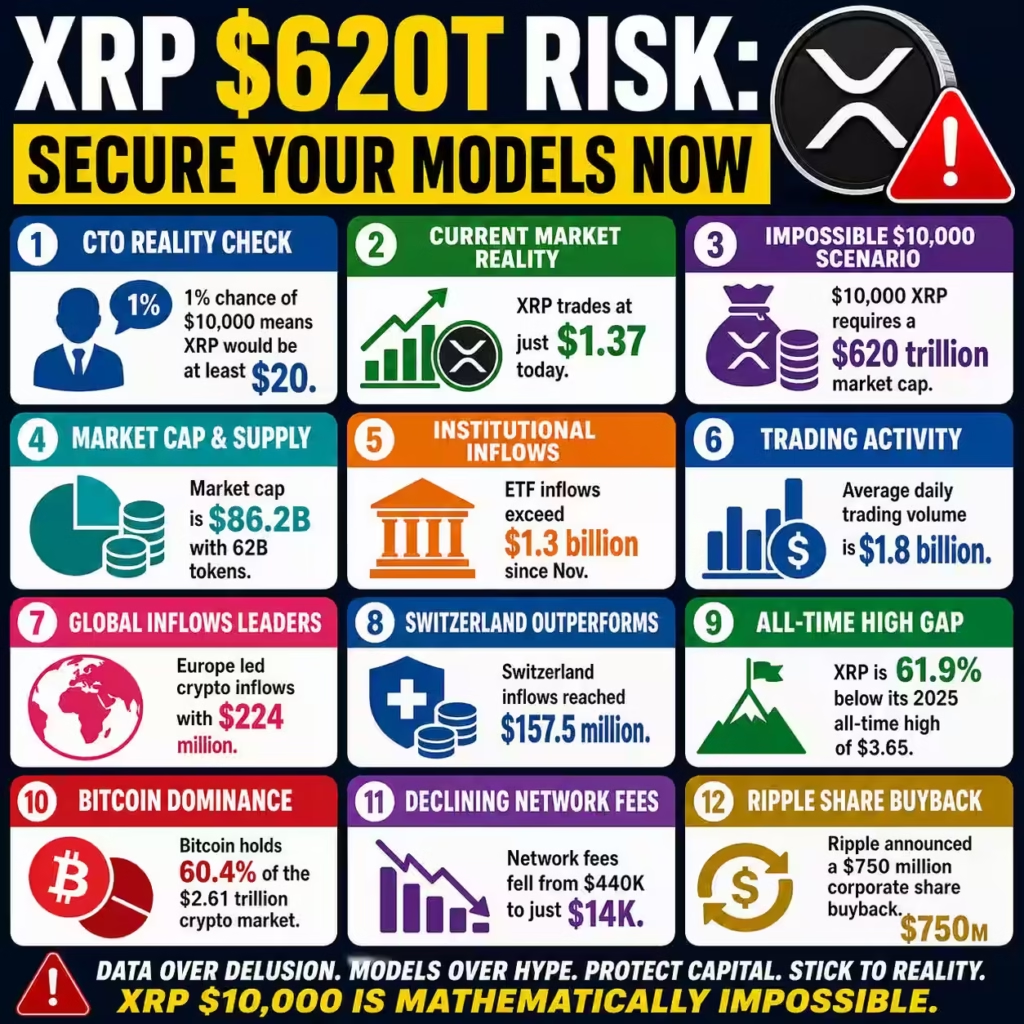
Ripple CTO David Schwartz recently dismantled the staggering $10,000 XRP price prediction by grounding expectations in fundamental market mathematics. Schwartz argued that if rational institutional investors saw even a 1% probability of this astronomical surge, heavy buying pressure would have already pushed the asset to a baseline of $20. Instead, the digital asset currently languishes at an actual trading value of just $1.37.
This stark disparity between social media hype and market reality creates a severe pain point for corporate treasuries navigating cryptocurrency allocations. We must implement rigorous quantitative modeling to strip away retail-driven sentiment and establish true intrinsic value frameworks. Current market data reveals a total crypto capitalization of $2.61 trillion, demanding logical diversification rather than reliance on single-asset lottery tickets.
Zooming into the latest May 2026 metrics, XRP maintains an $86.2 billion market capitalization alongside a massive circulating supply of 62 billion tokens. Approximately 62% of the current XRP supply remains in profit, with recent ETF investment inflows surpassing $1.3 billion since November. Despite these massive institutional capital injections, the average daily trading volume sits at a relatively modest $1.8 billion.
Institutional investors consistently utilize sophisticated risk-adjusted valuation models rather than chasing speculative internet projections. The Chris Burniske utility equation, often hijacked to justify a $10,000 target, utterly fails to account for current $1.37 price constraints. Wealthy fiduciaries operate on strict probability distributions where an $86.2 billion asset requires astronomical global liquidity to even approach a multi-trillion-dollar scale.
A sudden leap to a $10,000 valuation would inherently require an impossible $620 trillion market capitalization. This astronomical figure vastly eclipses the entire global equities market, highlighting the severe mathematical illiteracy driving retail-level token forecasting. Corporate analysts must therefore discard these hallucinatory projections and focus strictly on tangible blockchain growth catalysts.
European markets surprisingly led global crypto inflows recently with $224 million, heavily favoring the broader XRP ecosystem. Switzerland independently commanded $157.5 million of this institutional capital, vastly outperforming the $27.5 million observed in United States markets. This rapid geographic shift underscores a growing reliance on regulated exchange-traded products rather than unchecked speculative retail frenzy.
The recent 25% price surge for XRP early in 2026 demonstrates clear institutional appetite for regulated network utility. However, this momentum fundamentally aligns with realistic sub-$2 targets rather than astronomical five-figure delusions. True business analytics mandate anchoring enterprise digital asset strategies in verifiable liquidity metrics rather than engaging in social media euphoria.
David Schwartz correctly identified that fiduciaries protect corporate wealth by calculating asymmetric risk rather than chasing impossible fairy tales. The stark reality remains that XRP sits 61.9% below its 2025 all-time high of $3.65. This mathematical anchor proves that current institutional capital views the asset through a highly conservative, yield-focused lens.
L-Impact Solutions Critique: Addressing Speculative Risks and Valuation Gaps
L-Impact Solutions views this ongoing speculative detachment as a profound operational risk for modern digital asset management. Fiduciaries risk catastrophic capital destruction when they integrate wildly unfounded $10,000 price targets into their treasury projection models. The fundamental gap between a $1.37 reality and retail fantasy exposes a severe lack of quantitative discipline across the blockchain industry.
We strongly critique the dangerous ecosystem of financial influencers aggressively marketing impossible exponential returns to uneducated retail participants. This toxic narrative fundamentally ignores the $86.2 billion current valuation barrier that heavily restricts future percentage gains. When network activity metrics show daily transaction volumes of just 2.1 million, the underlying utility simply cannot support a multi-trillion-dollar enterprise valuation.
The 1% probability argument presented by the Ripple CTO perfectly encapsulates the baseline logic absent in modern retail trading. Rational capital allocation demands that potential exponential upside must reflect in immediate premium pricing, mathematically forcing a $20 valuation floor. The total absence of this $20 floor absolutely confirms that smart money assigns a zero percent probability to the $10,000 outcome.
Corporate treasurers must recognize that Bitcoin currently dominates 60.4% of the $2.61 trillion global cryptocurrency market capitalization. Against this macroeconomic backdrop, an alternative payment token attempting to absorb hundreds of trillions in liquidity represents an impossible capital reallocation. The structural mechanics of global finance permanently prevent any single settlement network from monopolizing the entire global monetary supply.
Our analytical frameworks reveal a persistent misalignment between actual enterprise software adoption and speculative token pricing. While Ripple recently initiated a $750 million corporate share buyback, this internal equity strength does not linearly translate to open-market token appreciation. We observe that utility-driven enterprise growth frequently outpaces the actual on-chain liquidity velocity required to sustain massive token price expansions.
Furthermore, the declining network fees, which recently dropped to $14,000 from $440,000 last year, indicate contracting organic network activity. This statistical contraction directly contradicts the hyper-growth narratives required to justify even a short-term trajectory toward a $10 target. Businesses adopting digital ledgers must strictly separate software integration efficiency from open-market cryptocurrency speculation.
The valuation pain point amplifies when retail participants leverage derivatives and futures open interest, currently sitting at a narrowed $2.45 billion. This highly leveraged speculation creates localized volatility traps that severely penalize long-term corporate holders managing significant digital asset reserves. L-Impact Solutions warns that failing to hedge against this retail-driven volatility invites severe corporate balance sheet instability.
We conclude that the greatest systemic gap remains the widespread failure to utilize foundational discounted cash flow or utility velocity models. By anchoring financial expectations strictly to the $1.39 daily conversion rate, enterprises can successfully construct resilient and predictable balance sheets. Ignoring empirical market data in favor of ideological tribalism ultimately guarantees catastrophic financial mismanagement.
| Related Analysis: Google Profit Surges 81%: Now Drive Efficient AI Scaling SanDisk $2.6B AI Storage Surge: Deploy Smart Orchestration Spirit Airlines $500M Bailout Failure: Pricing Blueprint |
Strategic Business Solutions for Digital Asset Valuation and Treasury Management
To actively combat these dangerous valuation distortions, enterprise treasuries must implement strict quantitative caps on digital asset projections. Your financial risk models must utilize the current spot pricing of $1.37 combined with conservative 5% to 15% annualized growth metrics. This immediate operational pivot instantly eliminates the toxic balance sheet volatility caused by factoring in multi-thousand-dollar fantasy targets.
You must actively diversify corporate digital reserves based on verifiable institutional inflow data rather than chasing social media sentiment. Integrating assets that demonstrate robust regulated inflows, such as the recent $1.3 billion injected into specialized XRP ETFs, guarantees superior liquidity. This methodology ensures your capital follows verified smart money rather than becoming exit liquidity for retail market manipulation.
Businesses must formally decouple the valuation of a blockchain software company from the open-market price of its associated native token. Your investment thesis should objectively weigh Ripple’s $40 billion enterprise valuation against the separate $86.2 billion cryptocurrency market capitalization. Recognizing these distinct financial ecosystems protects your firm from conflating corporate equity success with decentralized token price action.
Corporate governance boards must mandate the use of the Burniske utility equation solely with verified, real-time transaction volume data. Your analysts must input the current $1.8 billion daily trading volume to establish highly realistic baseline network utility metrics. This rigorous mathematical discipline prevents the accidental ingestion of manipulated influencer models into your core financial forecasting architecture.
Implementing dynamic hedging strategies against retail-driven volatility represents an absolute necessity for modern enterprise digital asset management. You must utilize regulated derivatives to lock in asset value around current moving averages, such as the 50-day $1.41 mark. This protective financial layering ensures that sudden market sentiment shifts do not aggressively erode your foundational treasury capital.
Establish an algorithmic trading threshold that automatically trims digital asset exposure during periods of extreme retail euphoria. Your systems should trigger mandatory profit-taking when the institutional Fear and Greed Index pushes past logical baseline constraints into extreme greed. Systematically extracting liquidity during unwarranted price spikes inherently fortifies your long-term corporate financial stability.
We strongly advise adopting a regional arbitrage perspective to systematically capture value across shifting global regulatory landscapes. Since European markets recently drove $224 million in weekly investments, your treasury should strategically route execution through highly regulated international corridors. Capitalizing on these verified geographic liquidity pools significantly minimizes your exposure to localized regulatory stagnation.
Finally, your accounting infrastructure must update daily asset valuations using stringent, real-time API integrations from top-tier aggregated indices. You must absolutely forbid the manual entry of projected future prices into any official quarterly corporate balance sheet reporting. This strict compliance mandate ensures that external auditors, shareholders, and stakeholders rely purely on verifiable $1.37 current-state mathematics.
Prevention Methods to Secure Enterprise Capital Against Speculative Contagion
Preventing future exposure to severe market delusion requires installing an unyielding data-driven culture within your financial allocation departments. You must formally ban the integration of unverified social media price targets into any internal risk assessment or strategic planning documentation. Establishing this strict informational firewall permanently protects your organization from destructive external retail propaganda.
We recommend developing proprietary algorithmic sentiment filters that aggressively flag and discard irrational outlier market projections. Your internal systems must automatically categorize any forecast predicting a $10,000 valuation for a heavily diluted asset as hazardous financial misinformation. Isolating your analysts from these toxic data streams ensures that your strategic corporate models remain anchored in empirical reality.
Corporate treasuries must pre-establish hardcoded liquidation triggers tied directly to shifting global macroeconomic liquidity indicators. You should automatically reduce crypto-asset exposure if global broad money supply contracts, as this inherently drains speculative momentum from digital markets. Proactively managing your liquidity against a $2.61 trillion total crypto market cap prevents sudden and catastrophic capital entrapment.
Conducting mandatory quarterly stress tests utilizing historical bear market data effectively inoculates your balance sheet against unexpected systemic drawdowns. Your risk officers must model scenarios where digital assets regress sharply toward historical floors, such as previous cycle lows near $0.25. Surviving these simulated liquidity crises guarantees your business operations continue uninterrupted regardless of underlying global blockchain volatility.
Enterprise compliance teams must enforce continuous monitoring of real-world on-chain utility versus speculative off-chain exchange trading volumes. You must demand automated alerts when centralized exchange volume artificially exceeds verified on-chain network transaction throughput by massive margins. Recognizing this dangerous ratio prevents your firm from holding assets heavily reliant on speculative trading rather than foundational network utility.
Strict vendor risk management protocols must apply to any third-party digital asset analytics or predictive software platforms you employ. You must rigorously audit these external algorithms to ensure they do not heavily weight historical outlier events into their forward-looking models. Discarding structurally flawed third-party forecasting tools immediately prevents poisoned data from infecting your broader corporate investment strategy.
Formally integrating traditional financial metrics, such as the Network Value to Transactions ratio, establishes a permanent reality check mechanism. Your analysts must aggressively utilize this metric to mathematically identify when a network’s valuation vastly outpaces its actual economic processing capability. Flagging a consistently high ratio serves as an immediate preventive warning against acquiring digital assets during periods of extreme speculative overvaluation.
Lastly, ongoing financial literacy education regarding basic tokenomics and supply dilution is absolutely vital for your executive leadership team. You must ensure key decision-makers mathematically comprehend why a 62 billion circulating supply permanently prohibits five-figure individual unit pricing. Empowering your corporate executives with unassailable mathematical logic remains the ultimate operational defense against dangerous corporate-level speculative contagion.
L-Impact Solutions Key Takeaway: Capital Preservation Through Rigorous Objectivity
L-Impact Solutions unequivocally asserts that the future of institutional digital asset management belongs exclusively to mathematically disciplined organizations. The total dismantling of the $10,000 XRP myth by Ripple’s own executive fundamentally validates our uncompromising demand for strict quantitative modeling. Corporate treasuries that continue entertaining retail-driven hallucinations actively violate their fiduciary duty and invite inevitable corporate financial ruin.
The glaring reality of a $1.37 trading price against an $86.2 billion market capitalization leaves absolutely zero room for mathematical misinterpretation. We maintain that institutional investors have already precisely priced in the highest probability of global utility, establishing a rigid ceiling on speculative growth. Your enterprise must operate strictly within these verified constraints rather than gambling corporate assets on impossible global monetary reallocations.
The highly documented $1.3 billion in recent institutional ETF inflows proves that smart capital only pursues heavily regulated, realistically valued utility. Fiduciaries ruthlessly optimize for calculated percentage yields rather than betting on assets spontaneously capturing hundreds of trillions in nonexistent global liquidity. Your digital allocation strategies must perfectly mirror this cold, calculating institutional behavior to ensure permanent long-term capital preservation.
We emphasize that accepting a sub-$2 reality is not a bearish capitulation, but rather a profound strategic advantage for sensible accumulation. Operating with accurate $1.39 entry metrics allows your corporate treasury to execute highly profitable, mathematically sound, low-risk arbitrage and yield-generation strategies. Discarding the $10,000 delusion instantly transforms volatile digital assets from speculative corporate liabilities into highly predictable, high-performing treasury reserve instruments.
The fundamental disconnect between a thriving $40 billion corporate enterprise valuation and a stagnating open-market token price requires aggressive analytical separation. Your investment committees must permanently stop treating decentralized network tokens as proxy equity shares for the software companies actively developing them. This crucial analytical maturity prevents devastating corporate capital misallocations driven by fundamental misunderstandings of baseline blockchain economic mechanics.
Fiduciary excellence heavily demands that every single financial projection survive the brutal scrutiny of basic supply-side mathematics and global liquidity constraints. An asset requiring an impossible $620 trillion valuation to achieve retail targets represents a mathematical absurdity that must be immediately excised from your portfolio. We formally mandate that corporate treasury capital must only flow toward assets demonstrating highly verifiable, mathematically sound institutional growth trajectories.
The persistent global dominance of Bitcoin, holding 60.4% of all market capital, mathematically crushes the probability of alternative asset hyper-valuations. Your macro strategy must reflect the reality that institutional capital systematically centralizes into highly established liquid assets during periods of economic uncertainty. Ignoring these massive macroeconomic gravity wells severely jeopardizes your organization’s broader financial longevity and strategic digital market positioning.
L-Impact Solutions concludes that uncompromising objectivity remains your absolute greatest competitive weapon in an industry heavily plagued by irrational exuberance. By aggressively rejecting speculative fiction and anchoring your financial operations to verifiable numerical data, your enterprise achieves an impenetrable financial resilience. You must actively weaponize mathematical truth to navigate the global digital asset landscape safely, profitably, and with absolute sovereign financial authority.
FAQs:
How can corporate treasuries justify XRP $10,000 forecasts when it implies a $620 trillion market cap vs current $86.2B valuation?
They can’t—this reflects a fundamental breakdown in quantitative discipline, demanding strict adoption of probability-weighted valuation models over speculative narratives.
Why does XRP remain at $1.37 despite $1.3B ETF inflows and a 25% 2026 price surge?
Institutional capital assesses risk-adjusted utility rather than speculative excitement, thereby revealing a significant disparity between liquidity inflows and excessively optimistic return projections.
What does a $1.8B daily trading volume signal about XRP’s ability to scale beyond its $86.2B market cap?
It signals constrained liquidity velocity, meaning exponential price projections lack the transactional throughput required for sustainable valuation expansion.
How does XRP being 61.9% below its $3.65 ATH reshape corporate crypto allocation strategies?
It reinforces that even with strong narratives, drawdown risk dominates, requiring disciplined entry pricing and hedging rather than momentum chasing.
Why is relying on a single asset like XRP risky in a $2.61T crypto market dominated 60.4% by Bitcoin?
Given that the concentration of capital inherently favors dominant liquidity centers, undiversified investments are structurally susceptible to fragility and constitute a strategically negligent approach.