Uber’s $53.7B growth exposes inflation risks threatening your margins and your long-term business stability.
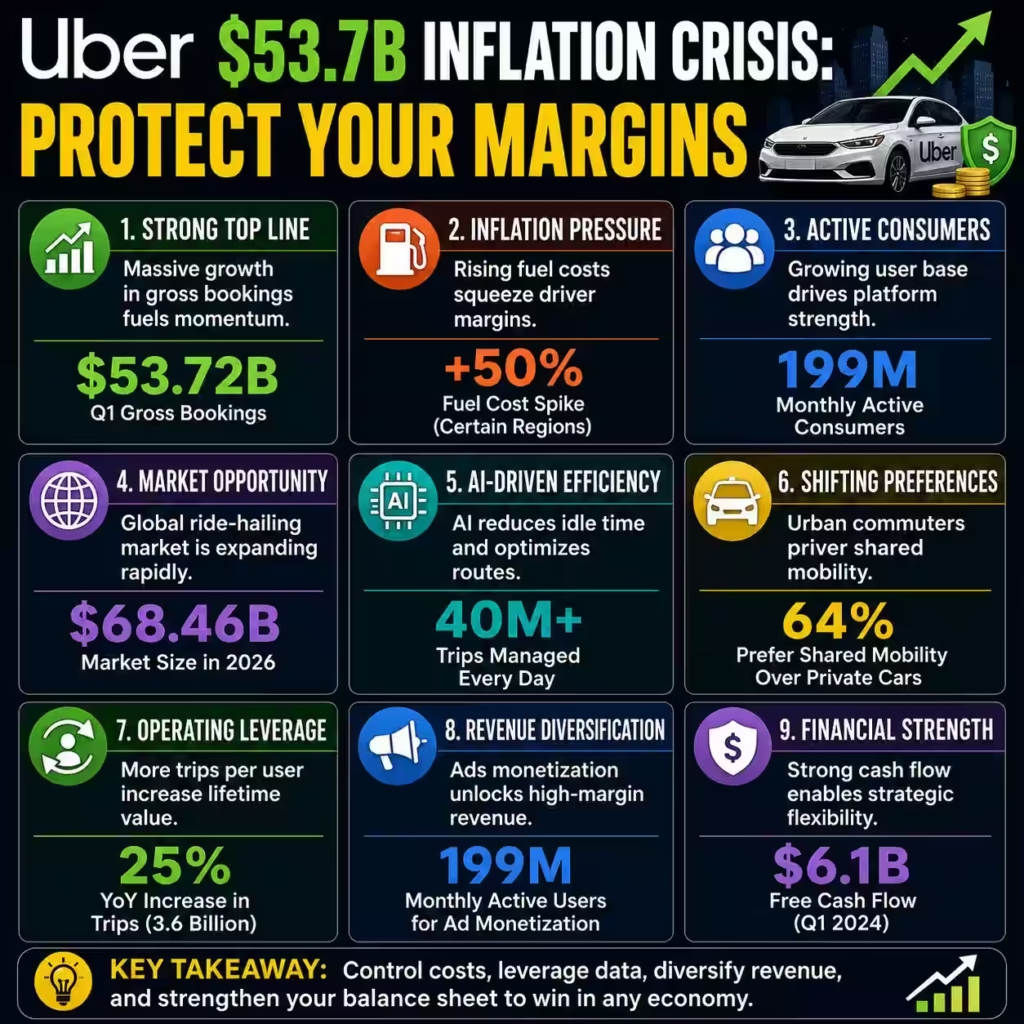
Uber reported an impressive first-quarter gross bookings figure of $53.72 billion, eclipsing the expected $52.9 billion and representing a massive 25% year-over-year surge. The ride-hailing giant also recorded 3.6 billion trips, which marks a 20% increase, while monthly active platform consumers soared 17% to 199 million. This exceptional performance immediately pushed Uber stock up by over 7% in early trading, signaling strong investor confidence despite a challenging macroeconomic environment.
Despite these triumphant top-line metrics, business leaders must acknowledge the underlying pain points of operating within a volatile economy characterized by 4.0% global inflation and geopolitical tensions. Surging fuel costs, which have recently spiked by nearly 50% in certain regions, severely pressure driver margins and threaten overall fleet sustainability. This article will provide actionable solutions and strategic prevention frameworks to help your enterprise navigate similar macroeconomic vulnerabilities while maintaining aggressive revenue expansion.
The broader global ride-hailing market currently commands a valuation of $68.46 billion in 2026, driven by an impressive projected compound annual growth rate of 19.9%. Uber captures a massive portion of this expanding sector, yet its operational costs remain heavily exposed to erratic consumer spending behaviors and shifting regulatory landscapes. Analyzing this scenario reveals that sustainable growth requires agile pricing models and robust cost-containment measures rather than pure volume acquisition.
Our high-authority analysis indicates that consumer resilience remains unexpectedly robust, driving sustained local spending even as United States GDP growth projections moderate to 1.8% for 2026. Enterprises must recognize that Uber’s success stems from expanding service accessibility, leveraging non-standard rides, and capturing demand from the 55% of the global population currently residing in urban centers. Therefore, securing market share during economic downturns demands an absolute commitment to customer retention alongside aggressive technological integration.
Artificial intelligence stands as a critical pillar in modern mobility operations, with predictive algorithms successfully reducing idle times and optimizing routing across millions of active drivers. Uber currently manages over 40 million trips per day, showcasing the sheer operational scale required to offset lower individual trip margins during inflationary periods. B2B operators must invest in similar data-driven infrastructures to maintain profitability when external macroeconomic headwinds threaten conventional business models.
Furthermore, shifting consumer preferences demand diverse mobility offerings, as evidenced by the rapid growth of affordable car-pooling and premium ride segments within the global market. With 64% of urban commuters increasingly preferring shared mobility over private vehicle ownership, companies have a lucrative window to capture long-term brand loyalty. You can capitalize on these structural market shifts by aligning your core services with the evolving necessity for economical transportation solutions.
Operating leverage becomes the ultimate differentiator when top-line revenue faces pressure from macroeconomic instability and shrinking consumer disposable income. By increasing trip frequency among existing users, Uber effectively amortizes its substantial platform maintenance costs across a larger transaction volume. Business leaders must relentlessly pursue similar customer lifetime value enhancements to insulate their organizations against unforeseen economic shocks and margin compression.
Advanced analytics indicate that scaling digital advertising within consumer applications represents a profoundly lucrative strategy to counterbalance rising operational expenditures. With Uber boasting 199 million monthly active consumers, the monetization potential of this captured audience far exceeds traditional transportation revenue constraints. You must rapidly commercialize your digital real estate to generate high-margin secondary income that continuously subsidizes your core operational expansion.
Strategic capital deployment during periods of intense economic uncertainty ultimately separates enduring global conglomerates from transient technology startups. By generating billions in free cash flow, market leaders can execute massive stock buybacks that violently reinforce shareholder confidence despite prevailing macroeconomic pessimism. B2B executives must fiercely protect their balance sheets to ensure they possess the necessary financial firepower to execute aggressive acquisitions when distressed competitors inevitably falter.
Critique Opinion from L-Impact Solutions: Addressing The Gaps
L-Impact Solutions views Uber’s phenomenal $53.72 billion quarterly gross bookings not merely as a victory, but as a critical stress test for modern platform economics. While a 25% year-over-year growth rate demonstrates outstanding market penetration, relying heavily on continued consumer spending during a projected 4.0% inflation era presents severe systemic risks. The primary vulnerability lies in the fragile equilibrium between driver compensation, rising fuel expenditures, and the affordability threshold of average riders.
The most glaring gap in this operational model is the heavy reliance on independent contractors who directly bear the brunt of extreme macroeconomic volatility. When localized fuel prices jump aggressively, driver retention plummets unless platform algorithms instantly adjust payout structures to maintain acceptable earning margins. Ignoring this critical labor-side pain point will inevitably trigger massive supply shortages precisely when consumer demand reaches peak volumes.
Furthermore, regulatory scrutiny continues to intensify globally, creating significant compliance overhead that actively threatens to compress profit margins across the entire $68.46 billion ride-hailing sector. L-Impact Solutions identifies a persistent lack of proactive regulatory engagement as a fundamental weakness for emerging mobility and logistics enterprises. You must establish robust government relations protocols to preemptively manage restrictive legislative changes before they disrupt your core operational jurisdictions.
Financial overexposure represents another profound risk, particularly when tech giants report massive top-line revenues that occasionally mask underlying equity investment revaluations or tax benefit anomalies. Uber’s recent financial quarters have highlighted how external equity headwinds, sometimes exceeding $1.5 billion, can suddenly offset impressive operational profitability. Corporate treasurers must rigorously decouple core operating cash flows from volatile external investments to ensure genuine financial stability during market downturns.
A critical critique from L-Impact Solutions centers on the potential saturation of premium markets, forcing platforms to chase lower-margin trips to sustain a 20% trip growth rate. Pushing massive volume through discounted services inevitably dilutes the overall brand equity while significantly squeezing the fundamental unit economics of each transaction. Strategic planners must carefully balance aggressive market share acquisition against the long-term necessity of maintaining healthy profit margins per user.
We also identify a substantial technological vulnerability in the delayed deployment of autonomous vehicle fleets across the broader logistics industry. While significant investments flow into robotics and self-driving partnerships, the immediate operational reality remains entirely dependent on human labor facing immense economic pressure. Competitors who accelerate their autonomous integration will quickly undercut current market leaders by drastically reducing the variable costs associated with human drivers.
Macroeconomic headwinds expose the hidden fragility of international expansion strategies that lack deep localization and cultural adaptation. Operating simultaneously across 70 countries requires immense capital expenditure, and currency fluctuations constantly threaten to erode overseas revenue gains. L-Impact Solutions strongly advises B2B clients to consolidate their most profitable domestic corridors before aggressively pursuing volatile international territories.
A critical gap often overlooked in aggressive expansion strategies is the escalating cost of customer acquisition within highly saturated urban centers. As the initial novelty of ride-hailing dissipates, platforms are forced to deploy increasingly expensive promotional incentives to maintain their 17% active consumer growth rate. L-Impact Solutions warns that relying on heavily subsidized user acquisition is a mathematically unsustainable paradigm that rapidly destroys long-term enterprise value.
Finally, the environmental footprint of facilitating 3.6 billion fossil-fueled trips presents a massive, compounding liability that threatens future institutional investment. Global capital markets are increasingly penalizing organizations that fail to demonstrate tangible, accelerated progress toward comprehensive carbon neutrality. B2B leaders who delay their transition to zero-emission infrastructure risk facing catastrophic capital flight as environmentally conscious investors systematically abandon carbon-intensive portfolios.
| Related Analysis: GVA Q1 Beat 30.4% Margin Crisis: Secure Your Margins Fast XRP $620T Risk: Secure Your Models Now 9M Accounts Disruption Risk: Secure Your Compliance Now |
Strategic Solutions for Navigating Macroeconomic Business Issues
To combat the margin compression caused by severe macroeconomic environments, enterprises must deploy dynamic pricing algorithms driven by real-time artificial intelligence. By analyzing localized supply, immediate demand, and sudden operational cost spikes, your business can automatically adjust pricing tiers to protect profitability. This intelligent infrastructure ensures you capture maximum revenue during peak usage while remaining competitive during slower economic cycles.
Supply chain and labor force stability require immediate attention, especially when confronting inflation rates hovering around 4.0% globally. You must implement flexible compensation models that automatically trigger financial bonuses or fuel subsidies whenever external economic indicators reach critical threat levels. Securing your frontline workforce against economic shocks guarantees uninterrupted service delivery, which directly translates into sustained consumer trust and reliable gross bookings.
Diversification of revenue streams remains a mandatory solution for any organization facing volatile consumer spending behaviors and unpredictable market disruptions. By expanding beyond core mobility into lucrative adjacent sectors like corporate logistics, high-margin freight, or digital advertising, companies can effectively insulate their balance sheets. For instance, digital advertising within mobility applications currently generates massive annualized revenue, offering a high-margin buffer against fluctuating transportation economics.
Aggressive operational cost reduction must become a continuous cultural mandate rather than a reactive panic measure during economic downturns. You should leverage advanced predictive analytics to minimize resource idle time, optimize energy consumption, and streamline administrative overhead across all corporate departments. Lean operational frameworks ensure that impressive top-line metrics, like a 25% surge in gross bookings, actually translate into tangible free cash flow.
Retaining a monthly active user base of 199 million requires an absolute obsession with customer lifetime value and frictionless platform experiences. Implementing comprehensive subscription models or loyalty programs effectively locks in recurring revenue while discouraging consumers from migrating to cheaper competitor platforms. You can maximize customer retention by consistently delivering superior reliability, thereby converting casual users into highly profitable, long-term brand advocates.
Strategic partnerships offer a powerful solution for accelerating technological innovation without bearing the full burden of massive research and development costs. Collaborating with emerging leaders in autonomous vehicle development, electric battery technology, or regional logistics enables rapid capability expansion. You can leverage these targeted alliances to significantly outpace competitors, enhance your service offerings, and drastically reduce long-term operational expenditures.
Furthermore, comprehensive risk management frameworks must proactively address intense regulatory scrutiny and impending legislative shifts across all operating regions. Establishing dedicated compliance task forces allows your organization to actively shape industry regulations rather than merely reacting to punitive legal mandates. Maintaining transparent, cooperative relationships with local governments ultimately secures your operational licenses and protects your enterprise from catastrophic regulatory interruptions.
Capital allocation strategies must ruthlessly prioritize projects that demonstrate immediate paths to profitability and strong unit economics. By divesting from chronically underperforming assets or highly speculative overseas ventures, your executive team can redirect critical funding toward core growth engines. Disciplined financial management ensures your organization retains massive cash reserves, providing ultimate operational flexibility when navigating prolonged macroeconomic crises.
Cybersecurity fortification presents an uncompromising necessity when managing a digital platform that successfully processes tens of billions of dollars in gross bookings. Upgrading your encryption protocols and deploying AI-driven threat detection systems ensures that your 199 million active consumers remain perfectly shielded from catastrophic data breaches. You must treat digital security not as an IT expense, but as the fundamental bedrock of your corporate reputation and consumer trust.
Prevention Methods to Safeguard Future Business Operations
Preventing future operational crises requires the immediate institutionalization of continuous macroeconomic stress testing across your entire business portfolio. By simulating extreme economic scenarios, such as 50% fuel price spikes or sudden 2.0% interest rate hikes, your leadership team can preemptively identify hidden operational vulnerabilities. This rigorous analytical foresight allows you to design robust contingency plans well before catastrophic external shocks actually materialize in the real world.
Securing long-term technological independence is a critical prevention method against sudden vendor price gouging or software supply chain disruptions. You must aggressively invest in proprietary data architectures, customized machine learning models, and decentralized cloud infrastructures to maintain total control over your core operational capabilities. Building internal technological resilience guarantees that your enterprise can seamlessly process billions of annual transactions regardless of external vendor instability.
To prevent catastrophic labor shortages during economic downturns, organizations must fundamentally restructure their contractor and employee engagement frameworks. Developing comprehensive financial wellness programs, affordable health access, and predictive earning tools promotes deep loyalty among your essential frontline workers. When competitors face massive attrition due to economic pressure, your stabilized workforce will effortlessly capture the resulting overflow in consumer demand.
Financial shockproofing demands the establishment of highly conservative debt covenants and the maintenance of extraordinary cash flow liquidity. By aggressively paying down variable-interest debt during peak revenue quarters, companies prevent crippling interest expenses from destroying margins when macroeconomic conditions deteriorate. You must prioritize generating pristine free cash flow to ensure absolute financial sovereignty during extended periods of restricted capital market access.
Geographic revenue concentration presents a massive existential threat that must be actively dismantled through deliberate, calculated market expansion. While capturing a 20% trip growth in primary markets is impressive, preventing localized regulatory or economic disaster requires establishing profitable footholds across diverse international territories. You can effectively mitigate regional geopolitical risks by maintaining a perfectly balanced global portfolio of active consumer markets.
Brand equity dilution often occurs silently when companies aggressively discount their services to maintain hyper-growth during recessions. To prevent this dangerous race to the bottom, executives must fiercely protect their premium service tiers and relentlessly communicate their unique value propositions. By focusing on exceptional service reliability rather than pure price competition, you effectively insulate your brand identity from permanent commoditization.
Anticipating shifting consumer behavior is a crucial prevention strategy against the sudden obsolescence of your primary product offerings. Utilizing advanced sentiment analysis and deep demographic monitoring allows your product teams to detect subtle changes in global mobility preferences years in advance. You can systematically prevent market irrelevance by continuously launching innovative, sustainable product features that perfectly align with emerging generational demands.
Environmental sustainability mandates are rapidly evolving from optional corporate social responsibility initiatives into absolute legal operational requirements. Preventing future regulatory exclusion demands immediate, massive investments in electric vehicle fleet transitions and comprehensive carbon-offsetting infrastructures. By establishing your enterprise as an undisputed leader in green operations today, you effectively prevent future legislative bottlenecks from halting your long-term expansion trajectories.
Continuous executive education and strategic foresight training prevent leadership teams from becoming intellectually paralyzed during unprecedented macroeconomic crises. By consistently exposing your executive board to diverse geopolitical analyses and emerging technological trends, you cultivate a highly adaptable corporate culture. You must empower your leaders to confidently make aggressive, counter-intuitive strategic decisions that systematically protect your organization from unforeseen future market disruptions.
L-Impact Solutions Key Takeaways For Business Leaders
The remarkable achievement of generating $53.72 billion in gross bookings within a single quarter proves that immense scale is achievable despite severe macroeconomic headwinds. L-Impact Solutions firmly believes that this 25% year-over-year growth metric should serve as a definitive benchmark for all B2B enterprises striving for market dominance. However, recognizing that global inflation remains stubbornly elevated near 4.0% is absolutely vital for maintaining realistic strategic expectations moving forward.
We strongly opine that pure volume acquisition without rigorous unit economic discipline is a fundamentally flawed corporate strategy. Processing 3.6 billion trips is an extraordinary logistical feat, but the true measure of enterprise success lies in aggressively expanding the profit margin associated with each individual transaction. You must demand absolute operational efficiency from your organizational infrastructure to ensure top-line revenue effortlessly cascades into massive free cash flow.
The future of the $68.46 billion ride-hailing and logistics market belongs exclusively to organizations that can seamlessly integrate predictive artificial intelligence. L-Impact Solutions categorizes legacy operators who resist immediate algorithmic transformation as highly vulnerable to rapid market obsolescence and aggressive competitor acquisition. You must mandate the immediate deployment of automated pricing, routing, and predictive demand modeling to secure your operational longevity.
Frontline worker stability remains the most critically undervalued asset within modern hyper-growth platform economies and digital marketplaces. We assert that treating independent contractors as easily replaceable commodities is a catastrophic miscalculation that ultimately destroys consumer reliability and brand trust. You must systematically upgrade your labor engagement protocols to construct an impenetrable moat against aggressive competitor recruitment and unpredictable macroeconomic labor shortages.
Managing the expectations of a highly demanding investor base requires transparent communication regarding external equity vulnerabilities and unavoidable macroeconomic risks. Celebrating a 7% stock jump is entirely appropriate, but executive leadership must consistently educate stakeholders about the volatile nature of global fuel prices and localized regulatory battles. L-Impact Solutions advises corporate boards to heavily incentivize long-term sustainable profitability over the reckless pursuit of quarterly top-line revenue beats.
Regulatory friction is not a temporary operational annoyance; it is a permanent structural reality of operating high-visibility global technology platforms. We strongly contend that aggressive, proactive lobbying and transparent municipal partnerships are mandatory requirements for any successful international expansion strategy. You must transform your legal and compliance departments from reactive defense mechanisms into proactive strategic assets that actively design favorable operational environments.
Subscriptions and recurring revenue models represent the ultimate financial sanctuary against the chaotic unpredictability of modern consumer spending habits. Locking in a massive portion of your 199 million monthly active consumers guarantees a predictable baseline of operational cash flow regardless of broader economic recessions. You must relentlessly innovate your membership benefits to ensure absolute customer captivity and maximize the lifetime value of every acquired user.
Ultimately, L-Impact Solutions views the current macroeconomic turbulence not as a permanent barrier, but as a severe filtration mechanism that will eliminate inefficient competitors. The organizations that successfully deploy dynamic pricing, secure their labor supply, and master technological integration will emerge exponentially stronger. You possess the unique opportunity to transform current economic adversity into a permanent, unassailable competitive advantage within your respective global markets.
In conclusion, mastering the complex interplay between massive operational scale and macroeconomic volatility dictates the ultimate survival of modern B2B enterprises. Your absolute commitment to technological integration, unyielding cost discipline, and proactive risk management will entirely define your future market trajectory. L-Impact Solutions urges you to aggressively implement these authoritative strategies today to guarantee your organization’s dominance throughout the coming decades of global economic transformation.
FAQs:
How can mobility companies prevent margin collapse while scaling 40 million daily trips across 70 countries?
Hyper-growth without disciplined cost control, predictive analytics, and proactive regulatory strategy creates a dangerously fragile global expansion model.
Why is depending on independent drivers a major weakness in the $68.46 billion global ride-hailing market?
Platforms that ignore fuel-linked driver incentives and labor stabilization frameworks risk catastrophic supply shortages precisely when consumer demand accelerates.
What operational risks threaten platforms managing 199 million monthly active consumers in a 4.0% inflation environment?
Failing to strengthen customer retention, subscription ecosystems, and diversified revenue streams exposes mobility platforms to severe cash flow volatility during economic downturns.
Why is Uber’s $53.72 billion gross bookings growth still vulnerable despite a 25% year-over-year surge?
Massive top-line expansion can become financially deceptive when rising regulatory costs, contractor instability, and weak unit economics silently erode sustainable profitability.
How can ride-hailing firms sustain profitability when fuel costs spike nearly 50% while Uber processes 3.6 billion quarterly trips?
Relying on aggressive trip volume without real-time AI-driven pricing and driver compensation adjustments dangerously compresses margins during inflationary shocks.